Pulling company fundamentals from the SEC's XBRL company facts API
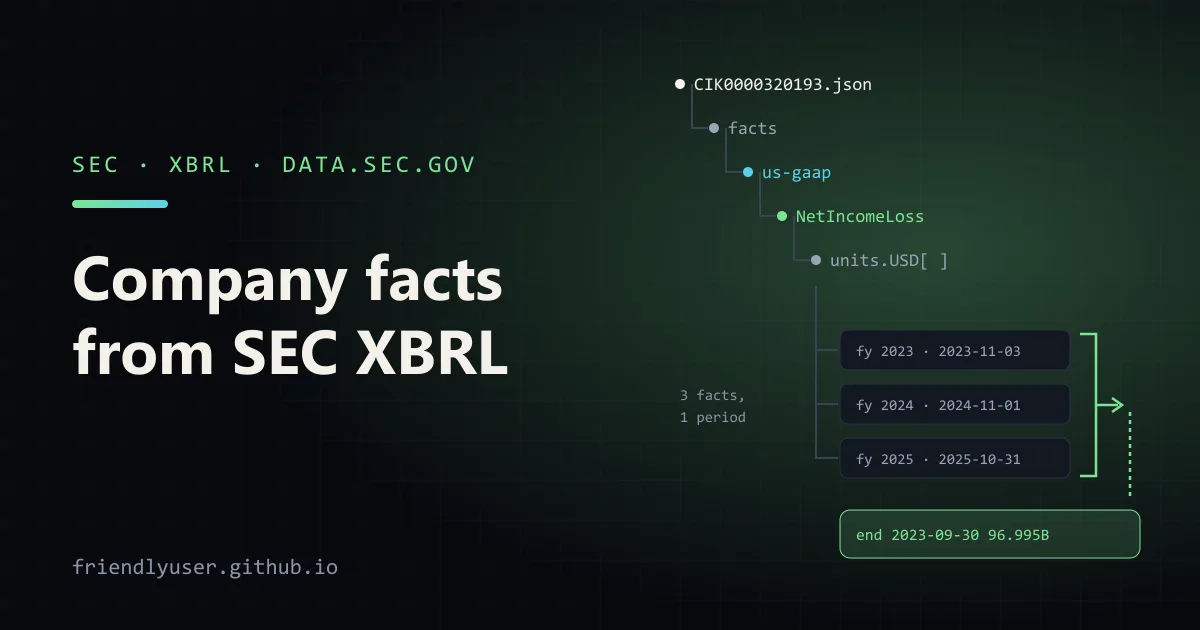
Every 10-K and 10-Q filed with the SEC includes the financial statements in XBRL, a machine-readable format where each number is tagged with a concept like NetIncomeLoss, a period and a unit. The SEC extracts those facts and serves them as JSON from data.sec.gov, free and without an API key.
That makes it the simplest source for a company’s reported revenue, earnings, share count or cash, going back to around 2009 when XBRL filing started. The catch is that the JSON is a list of every fact from every filing, so the same number appears several times and the concept names change over the years. This post covers the endpoints, the access rules, and the deduplication you need before the numbers are usable. Examples were run with Python 3.12, requests and pandas.
The rules: User-Agent and rate limit
Section titled “The rules: User-Agent and rate limit”The SEC’s developer FAQ asks automated clients to declare a User-Agent with a company or name and an admin contact email, in the form Sample Company Name AdminContact@<sample company domain>.com. Requests with a generic library user agent can be refused.
The fair access limit is 10 requests per second per user, regardless of how many machines you use, and the SEC reserves the right to block IPs that exceed it. For bulk work there are nightly ZIP files instead (companyfacts.zip and submissions.zip), which hold the same data for every company.
data.sec.gov does not send CORS headers, so you can’t call it directly from browser JavaScript. Use a server or a script.
The endpoints
Section titled “The endpoints”| Endpoint | URL | Returns |
|---|---|---|
| Ticker list | https://www.sec.gov/files/company_tickers.json | ticker, CIK and name for listed companies |
| Company facts | https://data.sec.gov/api/xbrl/companyfacts/CIK##########.json | every XBRL fact for one company |
| Company concept | https://data.sec.gov/api/xbrl/companyconcept/CIK##########/us-gaap/{Tag}.json | every fact for one company and one concept |
| Frames | https://data.sec.gov/api/xbrl/frames/us-gaap/{Tag}/{Unit}/{Period}.json | one fact per company for one period, e.g. CY2023 or CY2024Q1I |
The CIK (Central Index Key) is the SEC’s company id. In these URLs it is always zero-padded to 10 digits: Apple’s CIK 320193 becomes CIK0000320193.
What a fact looks like
Section titled “What a fact looks like”The company concept endpoint is the easiest way to see the shape. This asks for Apple’s NetIncomeLoss and prints the facts for the fiscal year ending September 30, 2023:
import jsonfrom sec_facts import get_json   # defined in the next section
url = "https://data.sec.gov/api/xbrl/companyconcept/CIK0000320193/us-gaap/NetIncomeLoss.json"concept = get_json(url)print(concept["label"], "|", list(concept["units"]))facts = [f for f in concept["units"]["USD"] if f["end"] == "2023-09-30" and f["form"] == "10-K" and "start" in f]for f in facts:    print(json.dumps(f))
Net Income (Loss) Attributable to Parent | ['USD']{"start": "2022-09-25", "end": "2023-09-30", "val": 96995000000, "accn": "0000320193-23-000106", "fy": 2023, "fp": "FY", "form": "10-K", "filed": "2023-11-03"}{"start": "2022-09-25", "end": "2023-09-30", "val": 96995000000, "accn": "0000320193-24-000123", "fy": 2024, "fp": "FY", "form": "10-K", "filed": "2024-11-01"}{"start": "2022-09-25", "end": "2023-09-30", "val": 96995000000, "accn": "0000320193-25-000079", "fy": 2025, "fp": "FY", "form": "10-K", "filed": "2025-10-31", "frame": "CY2023"}One period, three facts. An income statement in a 10-K shows three years, so each annual number is filed three times. The fields:
start,end: the period the number covers. Balance sheet items (assets, cash) have onlyend, because they are a point in time.val: the number, in the unit of the key it sits under (USD,shares,USD/shares).accn: the accession number of the filing it came from.fy,fp,form,filed: describe the filing, not the fact. The FY2023 number appears withfy: 2024andfy: 2025because it was repeated in those years’ 10-Ks. Grouping byfyis the most common mistake with this API.frame: present on only one fact per period, the one the SEC picked to represent that calendar period (CY2023) in the frames API. Apple’s fiscal year ends in September, so its “CY2023” frame is the year that is closest to calendar 2023, not an exact match.
Revenue tags change over time
Section titled “Revenue tags change over time”Net income has been NetIncomeLoss for as long as XBRL has existed. Revenue has not. Companies have used, among others:
SalesRevenueNet, common before 2018;Revenues, a general tag that some companies use throughout;RevenueFromContractWithCustomerExcludingAssessedTax, introduced with the ASC 606 revenue standard and used by most companies since around 2018.
To get a continuous series, query several tags and merge them, and choose a priority for periods that appear under more than one.
The script
Section titled “The script”Save as sec_facts.py, and change the User-Agent to your own name and email:
"""Annual revenue and net income from the SEC's XBRL company facts API."""import sysimport timefrom datetime import date
import pandas as pdimport requests
# The SEC asks automated clients to identify themselves: name plus a contact email.HEADERS = {"User-Agent": "Example Research admin@example.com"}REVENUE_TAGS = [    "RevenueFromContractWithCustomerExcludingAssessedTax",    "Revenues",    "SalesRevenueNet",]
session = requests.Session()session.headers.update(HEADERS)_last_request = 0.0

def get_json(url: str) -> dict:    """GET with a simple throttle well under the SEC's 10 requests/second limit."""    global _last_request    wait = 0.2 - (time.monotonic() - _last_request)    if wait > 0:        time.sleep(wait)    _last_request = time.monotonic()    resp = session.get(url, timeout=30)    resp.raise_for_status()    return resp.json()

def ticker_to_cik(ticker: str) -> str:    data = get_json("https://www.sec.gov/files/company_tickers.json")    for row in data.values():        if row["ticker"].upper() == ticker.upper():            return f"{row['cik_str']:010d}"    raise KeyError(f"unknown ticker {ticker}")

def annual_values(facts: dict, tags: list[str], unit: str = "USD", as_of: str = "9999-12-31") -> pd.DataFrame:    """One row per fiscal year end, from 10-K full-year facts filed on or before `as_of`."""    rows = []    for priority, tag in enumerate(tags):        concept = facts["facts"].get("us-gaap", {}).get(tag)        if not concept:            continue        for f in concept["units"].get(unit, []):            if f.get("form") not in ("10-K", "10-K/A") or "start" not in f or f["filed"] > as_of:                continue            days = (date.fromisoformat(f["end"]) - date.fromisoformat(f["start"])).days            if not 350 <= days <= 380:          # skip quarters reported inside the 10-K                continue            rows.append({"end": f["end"], "value": f["val"], "tag": tag, "priority": priority,                         "filed": f["filed"], "accn": f["accn"], "fy_of_filing": f["fy"]})    df = pd.DataFrame(rows)    if df.empty:        return df    # The same period appears in up to three 10-Ks (and amendments). Prefer the first tag    # in `tags`, then the most recent filing.    df = df.sort_values(["end", "priority", "filed"], ascending=[True, True, False])    return df.drop_duplicates("end").drop(columns="priority").reset_index(drop=True)

if __name__ == "__main__":    ticker = sys.argv[1] if len(sys.argv) > 1 else "AAPL"    cik = ticker_to_cik(ticker)    facts = get_json(f"https://data.sec.gov/api/xbrl/companyfacts/CIK{cik}.json")    print(facts["entityName"], "CIK", cik)
    as_of = sys.argv[2] if len(sys.argv) > 2 else date.today().isoformat()    revenue = annual_values(facts, REVENUE_TAGS, as_of=as_of)    income = annual_values(facts, ["NetIncomeLoss"], as_of=as_of)    table = revenue[["end", "value", "tag"]].merge(        income[["end", "value"]], on="end", how="left", suffixes=("_revenue", "_net_income"))    table["margin"] = (table["value_net_income"] / table["value_revenue"]).round(3)    with pd.option_context("display.width", 140, "display.max_columns", 10):        print(table.to_string(index=False))
The deduplication works on what the fact covers, not on the filing metadata:
- Keep only facts from annual reports (
10-K,10-K/A) that have astartdate. - Keep only periods of roughly one year (350 to 380 days, which allows for 52/53-week fiscal years). A 10-K can also contain fourth-quarter or other sub-year facts.
- For each period
end, keep one fact: the highest-priority tag, then the latestfiled.
The as_of argument drops facts filed after a given date. That gives you the numbers as they were known on that day, which matters if you are testing anything against history: using today’s restated numbers for a 2018 decision is a form of look-ahead.
Running it
Section titled “Running it”pip install requests pandaspython sec_facts.py AAPL 2026-06-25Apple Inc. CIK 0000320193 end value_revenue tag value_net_income margin2007-09-29 24578000000 SalesRevenueNet 3495000000 0.1422008-09-27 37491000000 SalesRevenueNet 6119000000 0.1632009-09-26 42905000000 SalesRevenueNet 8235000000 0.1922010-09-25 65225000000 SalesRevenueNet 14013000000 0.2152011-09-24 108249000000 SalesRevenueNet 25922000000 0.2392012-09-29 156508000000 SalesRevenueNet 41733000000 0.2672013-09-28 170910000000 SalesRevenueNet 37037000000 0.2172014-09-27 182795000000 SalesRevenueNet 39510000000 0.2162015-09-26 233715000000 SalesRevenueNet 53394000000 0.2282016-09-24 215639000000 Revenues 45687000000 0.2122017-09-30 229234000000 RevenueFromContractWithCustomerExcludingAssessedTax 48351000000 0.2112018-09-29 265595000000 RevenueFromContractWithCustomerExcludingAssessedTax 59531000000 0.2242019-09-28 260174000000 RevenueFromContractWithCustomerExcludingAssessedTax 55256000000 0.2122020-09-26 274515000000 RevenueFromContractWithCustomerExcludingAssessedTax 57411000000 0.2092021-09-25 365817000000 RevenueFromContractWithCustomerExcludingAssessedTax 94680000000 0.2592022-09-24 394328000000 RevenueFromContractWithCustomerExcludingAssessedTax 99803000000 0.2532023-09-30 383285000000 RevenueFromContractWithCustomerExcludingAssessedTax 96995000000 0.2532024-09-28 391035000000 RevenueFromContractWithCustomerExcludingAssessedTax 93736000000 0.2402025-09-27 416161000000 RevenueFromContractWithCustomerExcludingAssessedTax 112010000000 0.269The table shows all three revenue tags in use over Apple’s history, and the merge produces one continuous series. The 2007 and 2008 rows come from comparative figures in the first XBRL 10-Ks, not from XBRL filings for those years.
Restatements: which number is “right”?
Section titled “Restatements: which number is “right”?”“Latest filing wins” gives you the most recent version of each number, including restatements. That is usually what you want for analysis, but be aware of what it means. Microsoft, for example, adopted ASC 606 with full retrospective restatement. Its fiscal 2016 revenue was filed as 85,320,000,000 under SalesRevenueNet in 2016, and as 91,154,000,000 under RevenueFromContractWithCustomerExcludingAssessedTax in the 10-K filed in August 2018. Running the script for MSFT gives the restated value.
If you need “as originally reported”, sort by filed ascending instead and keep the first fact per period, or use as_of to cut off at the date you care about.
Quarterly data
Section titled “Quarterly data”Quarterly numbers come from 10-Qs, with two complications:
- 10-Qs report both the quarter and the year to date. Q2 income statement facts include a three-month fact and a six-month fact. Filter on a period length of about 91 days.
- There is no 10-Q for the fourth quarter. Q4 is the annual number minus the first three quarters, which you have to compute.
Gotchas
Section titled “Gotchas”- Custom tags are missing. Companies can define their own extension concepts, but these APIs only aggregate standard taxonomies such as
us-gaap,ifrs-full,deiandsrt. A number a company tagged with its own concept is only in the filing itself. Foreign private issuers filing under IFRS useifrs-fulltags, notus-gaap. - Signs and scale. Values are in base units (dollars, not millions). Some concepts are reported as positive numbers even when they reduce income, so check the concept label.
- Tickers change; CIKs don’t. Store the CIK, and refresh the ticker mapping from
company_tickers.jsonwhen you need it. - Not every number is tagged. Non-GAAP measures, segment details in the text, and anything a company describes only in prose are not in the API.
- Be polite with volume. For hundreds of companies, download the nightly
companyfacts.ziponce instead of making one request per company.
Further reading
Section titled “Further reading”© 2026 David Li · Home · Blog · RSS ·Classic site · Built with Astro, Starlight and three.js · Logos:Font Awesome Free (CC BY 4.0)