A REST API in Rust with Axum 0.8 and SQLx
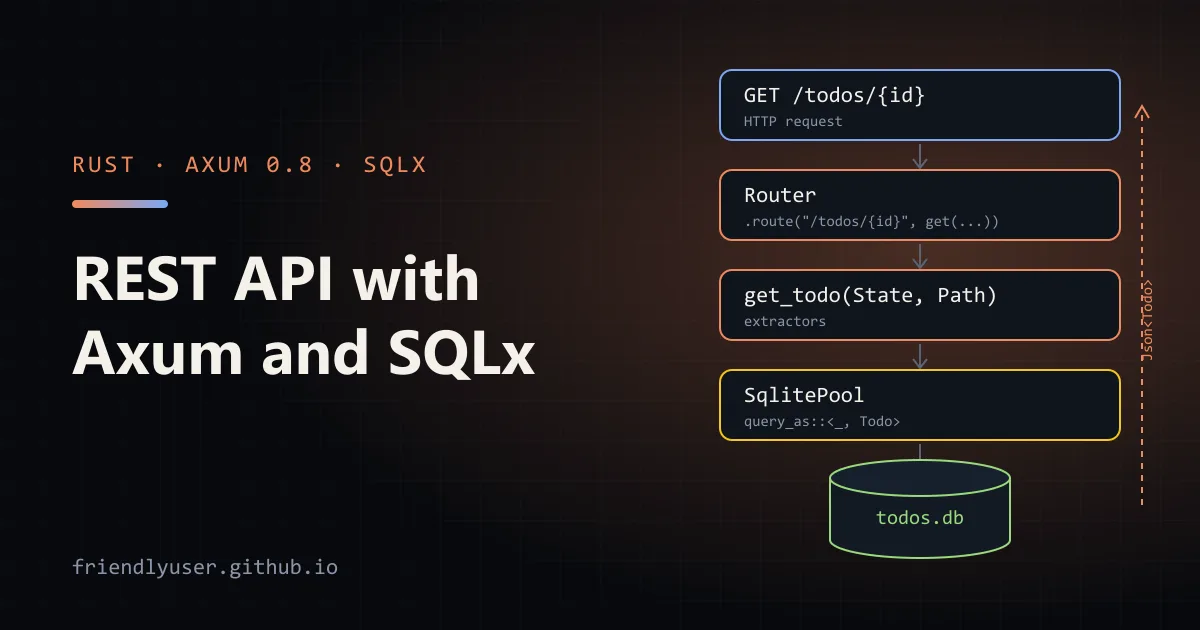
Axum is the HTTP framework from the Tokio project. Handlers are plain async functions, and their arguments (“extractors”) declare what they need from the request. SQLx is an async SQL toolkit that talks to SQLite, Postgres and MySQL without an ORM. Together they make a small, testable REST service with very little framework code.
This post builds a todo API with create, read, update and delete endpoints, an error type that turns failures into JSON responses, and tests that call the router directly without opening a socket. The examples were written against Axum 0.8.8, SQLx 0.8.6, Tokio 1.49 and tower 0.5, using the 2024 edition.
Project setup
Section titled “Project setup”cargo new todo-apicd todo-apimkdir migrationsCargo.toml:
[package]name = "todo-api"version = "0.1.0"edition = "2024"
[dependencies]axum = "0.8"serde = { version = "1", features = ["derive"] }serde_json = "1"sqlx = { version = "0.8", features = ["runtime-tokio", "sqlite"] }tokio = { version = "1", features = ["full"] }
[dev-dependencies]tower = { version = "0.5", features = ["util"] }
SQLx’s default features already include macros and migrate, which the migrate! macro below needs. The sqlite feature bundles SQLite, so there is nothing to install. tower is only a dev dependency, for ServiceExt::oneshot in the tests.
The migration
Section titled “The migration”SQLx runs plain SQL files from migrations/, in order of their numeric prefix, and records what it has applied in a _sqlx_migrations table. Create migrations/20260115000000_create_todos.sql:
CREATE TABLE IF NOT EXISTS todos ( id INTEGER PRIMARY KEY AUTOINCREMENT, title TEXT NOT NULL, done BOOLEAN NOT NULL DEFAULT 0);sqlx::migrate!() embeds every file in ./migrations into the binary at compile time, so the deployed binary doesn’t need the SQL files next to it. The flip side: if you add a migration and nothing else changes, Cargo may not rebuild. The sqlx-cli command sqlx migrate build-script writes a build.rs that fixes that.
The application
Section titled “The application”Here is the whole of src/main.rs apart from the tests. It is about 130 lines, and I’ll go through the parts after the listing.
use axum::{    extract::{Path, State},    http::StatusCode,    response::{IntoResponse, Response},    routing::get,    Json, Router,};use serde::{Deserialize, Serialize};use serde_json::json;use sqlx::sqlite::{SqliteConnectOptions, SqlitePool, SqlitePoolOptions};
#[derive(Clone)]struct AppState {    pool: SqlitePool,}
#[derive(Serialize, sqlx::FromRow)]struct Todo {    id: i64,    title: String,    done: bool,}
#[derive(Deserialize)]struct NewTodo {    title: String,}
#[derive(Deserialize)]struct UpdateTodo {    title: Option<String>,    done: Option<bool>,}
enum AppError {    NotFound,    Validation(String),    Database(sqlx::Error),}
impl From<sqlx::Error> for AppError {    fn from(err: sqlx::Error) -> Self {        AppError::Database(err)    }}
impl IntoResponse for AppError {    fn into_response(self) -> Response {        let (status, message) = match self {            AppError::NotFound => (StatusCode::NOT_FOUND, "todo not found".to_string()),            AppError::Validation(msg) => (StatusCode::UNPROCESSABLE_ENTITY, msg),            AppError::Database(err) => {                eprintln!("database error: {err}");                (                    StatusCode::INTERNAL_SERVER_ERROR,                    "internal server error".to_string(),                )            }        };        (status, Json(json!({ "error": message }))).into_response()    }}
async fn fetch_todo(pool: &SqlitePool, id: i64) -> Result<Todo, AppError> {    sqlx::query_as::<_, Todo>("SELECT id, title, done FROM todos WHERE id = ?")        .bind(id)        .fetch_optional(pool)        .await?        .ok_or(AppError::NotFound)}
async fn list_todos(State(state): State<AppState>) -> Result<Json<Vec<Todo>>, AppError> {    let todos = sqlx::query_as::<_, Todo>("SELECT id, title, done FROM todos ORDER BY id")        .fetch_all(&state.pool)        .await?;    Ok(Json(todos))}
async fn get_todo(    State(state): State<AppState>,    Path(id): Path<i64>,) -> Result<Json<Todo>, AppError> {    Ok(Json(fetch_todo(&state.pool, id).await?))}
async fn create_todo(    State(state): State<AppState>,    Json(input): Json<NewTodo>,) -> Result<(StatusCode, Json<Todo>), AppError> {    let title = input.title.trim();    if title.is_empty() {        return Err(AppError::Validation("title must not be empty".to_string()));    }    let id = sqlx::query("INSERT INTO todos (title) VALUES (?)")        .bind(title)        .execute(&state.pool)        .await?        .last_insert_rowid();    let todo = fetch_todo(&state.pool, id).await?;    Ok((StatusCode::CREATED, Json(todo)))}
async fn update_todo(    State(state): State<AppState>,    Path(id): Path<i64>,    Json(input): Json<UpdateTodo>,) -> Result<Json<Todo>, AppError> {    let result = sqlx::query(        "UPDATE todos SET title = COALESCE(?, title), done = COALESCE(?, done) WHERE id = ?",    )    .bind(input.title)    .bind(input.done)    .bind(id)    .execute(&state.pool)    .await?;    if result.rows_affected() == 0 {        return Err(AppError::NotFound);    }    Ok(Json(fetch_todo(&state.pool, id).await?))}
async fn delete_todo(    State(state): State<AppState>,    Path(id): Path<i64>,) -> Result<StatusCode, AppError> {    let result = sqlx::query("DELETE FROM todos WHERE id = ?")        .bind(id)        .execute(&state.pool)        .await?;    if result.rows_affected() == 0 {        return Err(AppError::NotFound);    }    Ok(StatusCode::NO_CONTENT)}
fn app(pool: SqlitePool) -> Router {    Router::new()        .route("/todos", get(list_todos).post(create_todo))        .route(            "/todos/{id}",            get(get_todo).patch(update_todo).delete(delete_todo),        )        .with_state(AppState { pool })}
#[tokio::main]async fn main() -> Result<(), Box<dyn std::error::Error>> {    let options = SqliteConnectOptions::new()        .filename("todos.db")        .create_if_missing(true);    let pool = SqlitePoolOptions::new()        .max_connections(5)        .connect_with(options)        .await?;    sqlx::migrate!().run(&pool).await?;
    let listener = tokio::net::TcpListener::bind("127.0.0.1:3000").await?;    println!("listening on http://{}", listener.local_addr()?);    axum::serve(listener, app(pool)).await?;    Ok(())}
Routing and the {id} path syntax
Section titled “Routing and the {id} path syntax”Axum 0.8 changed path parameters from /:id to /{id}, and wildcards from /*rest to /{*rest}. Routes still using the old syntax panic when the router is built, so a forgotten one shows up on startup. If you are upgrading from 0.7, search for ": in your route strings.
get(list_todos).post(create_todo) builds one MethodRouter that dispatches on the HTTP method. A request with a method you didn’t register gets 405 Method Not Allowed automatically.
Extractors and their order
Section titled “Extractors and their order”A handler’s arguments are extractors. State<AppState> hands you a clone of the state passed to with_state, Path<i64> parses the {id} segment, and Json<T> deserializes the body with serde.
Two rules matter in practice:
- The body extractor goes last.
Jsonconsumes the request body, so it must be the final argument. Putting it earlier is a compile error, though the message is a long trait-bound error rather than “moveJsonto the end”. - Extractors reject requests before your code runs. A non-numeric id gives
400 Bad Request, a body withoutContent-Type: application/jsongives415 Unsupported Media Type, malformed JSON gives400, and valid JSON that doesn’t fitNewTodogives422 Unprocessable Entity. Those responses are plain text, not the JSON shape your own errors use. If that matters for your clients, wrap the extractor in your own type, or useaxum-extra’sWithRejection.
State must be Clone, because Axum clones it for each request. SqlitePool is a cheap handle around an Arc, so cloning it is fine. If your state grows, put the fields in a struct as here rather than passing the pool alone. Adding a config value later then doesn’t change every handler signature.
Queries without compile-time checking
Section titled “Queries without compile-time checking”I used sqlx::query and sqlx::query_as instead of the query! macros. The macros check your SQL against a real database at compile time, which is great, but they need DATABASE_URL set during the build, or an offline cache generated by cargo sqlx prepare. The function versions check nothing at compile time. Column types are matched against your struct when the row is decoded, and a mismatch becomes a sqlx::Error at runtime. Start with the functions, and move to the macros once the schema settles.
#[derive(sqlx::FromRow)] maps columns to fields by name. SQLite has no real boolean type, so done is stored as an integer, and SQLx decodes it into bool.
One error type for every handler
Section titled “One error type for every handler”Every handler returns Result<T, AppError>. Axum accepts that as long as both T and AppError implement IntoResponse. The From<sqlx::Error> impl is what lets ? work on database calls.
The Database arm logs the real error and sends the client a generic message. Database errors can contain table names, constraint names, or bits of the query, and none of that belongs in a response body. In a real service, use tracing::error! instead of eprintln!.
Running it
Section titled “Running it”cargo runIn another terminal:
curl -i -X POST localhost:3000/todos \ -H 'content-type: application/json' \ -d '{"title":"buy milk"}'curl localhost:3000/todoscurl -X PATCH localhost:3000/todos/1 \ -H 'content-type: application/json' \ -d '{"done":true}'curl -i -X DELETE localhost:3000/todos/1curl -i localhost:3000/todos/1The last request gets a 404 with {"error":"todo not found"} as the body.
Testing with oneshot
Section titled “Testing with oneshot”Router implements tower’s Service trait, so a test can build a Request, send it to the router with ServiceExt::oneshot, and inspect the Response. No port, no HTTP client, and each test gets its own in-memory database. Add this to the bottom of main.rs:
#[cfg(test)]mod tests {    use super::*;    use axum::{        body::{to_bytes, Body},        http::Request,    };    use serde_json::Value;    use tower::ServiceExt; // for `oneshot`
    async fn test_app() -> Router {        let pool = SqlitePoolOptions::new()            .max_connections(1)            .connect("sqlite::memory:")            .await            .unwrap();        sqlx::migrate!().run(&pool).await.unwrap();        app(pool)    }
    async fn body_json(response: Response) -> Value {        let bytes = to_bytes(response.into_body(), usize::MAX).await.unwrap();        serde_json::from_slice(&bytes).unwrap()    }
    fn post_json(uri: &str, body: &'static str) -> Request<Body> {        Request::builder()            .method("POST")            .uri(uri)            .header("content-type", "application/json")            .body(Body::from(body))            .unwrap()    }
    #[tokio::test]    async fn create_then_fetch() {        let app = test_app().await;
        let response = app            .clone()            .oneshot(post_json("/todos", r#"{"title":"write tests"}"#))            .await            .unwrap();        assert_eq!(response.status(), StatusCode::CREATED);        let created = body_json(response).await;        assert_eq!(created["title"], "write tests");        assert_eq!(created["done"], false);
        let uri = format!("/todos/{}", created["id"]);        let response = app            .oneshot(Request::builder().uri(uri).body(Body::empty()).unwrap())            .await            .unwrap();        assert_eq!(response.status(), StatusCode::OK);        assert_eq!(body_json(response).await["title"], "write tests");    }
    #[tokio::test]    async fn missing_todo_is_404() {        let response = test_app()            .await            .oneshot(Request::builder().uri("/todos/999").body(Body::empty()).unwrap())            .await            .unwrap();        assert_eq!(response.status(), StatusCode::NOT_FOUND);        assert_eq!(body_json(response).await["error"], "todo not found");    }
    #[tokio::test]    async fn blank_title_is_rejected() {        let response = test_app()            .await            .oneshot(post_json("/todos", r#"{"title":"   "}"#))            .await            .unwrap();        assert_eq!(response.status(), StatusCode::UNPROCESSABLE_ENTITY);    }}
Run them with cargo test.
A few details:
oneshottakes the service by value, socreate_then_fetchclones the router for the first request. Cloning aRouteris cheap.axum::body::to_bytescollects a response body. The second argument is a size limit, andusize::MAXmeans no limit, which is fine in tests.- With SQLx, each
connect("sqlite::memory:")call creates a new, separate in-memory database, shared by the connections in that pool. The database disappears when its last connection closes. I setmax_connections(1)so there is only ever one connection. That keeps the database alive for the whole test and avoids locking surprises between connections.
Things to watch for
Section titled “Things to watch for”- Old path syntax.
/:idroutes panic at startup in 0.8. Many blog posts and answers online still use it. - SQLite and concurrent writes. SQLite allows one writer at a time. SQLx sets a 5 second busy timeout by default, so a blocked writer waits before failing, but under write-heavy load you’ll still see “database is locked” errors. Switching to WAL with
.journal_mode(SqliteJournalMode::Wal)onSqliteConnectOptionslets readers carry on while a write is in progress. If writes are the main workload, move to Postgres. With SQLx that mostly means changing the pool type and the?placeholders to$1,$2. - Graceful shutdown.
axum::serve(...).with_graceful_shutdown(signal)takes a future, typically one that waits ontokio::signal::ctrl_c(). Use it so in-flight requests finish before the process exits. - Rejection format. As mentioned above, the built-in extractor rejections are plain text. Decide early whether your API promises JSON errors everywhere.
Further reading
Section titled “Further reading”- Axum documentation and the examples directory, which includes a testing example
- SQLx on GitHub, including the
sqlx-cliREADME - Axum 0.8 announcement on the Tokio blog
© 2026 David Li · Home · Blog · RSS ·Classic site · Built with Astro, Starlight and three.js · Logos:Font Awesome Free (CC BY 4.0)