Cow<str> in Rust: borrow when you can, allocate when you must
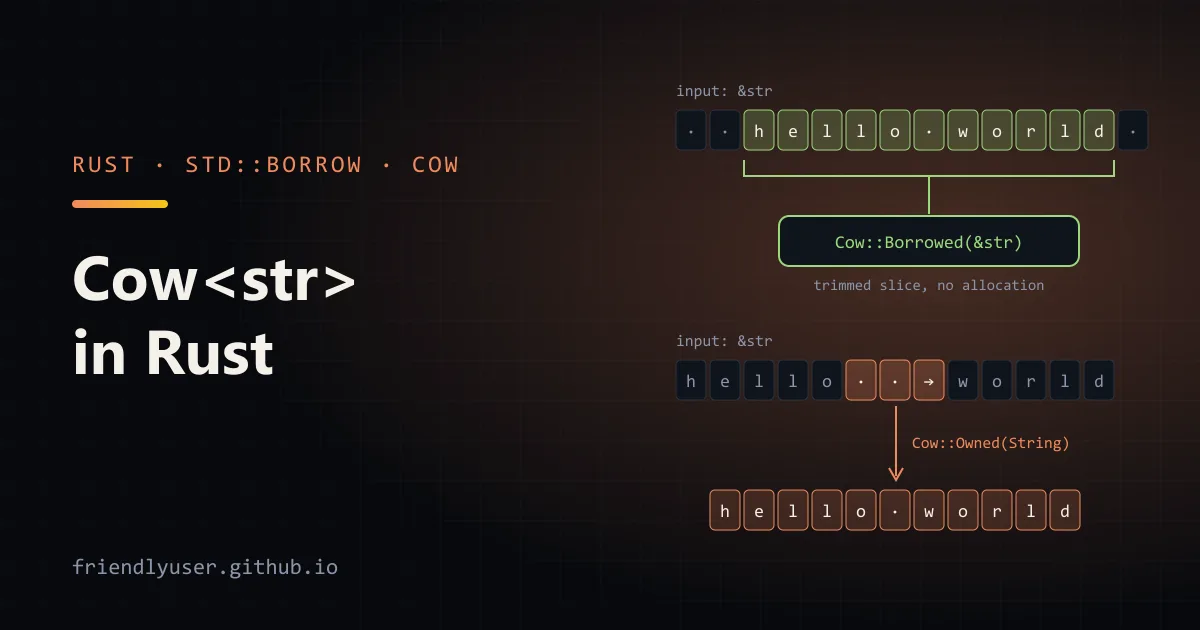
std::borrow::Cow (“clone on write”) is an enum that holds either a borrowed reference or an owned value. Cow<'a, str> is either a &'a str or a String. It’s for functions that usually return their input unchanged but sometimes have to build a new string. With Cow, the common case costs no allocation, and the caller handles both cases through the same type.
This post builds a text normaliser that returns Cow, shows the methods you’ll actually use (into_owned, to_mut, deref), puts Cow in a struct with a lifetime, and looks at String::from_utf8_lossy, the standard library function you’ve probably already met returning one. Everything is standard library only, using the 2024 edition. If lifetimes in struct definitions are new to you, the lifetimes post covers the background.
The problem
Section titled “The problem”Say you clean up user-supplied text by trimming it and collapsing runs of whitespace into single spaces. The obvious signature is:
fn normalize_whitespace(input: &str) -> StringThat allocates a new String for every call, even though most real input (names, tags, header values) is already clean. Returning &str doesn’t work either, because when the text does need changes, the result is new data that the input doesn’t contain.
Cow covers both:
pub enum Cow<'a, B: ?Sized + ToOwned + 'a> { Borrowed(&'a B), Owned(<B as ToOwned>::Owned),}For B = str, the owned type is String. Cow implements Deref<Target = str>, so callers can use the result like a &str without caring which variant they got.
A normaliser that returns Cow
Section titled “A normaliser that returns Cow”use std::borrow::Cow;
/// Trims the input and collapses each run of whitespace into one space./// Allocates only when the trimmed input contains something to collapse.pub fn normalize_whitespace(input: &str) -> Cow<'_, str> { let trimmed = input.trim(); let already_clean = !trimmed.contains(" ") && !trimmed.contains(|c: char| c.is_whitespace() && c != ' '); if already_clean { // Possibly a shorter slice of the input, but still a borrow. return Cow::Borrowed(trimmed); }
let mut out = String::with_capacity(trimmed.len()); for word in trimmed.split_whitespace() { if !out.is_empty() { out.push(' '); } out.push_str(word); } Cow::Owned(out)}The check up front is the important part. If the trimmed text has no double spaces and no whitespace other than plain spaces, collapsing would change nothing. So we return a borrow, and the borrow can be a sub-slice: trimming never needs an allocation, because the trimmed text is a contiguous part of the input.
Cow<'_, str> ties the result’s lifetime to input, just as a &str return would. The compiler won’t let a Cow::Borrowed outlive the string it points into.
Tests that pin down which case allocates:
#[cfg(test)]mod tests {    use super::*;
    #[test]    fn clean_input_is_borrowed() {        assert!(matches!(normalize_whitespace("hello world"), Cow::Borrowed("hello world")));        // Trimming alone still borrows: it's a slice of the input.        assert!(matches!(normalize_whitespace("  hello world "), Cow::Borrowed("hello world")));    }
    #[test]    fn messy_input_is_owned() {        let out = normalize_whitespace("hello \t  world");        assert_eq!(out, "hello world");        assert!(matches!(out, Cow::Owned(_)));    }}
Cow<str> compares equal to &str and String, so assert_eq! works directly. matches! checks the variant.
Using a Cow
Section titled “Using a Cow”Most of the time you don’t touch the variants at all.
Read it as a &str. Thanks to Deref, out.len(), out.starts_with("x") and passing &out to a function that takes &str all work. Writing &*out gives you a plain &str explicitly.
into_owned() when you need a String. It returns the String inside an Owned without copying, and clones the data in a Borrowed. Call it at the point where you actually need ownership, such as storing the value in a long-lived struct, not “just in case” right after the call. That would throw away the saving.
to_mut() to modify it. to_mut() returns &mut String. If the Cow is borrowed, it first clones the data into an owned String and switches to Owned. If it’s already owned, it hands out the existing String, with no copy. That makes it the right tool for chaining steps that each modify the text only sometimes:
/// Normalised whitespace, ASCII-lowercased. Allocates at most once.pub fn normalize_key(input: &str) -> Cow<'_, str> { let mut key = normalize_whitespace(input); if key.bytes().any(|b| b.is_ascii_uppercase()) { key.to_mut().make_ascii_lowercase(); } key}There are three cases:
"content-type": clean and lowercase, so it’s borrowed all the way through. No allocation."Content-Type": borrowed after the first step, thento_mutclones it once and lowercases in place."Content Type": the first step already allocated, soto_mutreuses thatString. Still one allocation in total.
Only call to_mut once you know you’re going to change something. Calling it unconditionally forces a clone even when nothing changes, which brings back the cost Cow was meant to avoid.
Cow in struct fields
Section titled “Cow in struct fields”A struct can hold Cow fields with a lifetime parameter. Each field is then either borrowed from some input or owned, independently:
#[derive(Debug)]pub struct Header<'a> {    pub name: Cow<'a, str>,    pub value: Cow<'a, str>,}
impl<'a> Header<'a> {    /// Parses `Name: value`, normalising both parts.    pub fn parse(line: &'a str) -> Option<Header<'a>> {        let (name, value) = line.split_once(':')?;        Some(Header {            name: normalize_key(name),            value: normalize_whitespace(value),        })    }
    /// Detaches the header from the input it was parsed from.    pub fn into_owned(self) -> Header<'static> {        Header {            name: Cow::Owned(self.name.into_owned()),            value: Cow::Owned(self.value.into_owned()),        }    }}
Parsing a few thousand headers out of a buffer this way mostly borrows. The type also accepts both literals and computed values when you build headers yourself:
let fixed = Header { name: Cow::Borrowed("accept"), value: Cow::Borrowed("*/*") };let computed = Header { name: Cow::Borrowed("content-length"), value: Cow::Owned(1024.to_string()),};Both are Header<'static>, since string literals live for 'static and owned data borrows nothing.
The into_owned method is the usual escape hatch. A Header<'a> can’t outlive the buffer it was parsed from, so you can’t send it to thread::spawn, return it after the buffer is dropped, or keep it in a long-lived cache. into_owned copies only the fields that are still borrowed (the into_owned() on an Owned field just moves its String) and returns a Header<'static> with no ties to the input.
To accept either a &str or a String in a constructor, take impl Into<Cow<'a, str>>. Both types convert into Cow for free:
impl<'a> Header<'a> {    pub fn new(name: impl Into<Cow<'a, str>>, value: impl Into<Cow<'a, str>>) -> Self {        Header { name: name.into(), value: value.into() }    }}
let a = Header::new("accept", "*/*");               // borrowslet b = Header::new("x-request-id", format!("{}", 42)); // owns
String::from_utf8_lossy returns Cow
Section titled “String::from_utf8_lossy returns Cow”The standard library uses Cow where an operation usually changes nothing. String::from_utf8_lossy takes bytes that are probably UTF-8. If they are valid, it returns Cow::Borrowed pointing at the same bytes as a &str. If not, it builds a new String with each invalid sequence replaced by U+FFFD, the replacement character.
use std::borrow::Cow;
fn main() {    let valid = b"hello";    let invalid = b"caf\xE9"; // 0xE9 is Latin-1 for e-acute, invalid on its own in UTF-8
    assert!(matches!(String::from_utf8_lossy(valid), Cow::Borrowed("hello")));    assert_eq!(String::from_utf8_lossy(invalid), "caf\u{FFFD}");    println!("from_utf8_lossy: borrowed when valid, owned when repaired");}
So reading a file of mostly valid UTF-8 log lines with from_utf8_lossy costs an allocation only for the broken lines. Path::to_string_lossy and OsStr::to_string_lossy work the same way.
A runnable example
Section titled “A runnable example”Put normalize_whitespace, normalize_key and Header (with use std::borrow::Cow; at the top) into src/main.rs and add:
fn main() {    let inputs = ["already clean", "  padded  ", "tabs\tand  doubles", ""];    for input in inputs {        let out = normalize_whitespace(input);        let kind = match &out {            Cow::Borrowed(_) => "borrowed",            Cow::Owned(_) => "owned",        };        println!("{input:?} -> {out:?} ({kind})");    }
    let raw = "Content-Type:  text/html;   charset=utf-8";    let header = Header::parse(raw).expect("has a colon");    println!("{header:?}");
    // Outlive `raw` by detaching it first.    let stored: Header<'static> = header.into_owned();    println!("{} = {}", stored.name, stored.value);}
Only the third input should report owned, and the header’s name and value both end up owned, because each needed a change.
When not to bother
Section titled “When not to bother”- When the function almost always allocates. If nearly every input gets modified,
Cowadds a branch and a more complicated type for no gain. ReturnString. - When every caller needs a
Stringanyway. If each call site does.into_owned()straight away, the borrow never survives long enough to save anything. - On cold paths. Saving an allocation in a function that runs ten times per request isn’t worth the extra lifetime parameter on your API.
Cowpays off in loops over many small strings: parsers, normalisers, serializers.
One case where I do reach for it without thinking: Cow<'static, str> for names and messages that are usually literals but sometimes formatted. A literal costs nothing, and a format! result fits the same field.
Further reading
Section titled “Further reading”std::borrow::CowString::from_utf8_lossyToOwned, the trait that defines what “owned” means for each borrowed type
© 2026 David Li · Home · Blog · RSS ·Classic site · Built with Astro, Starlight and three.js · Logos:Font Awesome Free (CC BY 4.0)