Tokio channels in Rust: mpsc, oneshot, broadcast and watch
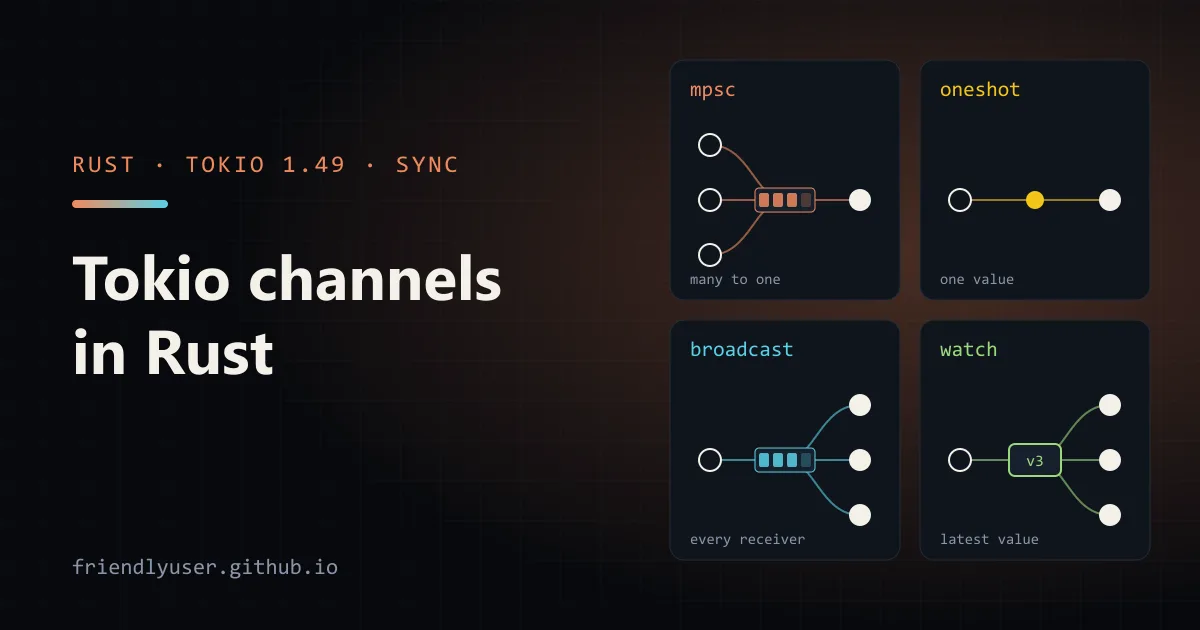
Tokio ships four channel types in tokio::sync, and each one fits a different communication shape between tasks. Picking the right one removes most of the need for Arc<Mutex<_>>: instead of sharing state, one task owns it and the others send it messages.
This post covers when to use each channel, shows the patterns I reach for most (bounded queues, an actor with request/reply, config reloads), and ends with how to shut it all down. Examples use Tokio 1.49 with the full feature:
[dependencies]tokio = { version = "1.49", features = ["full"] }Which channel for which job
Section titled “Which channel for which job”| Channel | Shape | Each message goes to | Typical use |
|---|---|---|---|
mpsc | many senders, one receiver | the single receiver | work queues, actors, log or metrics pipelines |
oneshot | one sender, one receiver, one value | the receiver | replying to a request, returning a result from a task |
broadcast | many senders, many receivers | every receiver (cloned) | events every subscriber should see, like chat messages or cache invalidations |
watch | many senders, many receivers, one value | receivers see the latest value only | config, status, a shutdown flag |
The main question is whether receivers need every message (mpsc, broadcast) or only the current state (watch). The second question is whether one consumer or all of them should see each message.
mpsc: queues with backpressure
Section titled “mpsc: queues with backpressure”mpsc::channel(n) is bounded. Once n messages are buffered, send().await waits until the receiver makes room. That’s backpressure: a fast producer slows down to the pace of the consumer instead of filling memory.
use tokio::sync::mpsc;
#[tokio::main]async fn main() {    let (tx, mut rx) = mpsc::channel::<String>(8);
    for id in 0..3 {        let tx = tx.clone();        tokio::spawn(async move {            for n in 0..5 {                // Waits here while 8 messages are already queued.                if tx.send(format!("producer {id}: item {n}")).await.is_err() {                    return; // the receiver was dropped                }            }        });    }    // Drop the original sender, or recv() below never returns None.    drop(tx);
    while let Some(msg) = rx.recv().await {        println!("{msg}");    }}
recv() returns None once every Sender is gone and the buffer is empty. Forgetting drop(tx) here is the most common reason a consumer loop hangs forever: the original sender is still alive in main, so the channel never closes.
When waiting is the wrong response to a full queue, for example when sampling telemetry you can afford to lose, use try_send:
use tokio::sync::mpsc::{self, error::TrySendError};
fn record(tx: &mpsc::Sender<u64>, value: u64, dropped: &mut u64) {    match tx.try_send(value) {        Ok(()) => {}        Err(TrySendError::Full(_)) => *dropped += 1,        Err(TrySendError::Closed(_)) => {} // consumer has shut down    }}
mpsc::unbounded_channel() has a synchronous send that never waits. It’s handy when sending from code that can’t .await, such as a Drop impl or a callback. But it has no backpressure, so a slow consumer means unbounded memory growth. I’d only use it when something else already limits the message rate.
For plain synchronous threads, the bounded channel also has blocking_send and blocking_recv. Don’t call those from inside async code. They panic when called from within the runtime.
oneshot: one reply
Section titled “oneshot: one reply”A oneshot carries exactly one value. Sender::send is not async (there’s no buffer to wait on), and it returns Err(value) if the receiver has already been dropped. The Receiver is itself a future that resolves to Result<T, RecvError>, which is an error if the sender was dropped without sending.
On its own that’s a way to get a result back from a spawned task. Combined with mpsc, it gives you request/response.
The actor pattern: mpsc + oneshot
Section titled “The actor pattern: mpsc + oneshot”An actor is a task that owns some state and processes commands from an mpsc receiver, one at a time. Commands that need an answer carry a oneshot::Sender. Callers use a cheap, cloneable handle and never touch the state directly, so there are no locks.
use std::collections::HashMap;use tokio::sync::{mpsc, oneshot};
enum Command {    Set { key: String, value: String },    Get { key: String, reply: oneshot::Sender<Option<String>> },}
#[derive(Clone)]struct KvHandle {    tx: mpsc::Sender<Command>,}
impl KvHandle {    fn spawn() -> Self {        let (tx, rx) = mpsc::channel(32);        tokio::spawn(run_kv(rx));        KvHandle { tx }    }
    async fn set(&self, key: &str, value: &str) {        let cmd = Command::Set { key: key.to_string(), value: value.to_string() };        // An error means the actor has stopped. This example ignores it.        let _ = self.tx.send(cmd).await;    }
    async fn get(&self, key: &str) -> Option<String> {        let (reply, rx) = oneshot::channel();        self.tx            .send(Command::Get { key: key.to_string(), reply })            .await            .ok()?;        rx.await.ok().flatten()    }}
async fn run_kv(mut rx: mpsc::Receiver<Command>) {    let mut store = HashMap::new();    while let Some(cmd) = rx.recv().await {        match cmd {            Command::Set { key, value } => {                store.insert(key, value);            }            Command::Get { key, reply } => {                // The caller may have stopped waiting. That's fine.                let _ = reply.send(store.get(&key).cloned());            }        }    }    // Every KvHandle has been dropped, so the loop ends and the task exits.}
#[tokio::main]async fn main() {    let kv = KvHandle::spawn();
    let writer = kv.clone();    tokio::spawn(async move { writer.set("lang", "rust").await })        .await        .unwrap();
    assert_eq!(kv.get("lang").await, Some("rust".to_string()));    assert_eq!(kv.get("missing").await, None);    println!("actor answered both requests");}
Some things this structure gets you for free:
- Shutdown follows ownership. When the last
KvHandleis dropped, the channel closes,recv()returnsNone, and the actor task ends. You don’t need a separate stop message. - Ordering. Commands from one handle are processed in the order they were sent.
- Backpressure. The bounded channel limits how many requests can queue up.
The cost is that the actor is a single task, so it processes one command at a time. If a command needs slow I/O, don’t .await it inside the loop. Spawn the work and let that task reply on the oneshot, or every other caller waits behind it.
broadcast: everyone sees every message, unless they fall behind
Section titled “broadcast: everyone sees every message, unless they fall behind”broadcast::channel(capacity) gives you a Sender and a first Receiver. Call tx.subscribe() for more receivers. Each receiver gets a clone of every message sent after it subscribed, so T must be Clone. For large payloads, send an Arc<T>.
The buffer is shared and has a fixed capacity. When it’s full, sending doesn’t wait. It overwrites the oldest message. A receiver that hadn’t read that message yet gets RecvError::Lagged(n) on its next recv(), where n is how many messages it missed, and then continues from the oldest message still in the buffer:
use tokio::sync::broadcast::{self, error::RecvError};
#[tokio::main]async fn main() {    let (tx, mut rx) = broadcast::channel::<u32>(2);
    for n in 1..=5 {        tx.send(n).unwrap();    }
    // Only the last two values fit in the buffer; 1, 2 and 3 were overwritten.    assert_eq!(rx.recv().await, Err(RecvError::Lagged(3)));    assert_eq!(rx.recv().await, Ok(4));    assert_eq!(rx.recv().await, Ok(5));    println!("lagged receiver caught up");}
That means a broadcast receiver loop has to handle three cases, not two:
use tokio::sync::broadcast::{self, error::RecvError};
async fn listen(mut rx: broadcast::Receiver<String>) {    loop {        match rx.recv().await {            Ok(event) => println!("got {event}"),            Err(RecvError::Lagged(missed)) => eprintln!("missed {missed} events"),            Err(RecvError::Closed) => break,        }    }}
Treating Lagged as fatal (while let Ok(event) = rx.recv().await) is a common bug. A slow subscriber then silently stops listening the first time it falls behind. Whether skipping messages is acceptable depends on your data. If a subscriber must never miss anything, give it its own mpsc channel instead.
Also note that tx.send returns an error when there are no receivers at all, and Ok(n) with the number of receivers otherwise. Code that broadcasts events nobody may be listening to yet should not unwrap() that result.
watch: the latest value
Section titled “watch: the latest value”A watch channel stores one value. Receivers can read it at any time with borrow(), and wait for it to change with changed(). Intermediate values can be skipped: if the sender updates three times before a receiver looks, the receiver only sees the last one. For configuration, that’s exactly what you want.
use std::time::Duration;use tokio::sync::watch;
#[derive(Clone, Debug)]struct Config {    log_level: String,    max_connections: usize,}
#[tokio::main]async fn main() {    let initial = Config { log_level: "info".into(), max_connections: 10 };    let (tx, mut rx) = watch::channel(initial);
    let worker = tokio::spawn(async move {        // The initial value counts as seen, so this waits for the first update.        while rx.changed().await.is_ok() {            let config = rx.borrow_and_update().clone();            println!("worker now using {config:?}");        }        println!("config sender dropped, worker exiting");    });
    tx.send_modify(|c| c.log_level = "debug".into());    tokio::time::sleep(Duration::from_millis(10)).await;    tx.send_modify(|c| c.max_connections = 50);
    drop(tx);    worker.await.unwrap();}
Details worth knowing:
borrow()andborrow_and_update()return a guard that holds a read lock. Clone what you need and drop the guard quickly. Don’t hold it across an.await. The guard isn’tSend, so in a spawned task the compiler stops you anyway.borrow_and_update()marks the value as seen,borrow()doesn’t.changed()also marks the value it woke for, but if another update lands before you read,borrow()hands you the newer value without marking it, and the nextchanged()fires for a value you’ve already handled. Inside achanged()loop, useborrow_and_update().send()fails if there are no receivers, and then the value is not stored.send_modifyandsend_replacealways update the value, so receivers that subscribe later still see it. For config, I use those.changed()returns an error only when the sender is gone and the current value has already been seen. A final update sent just before the sender is dropped is still delivered.
Shutting down
Section titled “Shutting down”There are two ways tasks end in channel-based code.
Close the channel. Drop every sender and the receiver loops end on their own, as in the actor above. This is the cleanest option when the producers are finished.
Signal a stop. Long-running workers whose senders live forever need an explicit signal. A watch::channel(false) works well, because every worker can hold a receiver and the “stopped” state stays visible to tasks that check it later:
use std::time::Duration;use tokio::sync::{mpsc, watch};
async fn worker(mut jobs: mpsc::Receiver<u64>, mut shutdown: watch::Receiver<bool>) {    loop {        tokio::select! {            job = jobs.recv() => match job {                Some(n) => println!("processing job {n}"),                None => break, // every job sender is gone            },            _ = shutdown.changed() => {                println!("shutdown requested");                break;            }        }    }}
#[tokio::main]async fn main() {    let (job_tx, job_rx) = mpsc::channel(16);    let (shutdown_tx, shutdown_rx) = watch::channel(false);
    let handle = tokio::spawn(worker(job_rx, shutdown_rx));
    for n in 0..3 {        job_tx.send(n).await.unwrap();    }    tokio::time::sleep(Duration::from_millis(50)).await;
    shutdown_tx.send(true).unwrap();    handle.await.unwrap();}
Two caveats. First, select! picks randomly among branches that are ready, so a worker told to stop may leave jobs in the queue. If those jobs must finish, call jobs.close() when shutdown is requested. That stops new sends but lets you keep calling recv() until it returns None. Second, changed() also returns (with an error) if the shutdown sender is dropped, so this worker stops in that case too. That’s usually what you want.
If you already depend on tokio-util, its CancellationToken does the same job with a nicer API (token.cancelled().await, plus child tokens for cancelling groups of tasks).
Gotchas
Section titled “Gotchas”- A clone of the sender kept by accident keeps an
mpscchannel open forever. Look for one held in a struct, or captured by a closure that never finishes. - Channel capacity is not a performance knob to max out. A huge bound hides a slow consumer until memory runs out. Size it for the bursts you expect, and measure.
- Don’t block inside a consumer loop. A synchronous
std::fscall or a CPU-heavy loop stalls the runtime thread. Usespawn_blockingfor that work. std::sync::mpscis not interchangeable. Itsrecv()blocks the thread, which stalls a Tokio worker. Use the Tokio channels in async code.
Further reading
Section titled “Further reading”tokio::syncmodule docs, whose “Message passing” section describes each channel type- Tokio tutorial: Channels
- Actors with Tokio by Alice Ryhl, a Tokio maintainer
© 2026 David Li · Home · Blog · RSS ·Classic site · Built with Astro, Starlight and three.js · Logos:Font Awesome Free (CC BY 4.0)