Writing a parser in Rust with nom 8
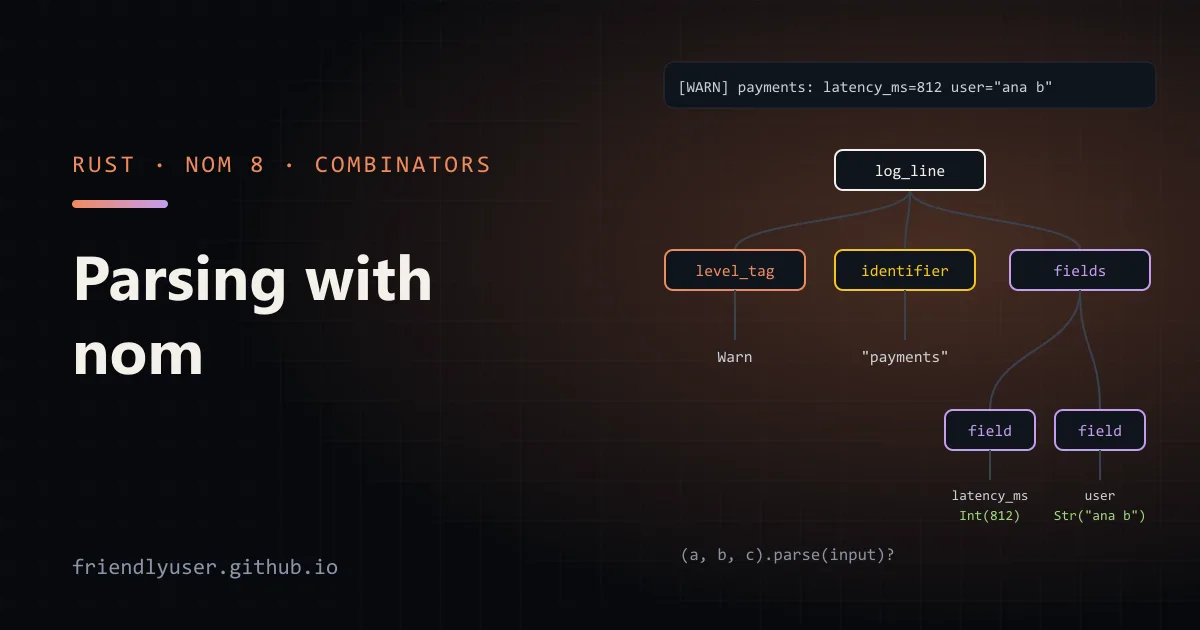
nom is a parser combinator library: you write small functions that each recognise one piece of input (a word, a number, a quoted string), then combine them into bigger parsers with functions like alt, delimited and separated_list0. It works on &str and &[u8], returns slices that borrow from the input instead of copying, and needs no separate grammar file or code generation step.
This post builds a parser for structured log lines with nom 8 and covers the API change that makes most older nom tutorials fail to compile. The examples use nom 8.0.0 and the 2024 edition:
[dependencies]nom = "8.0"What changed in nom 8
Section titled “What changed in nom 8”Up to nom 7, combinators returned closures, and you called them directly: tag("abc")(input), delimited(a, b, c)(input). In nom 8, most combinators return a type implementing the Parser trait, and you run it with the parse method:
// nom 7let (rest, word) = delimited(char('['), alpha1, char(']'))(input)?;
// nom 8use nom::Parser;let (rest, word) = delimited(char('['), alpha1, char(']')).parse(input)?;
Other changes you’ll run into:
- Tuples are parsers.
(a, b, c).parse(input)runs three parsers in sequence and returns a tuple of their outputs. The oldtuple((a, b, c))function is deprecated. VerboseErrormoved to the companion cratenom-language, together withconvert_error.- Input traits were merged.
InputIter,InputTake,InputLengthand friends became a singleInputtrait. This only matters if you wrote parsers over your own input type.
Functions you write yourself, with the signature fn(&str) -> IResult<&str, T>, still work everywhere a parser is expected. nom implements Parser for any function or closure with that shape, so you can mix them freely with the built-in combinators.
The format
Section titled “The format”The parser handles log lines like this:
[WARN] payments: latency_ms=812 user="ana b" retry=trueThat’s a level in brackets, a target followed by a colon, and zero or more key=value fields separated by spaces. A value is either a quoted string (which may contain spaces) or a bare word. Bare words that parse as integers become numbers.
The parser
Section titled “The parser”src/lib.rs:
use nom::{    branch::alt,    bytes::complete::{tag, take_while, take_while1},    character::complete::{char, digit1, space0, space1},    combinator::{all_consuming, cut, map, map_res, value},    multi::separated_list0,    sequence::{delimited, preceded, separated_pair, terminated},    Finish, IResult, Parser,};
#[derive(Debug, Clone, Copy, PartialEq)]pub enum Level {    Info,    Warn,    Error,}
#[derive(Debug, PartialEq)]pub enum Value<'a> {    Int(i64),    Str(&'a str),}
#[derive(Debug, PartialEq)]pub struct LogLine<'a> {    pub level: Level,    pub target: &'a str,    pub fields: Vec<(&'a str, Value<'a>)>,}
/// `[INFO]`, `[WARN]` or `[ERROR]`.fn level_tag(input: &str) -> IResult<&str, Level> {    delimited(        char('['),        alt((            value(Level::Info, tag("INFO")),            value(Level::Warn, tag("WARN")),            value(Level::Error, tag("ERROR")),        )),        char(']'),    )    .parse(input)}
/// Letters, digits, `_` and `.`.fn identifier(input: &str) -> IResult<&str, &str> {    take_while1(|c: char| c.is_ascii_alphanumeric() || c == '_' || c == '.').parse(input)}
/// `"..."`: once the opening quote is seen, a missing closing quote is fatal.fn quoted(input: &str) -> IResult<&str, &str> {    preceded(        char('"'),        cut(terminated(take_while(|c: char| c != '"'), char('"'))),    )    .parse(input)}
/// Anything up to the next space or quote.fn bare(input: &str) -> IResult<&str, &str> {    take_while1(|c: char| !c.is_whitespace() && c != '"').parse(input)}
fn to_value(s: &str) -> Value<'_> {    match s.parse::<i64>() {        Ok(n) => Value::Int(n),        Err(_) => Value::Str(s),    }}
fn field_value(input: &str) -> IResult<&str, Value<'_>> {    alt((map(quoted, Value::Str), map(bare, to_value))).parse(input)}
/// `key=value`fn field(input: &str) -> IResult<&str, (&str, Value<'_>)> {    separated_pair(identifier, char('='), field_value).parse(input)}
/// One log line, possibly followed by unparsed input.pub fn log_line(input: &str) -> IResult<&str, LogLine<'_>> {    let (input, (level, _, target, _, fields)) = (        level_tag,        space1,        terminated(identifier, char(':')),        space0,        separated_list0(space1, field),    )        .parse(input)?;    Ok((input, LogLine { level, target, fields }))}
/// A whole line, with nothing left over.pub fn parse_line(input: &str) -> Result<LogLine<'_>, nom::error::Error<&str>> {    all_consuming(delimited(space0, log_line, space0))        .parse(input)        .finish()        .map(|(_, line)| line)}
/// A port number: digits that fit in a u16.fn port(input: &str) -> IResult<&str, u16> {    map_res(digit1, |s: &str| s.parse::<u16>()).parse(input)}
/// `host:port`pub fn host_port(input: &str) -> IResult<&str, (&str, u16)> {    separated_pair(identifier, char(':'), port).parse(input)}
Reading it bottom-up
Section titled “Reading it bottom-up”Each function returns IResult<Input, Output>, which is Result<(remaining_input, output), nom::Err<Error>>. A parser takes the input, consumes what it recognises, and hands back the rest.
level_tagusesdelimited(open, inner, close)to keep only the middle result, andaltto try alternatives in order.value(Level::Info, tag("INFO"))replaces the matched text with a fixed value.identifierandbareusetake_while1, which consumes characters while the predicate holds and fails if it matched none.take_while(without the 1) can match zero characters, which is what an empty quoted string needs.field_valuetriesquotedfirst, thenbare.map(parser, f)transforms a parser’s output.Value::Strworks as a function here, because tuple-variant constructors are functions.log_lineruns five parsers in sequence with a tuple and destructures the result, ignoring the whitespace parts.separated_list0(space1, field)parses zero or more fields separated by spaces. When a separator matches but the next field doesn’t, it stops before that separator. That leaves the trailing spaces for thespace0inparse_line.
Everything here returns borrowed slices of the input (&'a str), so parsing a line allocates only the Vec of fields.
I wrote to_value as a named function rather than a closure on purpose. A closure whose parameter type is written as |s: &str| and whose result borrows from s runs into a lifetime error, because the compiler treats each call as having its own unrelated lifetime. The named function’s signature ties the output lifetime to the input and avoids that. The map_res closure in port is fine, because a u16 doesn’t borrow anything.
complete versus streaming
Section titled “complete versus streaming”The imports come from bytes::complete and character::complete. nom also has streaming versions of these parsers. When a streaming parser reaches the end of its input, it returns Err::Incomplete, meaning “give me more data”. A complete parser treats the end of input as the end. For a line or a whole file already in memory, use complete. Use streaming when parsing data as it arrives from a socket.
Errors
Section titled “Errors”nom has two kinds of failure, and the difference matters:
Err::Errormeans “this parser didn’t match here”. Combinators likealt,optandseparated_list0treat it as a cue to backtrack and try something else.Err::Failuremeans “the input is wrong, stop”. Nothing backtracks past it.
cut(parser) turns an Error into a Failure. In quoted, once we’ve seen an opening quote, a missing closing quote is definitely an error. Without cut, alt would quietly try bare instead, separated_list0 would stop, and the error would point at the start of the field, or somewhere even less helpful. With cut, the error points at the end of the input, where the closing quote should have been.
parse_line wraps everything in all_consuming, which fails if any input is left over. .finish() (from the Finish trait) converts the IResult into a plain Result with the error type inside, which is easier to pass to the rest of your program. Don’t call finish on the result of a streaming parser: it panics on Incomplete.
The default error type, nom::error::Error<&str>, holds the remaining input where parsing failed and an ErrorKind saying which parser failed. Its Display prints something like error Tag at: DEBUG] x: a=1. You can turn that into a position: the original input’s length minus the remaining length is the byte offset of the failure. For messages that explain what was expected, use VerboseError from the nom-language crate, add labels with nom::error::context("level", level_tag), and render with nom_language::error::convert_error. context exists on the default error type too, but it’s a no-op there.
Parsers are pure functions from &str to a result, which makes them easy to test:
#[cfg(test)]mod tests {    use super::*;
    #[test]    fn parses_a_full_line() {        let line =            parse_line(r#"[WARN] payments: latency_ms=812 user="ana b" retry=true"#).unwrap();        assert_eq!(line.level, Level::Warn);        assert_eq!(line.target, "payments");        assert_eq!(            line.fields,            vec![                ("latency_ms", Value::Int(812)),                ("user", Value::Str("ana b")),                ("retry", Value::Str("true")),            ]        );    }
    #[test]    fn fields_are_optional() {        let line = parse_line("[INFO] startup:").unwrap();        assert!(line.fields.is_empty());    }
    #[test]    fn log_line_stops_at_what_it_cannot_parse() {        let (rest, line) = log_line("[ERROR] db: code=5 !!").unwrap();        assert_eq!(line.fields, vec![("code", Value::Int(5))]);        assert_eq!(rest, " !!");    }
    #[test]    fn unknown_level_is_an_error() {        let err = parse_line("[DEBUG] x: a=1").unwrap_err();        assert_eq!(err.input, "DEBUG] x: a=1");    }
    #[test]    fn unterminated_quote_points_at_the_end() {        let err = parse_line(r#"[INFO] api: msg="unterminated"#).unwrap_err();        assert_eq!(err.input, "");    }
    #[test]    fn typed_values_with_map_res() {        assert_eq!(host_port("db.internal:5432"), Ok(("", ("db.internal", 5432))));        assert!(host_port("db.internal:99999").is_err());    }}
Test the small parsers as well as the top-level one. When parse_line fails on a real log file, a failing field_value test tells you much more than a failing parse_line test. The fact that log_line returns the unconsumed rest, as the third test shows, is handy here: you can see exactly how far parsing got.
Using it
Section titled “Using it”use std::io::{self, BufRead};
fn main() { let stdin = io::stdin(); for line in stdin.lock().lines() { let line = line.expect("read error"); match logparse::parse_line(&line) { Ok(parsed) => println!("{parsed:?}"), Err(err) => eprintln!("skipping line: {err}"), } }}This goes in src/main.rs of a crate named logparse, next to the lib.rs above. Pipe a log file into cargo run.
When not to use nom
Section titled “When not to use nom”- The format has a grammar already. For JSON, TOML, CSV and friends, use the existing crates (
serde_json,toml,csv). They’re faster and better tested than anything you’ll write in an afternoon. - A regex is enough. If a line has a fixed shape and you only need two fields out of it, the
regexcrate with named groups is shorter and easier to read. - You need great error messages. nom can produce them, but it takes work. For languages users type by hand, look at
chumskyorwinnow. winnow started as a fork of nom and focuses on errors and ergonomics.
Further reading
Section titled “Further reading”- nom on docs.rs
- nom’s list of combinators
- nom CHANGELOG, for the 8.0 changes
- nom-language for
VerboseErrorand precedence parsing
© 2026 David Li · Home · Blog · RSS ·Classic site · Built with Astro, Starlight and three.js · Logos:Font Awesome Free (CC BY 4.0)