Routing in Go's net/http with method and wildcard patterns
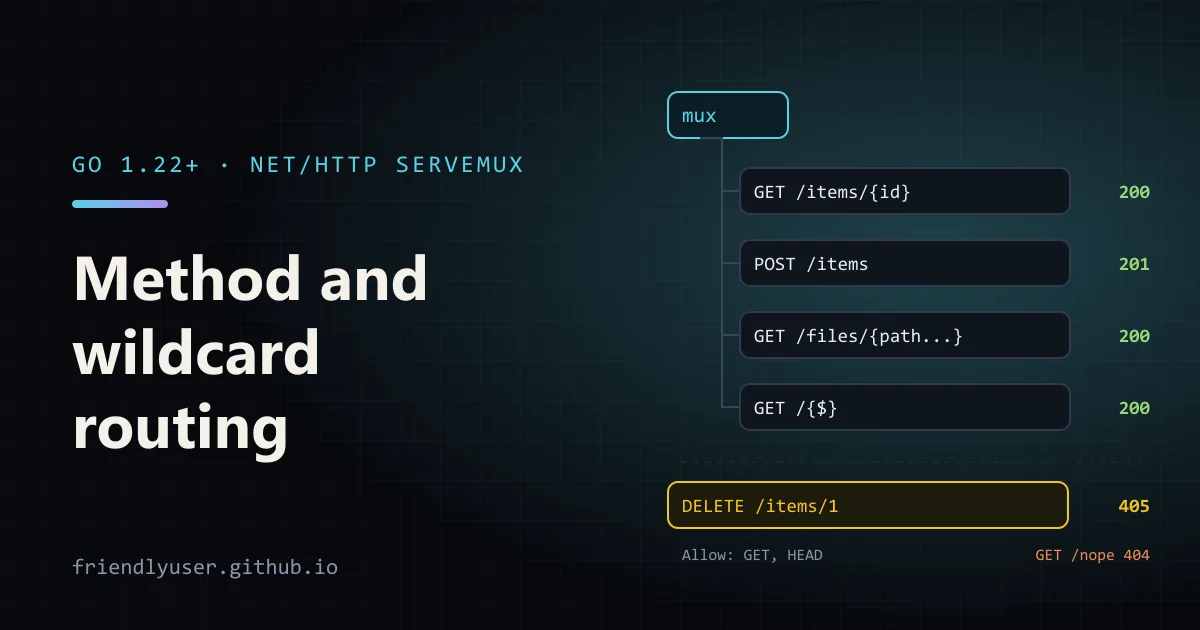
Since Go 1.22, the standard library’s http.ServeMux matches on HTTP method and path wildcards, so mux.HandleFunc("GET /items/{id}", ...) works with no third-party router. For a typical JSON API that covers what people used to pull in chi or gorilla/mux for. This post goes past the basics: how the pattern syntax works in detail, which pattern wins when several match, what you get for free (405 responses, HEAD), and how to write middleware without a framework.
Examples use Go 1.26 and were run on the Go playground. For a gentler introduction to net/http and html/template, see Web development in Go: net/http routing and html/template.
Pattern syntax
Section titled “Pattern syntax”A pattern has up to three parts:
[METHOD ][HOST]/[PATH]- Method, followed by a space:
GET /items. Without one, the pattern matches every method. AGETpattern also matchesHEADrequests. - Host:
api.example.com/items. Only requests for that host match. Patterns with a host take precedence over patterns without one. - Path, with optional wildcards.
There are three kinds of wildcard:
| Wildcard | Matches | Example |
|---|---|---|
{name} | exactly one path segment | GET /items/{id} matches /items/42, not /items/42/edit |
{name...} | the rest of the path, must be last | GET /files/{path...} matches /files/css/site.css |
{$} | the end of the path, after a trailing slash | GET /{$} matches only /, not /anything |
A pattern that ends in a slash, such as /static/, still matches the whole subtree, as it always did. That is why GET / on its own is a catch-all, and why you need GET /{$} for a handler that serves only the home page.
Wildcard values come from r.PathValue("id"). They are always strings, so parse and validate them yourself. Path segments are unescaped before matching, so /files/a%2Fb gives PathValue("path") the value a/b. Keep that in mind if a wildcard ends up in a filesystem path.
A worked example
Section titled “A worked example”This program builds a small item API with a logging middleware, then sends it requests with httptest, so you can run it with go run . and see every routing rule in the output without starting a server:
package main
import (  "encoding/json"  "fmt"  "log/slog"  "net/http"  "net/http/httptest"  "os"  "strconv"  "strings"  "sync"  "time")
type Item struct {  ID   int    `json:"id"`  Name string `json:"name"`}
type store struct {  mu    sync.Mutex  items map[int]Item  next  int}
func (s *store) get(w http.ResponseWriter, r *http.Request) {  id, err := strconv.Atoi(r.PathValue("id"))  if err != nil {    http.Error(w, "id must be a number", http.StatusBadRequest)    return  }  s.mu.Lock()  item, ok := s.items[id]  s.mu.Unlock()  if !ok {    http.NotFound(w, r)    return  }  writeJSON(w, http.StatusOK, item)}
func (s *store) create(w http.ResponseWriter, r *http.Request) {  var in Item  if err := json.NewDecoder(r.Body).Decode(&in); err != nil || in.Name == "" {    http.Error(w, "body must be {\"name\": \"...\"}", http.StatusBadRequest)    return  }  s.mu.Lock()  s.next++  in.ID = s.next  s.items[in.ID] = in  s.mu.Unlock()  w.Header().Set("Location", "/items/"+strconv.Itoa(in.ID))  writeJSON(w, http.StatusCreated, in)}
func writeJSON(w http.ResponseWriter, status int, v any) {  w.Header().Set("Content-Type", "application/json")  w.WriteHeader(status)  json.NewEncoder(w).Encode(v)}
// statusRecorder remembers the status code a handler wrote.type statusRecorder struct {  http.ResponseWriter  status int}
func (r *statusRecorder) WriteHeader(code int) {  r.status = code  r.ResponseWriter.WriteHeader(code)}
// Unwrap lets http.ResponseController reach the real writer (Flush, deadlines).func (r *statusRecorder) Unwrap() http.ResponseWriter { return r.ResponseWriter }
func logRequests(log *slog.Logger) func(http.Handler) http.Handler {  return func(next http.Handler) http.Handler {    return http.HandlerFunc(func(w http.ResponseWriter, r *http.Request) {      start := time.Now()      rec := &statusRecorder{ResponseWriter: w, status: http.StatusOK}      next.ServeHTTP(rec, r)      log.Info("request",        "method", r.Method,        "path", r.URL.Path,        "pattern", r.Pattern, // set by ServeMux (Go 1.23+)        "status", rec.status,        "took", time.Since(start).Round(time.Microsecond),      )    })  }}
func requireJSON(next http.Handler) http.Handler {  return http.HandlerFunc(func(w http.ResponseWriter, r *http.Request) {    if !strings.HasPrefix(r.Header.Get("Content-Type"), "application/json") {      http.Error(w, "Content-Type must be application/json", http.StatusUnsupportedMediaType)      return    }    next.ServeHTTP(w, r)  })}
func newMux(s *store) *http.ServeMux {  mux := http.NewServeMux()  mux.HandleFunc("GET /items/{id}", s.get)  mux.Handle("POST /items", requireJSON(http.HandlerFunc(s.create)))  mux.HandleFunc("GET /files/{path...}", func(w http.ResponseWriter, r *http.Request) {    fmt.Fprintf(w, "file %q\n", r.PathValue("path"))  })  mux.HandleFunc("GET /{$}", func(w http.ResponseWriter, r *http.Request) {    fmt.Fprintln(w, "home")  })  return mux}
func main() {  log := slog.New(slog.NewTextHandler(os.Stdout, &slog.HandlerOptions{    ReplaceAttr: func(groups []string, a slog.Attr) slog.Attr {      if a.Key == slog.TimeKey || a.Key == "took" {        return slog.Attr{} // keep the output below short and stable      }      return a    },  }))  s := &store{items: map[int]Item{}}  handler := logRequests(log)(newMux(s))
  do := func(method, target, body string) {    req := httptest.NewRequest(method, target, strings.NewReader(body))    if body != "" {      req.Header.Set("Content-Type", "application/json")    }    rec := httptest.NewRecorder()    handler.ServeHTTP(rec, req)    fmt.Printf("%s %s -> %d %s", method, target, rec.Code, rec.Body.String())    if allow := rec.Header().Get("Allow"); allow != "" {      fmt.Printf("   Allow: %s\n", allow)    }  }
  do("POST", "/items", `{"name":"lamp"}`)  do("GET", "/items/1", "")  do("GET", "/items/abc", "")  do("DELETE", "/items/1", "")  do("GET", "/files/css/site.css", "")  do("GET", "/files/a%2Fb", "")  do("GET", "/", "")  do("GET", "/nope", "")}
The output, one log line from the middleware and one line from do per request:
level=INFO msg=request method=POST path=/items pattern="POST /items" status=201POST /items -> 201 {"id":1,"name":"lamp"}level=INFO msg=request method=GET path=/items/1 pattern="GET /items/{id}" status=200GET /items/1 -> 200 {"id":1,"name":"lamp"}level=INFO msg=request method=GET path=/items/abc pattern="GET /items/{id}" status=400GET /items/abc -> 400 id must be a numberlevel=INFO msg=request method=DELETE path=/items/1 pattern="" status=405DELETE /items/1 -> 405 Method Not Allowed Allow: GET, HEADlevel=INFO msg=request method=GET path=/files/css/site.css pattern="GET /files/{path...}" status=200GET /files/css/site.css -> 200 file "css/site.css"level=INFO msg=request method=GET path=/files/a/b pattern="GET /files/{path...}" status=200GET /files/a%2Fb -> 200 file "a/b"level=INFO msg=request method=GET path=/ pattern="GET /{$}" status=200GET / -> 200 homelevel=INFO msg=request method=GET path=/nope pattern="" status=404GET /nope -> 404 404 page not foundA few things to notice:
DELETE /items/1matched a path that exists for another method, so the mux answered405 Method Not Allowedand setAllow: GET, HEAD. You didn’t write that./items/abcmatched the route; the wildcard does no type checking. The handler returned 400.r.Patternis the pattern that matched, read after the handler ran. Use it, notr.URL.Path, as the route label in metrics, or every item ID becomes its own time series.
To serve it for real, replace the do calls with http.ListenAndServe(":8080", handler), or better, an http.Server with timeouts.
Which pattern wins
Section titled “Which pattern wins”When more than one pattern matches a request, the most specific one wins. A pattern is more specific than another if it matches a strict subset of that pattern’s requests. With these registered:
mux.Handle("GET /items/{id}", itemByID)mux.Handle("GET /items/new", newItemForm)mux.Handle("/items/", itemsSubtree)/items/newgoes tonewItemForm: a literal segment beats a wildcard./items/42goes toitemByID./items/42/editgoes toitemsSubtree:{id}matches only one segment.
Registration order doesn’t matter, unlike in many routers. If two patterns overlap and neither is more specific, Handle panics when you register the second one, so the conflict shows up the first time the program starts rather than as a wrong response in production:
mux.Handle("GET /posts/{id}", a)mux.Handle("GET /{resource}/latest", b) // panicsThe panic message explains it: both patterns match /posts/latest, but each also matches paths the other doesn’t. Conflicts are checked pair by pair, so registering a third pattern such as GET /posts/latest doesn’t help; it still panics. Change one of the two patterns, for example to GET /latest/{resource}, or restructure the URLs.
The precedence rules also explain a common surprise. A pattern without a method, like /items/ above, matches every method, so once it is registered, DELETE /items/42/edit goes to itemsSubtree instead of getting a 405. If you want automatic 405s, give every pattern a method.
Trailing slashes and redirects
Section titled “Trailing slashes and redirects”If you register GET /docs/ and a request comes in for /docs, the mux redirects to /docs/. Since Go 1.26 that redirect is 307 Temporary Redirect. Earlier versions sent 301 Moved Permanently, which browsers cache. If you want /docs to be its own page, register it explicitly.
Middleware without a framework
Section titled “Middleware without a framework”The middleware shape in Go is a function from handler to handler:
type Middleware func(http.Handler) http.HandlerrequireJSON above is one; logRequests(log) is a function that returns one, which is how you give middleware configuration. To apply several in a readable order, a small helper is enough:
// Chain applies middleware so that the first one listed runs first.func Chain(h http.Handler, mws ...func(http.Handler) http.Handler) http.Handler {  for i := len(mws) - 1; i >= 0; i-- {    h = mws[i](h)  }  return h}
handler := Chain(mux, logRequests(log), recoverPanics, requireAuth)
You can apply middleware in two places, and both are useful:
- Around the whole mux, for things every request needs: logging, panic recovery, request IDs.
- Around a single route, for things only some routes need, like
requireJSONonPOST /itemsabove.
For a group of routes under a prefix, mount a second mux:
api := http.NewServeMux()api.HandleFunc("GET /users/{id}", getUser)
root := http.NewServeMux()root.Handle("/api/", http.StripPrefix("/api", requireAuth(api)))
The inner mux sees /users/7, and requireAuth wraps only the API.
Two details in the logging middleware are worth copying. It defaults status to 200, because a handler that never calls WriteHeader sends 200 implicitly. And it has an Unwrap method: http.ResponseController, which handlers use to flush or set per-request deadlines, looks for Unwrap to get past wrappers like this one. Without it, a streaming handler behind your logger can’t flush.
Gotchas
Section titled “Gotchas”- Old behaviour switch. The
GODEBUGsettinghttpmuxgo121=1restores the pre-1.22 matching, where braces and methods were treated as literal text. It’s there for migration; don’t leave it on. - The space matters. The method must be followed by a space or tab.
"GET/items"is parsed as hostGETand path/items, so it registers without error and then never matches a normal request. - No regex constraints.
{id}matches any segment. If you need “digits only”, check in the handler, asgetdoes withstrconv.Atoi. - Custom 404 and 405 bodies.
ServeMuxwrites its own plain-text responses. If you need JSON errors everywhere, wrap the mux and check the status in a recorder, or register a/catch-all for 404s (which also removes the automatic 405s, as described above). - When a router still helps. If you want per-group middleware declared inline, named routes, or URL generation from route names, chi and similar routers still add something. For a JSON API with a few dozen routes, the standard mux is enough.
Further reading
Section titled “Further reading”http.ServeMuxdocumentation, including the full precedence rules- Routing Enhancements for Go 1.22 (Go blog)
http.ResponseControllernet/http/httptest
© 2026 David Li · Home · Blog · RSS ·Classic site · Built with Astro, Starlight and three.js · Logos:Font Awesome Free (CC BY 4.0)