Table-driven tests and native fuzzing in Go
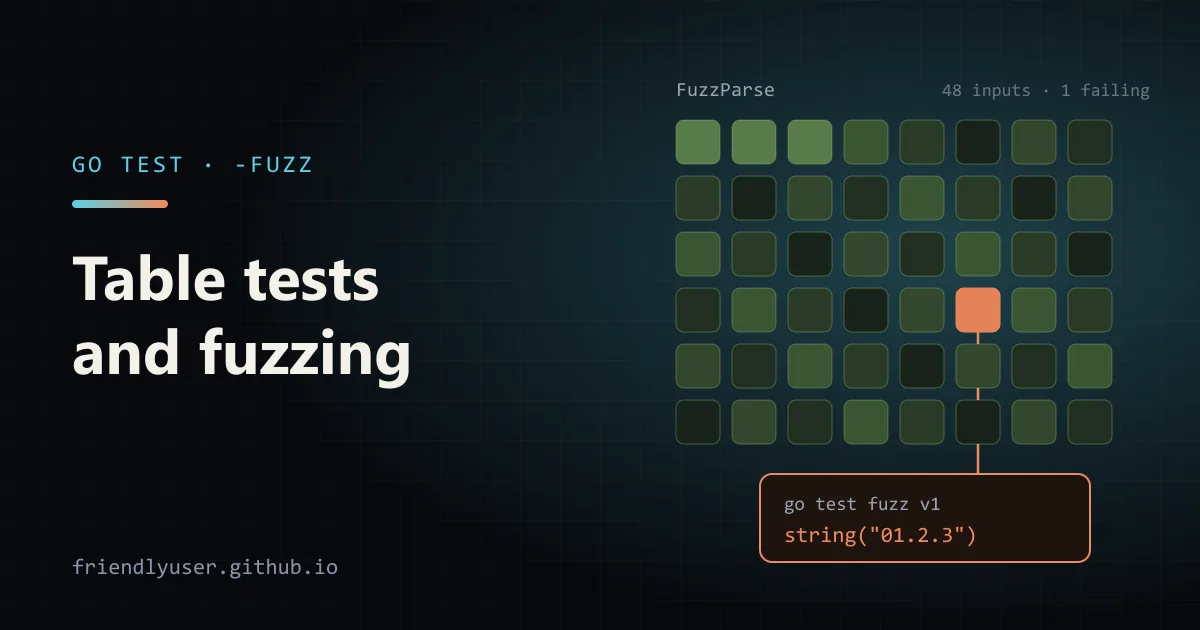
Table-driven tests are the standard way to test a Go function: a slice of cases, one loop, and t.Run so each case reports on its own. Fuzzing, built into go test since Go 1.18, is the complement. Instead of the cases you thought of, it generates inputs you didn’t, guided by code coverage, and checks a property you state. This post builds both for a small version-string parser, and the fuzz target finds a bug the table missed.
Examples use Go 1.26. The table tests and the seed corpus were run with go test.
The code under test
Section titled “The code under test”A parser for MAJOR.MINOR.PATCH with an optional -PRERELEASE suffix, the shape of semantic version strings. Create a module with go mod init example.com/version and add version.go:
// Package version parses MAJOR.MINOR.PATCH[-PRERELEASE] version strings.package version
import (  "errors"  "fmt"  "strconv"  "strings")
type Version struct {  Major, Minor, Patch int  Pre                 string // pre-release, e.g. "rc.1"; empty for a release}
func Parse(s string) (Version, error) {  var v Version  core, pre, hasPre := strings.Cut(s, "-")  if hasPre {    if pre == "" {      return Version{}, errors.New("empty pre-release")    }    v.Pre = pre  }  parts := strings.Split(core, ".")  if len(parts) != 3 {    return Version{}, fmt.Errorf("want MAJOR.MINOR.PATCH, got %q", core)  }  nums := []*int{&v.Major, &v.Minor, &v.Patch}  for i, p := range parts {    n, err := strconv.Atoi(p)    if err != nil {      return Version{}, fmt.Errorf("part %d of %q: %w", i+1, s, err)    }    *nums[i] = n  }  return v, nil}
func (v Version) String() string {  s := fmt.Sprintf("%d.%d.%d", v.Major, v.Minor, v.Patch)  if v.Pre != "" {    s += "-" + v.Pre  }  return s}
It looks fine, and it has a bug. Keep reading before you look for it.
A table-driven test
Section titled “A table-driven test”Each case is a struct with a name, the input and the expected result. The loop runs each one as a subtest:
package version
import (  "bufio"  "os"  "testing")
func TestParse(t *testing.T) {  tests := []struct {    name    string    in      string    want    Version    wantErr bool  }{    {name: "release", in: "1.2.3", want: Version{1, 2, 3, ""}},    {name: "zeros", in: "0.0.0", want: Version{0, 0, 0, ""}},    {name: "pre-release", in: "2.0.0-rc.1", want: Version{2, 0, 0, "rc.1"}},    {name: "big numbers", in: "10.200.3000", want: Version{10, 200, 3000, ""}},    {name: "too few parts", in: "1.2", wantErr: true},    {name: "too many parts", in: "1.2.3.4", wantErr: true},    {name: "not a number", in: "1.x.3", wantErr: true},    {name: "empty pre-release", in: "1.2.3-", wantErr: true},    {name: "empty string", in: "", wantErr: true},  }  for _, tc := range tests {    t.Run(tc.name, func(t *testing.T) {      t.Parallel()      got, err := Parse(tc.in)      if tc.wantErr {        if err == nil {          t.Fatalf("Parse(%q) = %v, want an error", tc.in, got)        }        return      }      if err != nil {        t.Fatalf("Parse(%q) returned error: %v", tc.in, err)      }      if got != tc.want {        t.Errorf("Parse(%q) = %+v, want %+v", tc.in, got, tc.want)      }    })  }}
What each part buys you:
t.Run(name, ...)makes each case a subtest. A failure reportsTestParse/not_a_number(spaces become underscores), andt.Fatalfstops only that case, not the whole table.- Running one case:
go test -run 'TestParse/^pre-release$' -v. The part after/is an unanchored regular expression matched against subtest names, so without^and$it would also runempty_pre-release. t.Parallel()inside the subtest pauses it until the loop finishes, then runs all the paused subtests concurrently. Since Go 1.22 each loop iteration has its owntc, so the oldtc := tcline is no longer needed (thego.modmust saygo 1.22or later).got != tc.wantworks becauseVersionis a comparable struct. For structs with slices or maps, usereflect.DeepEqualor thego-cmppackage’scmp.Diff, which also prints what differs.%qin messages shows invisible characters and empty strings, which matters for a parser.
Run it with go test ./.... Every case passes.
Fixtures in testdata
Section titled “Fixtures in testdata”The go tool ignores any directory named testdata, and go test runs with the package directory as the working directory. That makes testdata/ the place for input files and golden outputs. A list of known-good versions, testdata/valid.txt:
# one version per line; each must parse and print back unchanged1.0.00.9.122.0.0-rc.110.20.30-alpha.betaAnd a test that reads it:
// TestRoundTripFile checks every version listed in testdata/valid.txt.func TestRoundTripFile(t *testing.T) {  f, err := os.Open("testdata/valid.txt")  if err != nil {    t.Fatal(err)  }  defer f.Close()
  sc := bufio.NewScanner(f)  for sc.Scan() {    line := sc.Text()    if line == "" || line[0] == '#' {      continue    }    v, err := Parse(line)    if err != nil {      t.Errorf("Parse(%q): %v", line, err)      continue    }    if v.String() != line {      t.Errorf("Parse(%q).String() = %q", line, v.String())    }  }  if err := sc.Err(); err != nil {    t.Fatal(err)  }}
This also passes. The test checks a property, “a valid version prints back unchanged”, but only for inputs someone typed. That is exactly what fuzzing generalises.
The fuzz target
Section titled “The fuzz target”A fuzz test is a function named FuzzXxx that takes *testing.F. You add seed inputs with f.Add, then pass f.Fuzz a function whose arguments after *testing.T are the generated values. Add it to version_test.go:
func FuzzParse(f *testing.F) { for _, seed := range []string{"1.2.3", "0.0.0", "2.0.0-rc.1", "1.2", "1.x.3", ""} { f.Add(seed) } f.Fuzz(func(t *testing.T, s string) { v, err := Parse(s) if err != nil { return // rejecting input is fine; we only check what Parse accepts } // Every accepted string must already be in canonical form. if got := v.String(); got != s { t.Fatalf("Parse(%q) accepted a non-canonical version; String() = %q", s, got) } // And the canonical form must parse back to the same value. v2, err := Parse(v.String()) if err != nil || v2 != v { t.Fatalf("round trip of %q: got %+v, %v", s, v2, err) } })}The hard part of fuzzing is not the API; it is deciding what to assert, because the fuzzer can’t know the right answer for a random string. Properties that work well for parsers:
- it never panics (you get this one for free: a panic fails the run);
- whatever it accepts round-trips through the printer;
- it agrees with a slower, obviously correct implementation;
- it rejects everything a reference parser rejects.
A plain go test runs FuzzParse with only the seed inputs, as a normal test. They all pass. To actually fuzz:
go test -fuzz=FuzzParse -fuzztime=60s-fuzz takes a regular expression that must match exactly one fuzz target. Without -fuzztime, it runs until it finds a failure or you press Ctrl+C. The fuzzer mutates the seeds, keeps inputs that reach new code, and runs workers in parallel (as many as GOMAXPROCS by default).
What it finds
Section titled “What it finds”The seeds contain valid versions, and inputs such as 01.2.3 or 1.+2.3 are a single inserted byte away from them. Both are accepted by Parse, and both print back as 1.2.3. strconv.Atoi accepts a leading + and leading zeros, and the table never tried either. Semantic Versioning forbids leading zeros, and two different strings meaning the same version is the kind of thing that breaks a cache key or a uniqueness check later.
When the property fails, the fuzzer stops, prints the failing input, and writes it to a file under testdata/fuzz/FuzzParse/. The exact input differs from run to run. The file looks like this:
go test fuzz v1string("01.2.3")From then on, a plain go test runs that file as a subtest of FuzzParse, so the bug stays reproducible for everyone, with no fuzzing needed. Commit the file. It’s a regression test that writes itself.
The fix
Section titled “The fix”Accept only digits, with no sign and no leading zero:
// parseNum accepts only canonical non-negative integers: digits, no sign,// no leading zeros.func parseNum(p string) (int, error) { if p == "" { return 0, errors.New("empty number") } if len(p) > 1 && p[0] == '0' { return 0, fmt.Errorf("leading zero in %q", p) } for _, c := range p { if c < '0' || c > '9' { return 0, fmt.Errorf("%q is not a number", p) } } return strconv.Atoi(p)}In Parse, replace strconv.Atoi(p) with parseNum(p). Add the two inputs to the table as error cases too, so the intent is written down where people read it:
{name: "leading zero", in: "01.2.3", wantErr: true}, {name: "plus sign", in: "1.+2.3", wantErr: true},With the fix, go test passes, including the saved corpus file. For the buggy version, the two new table cases fail with Parse("01.2.3") = 1.2.3, want an error and Parse("1.+2.3") = 1.2.3, want an error. strconv.Atoi still does the conversion, and also rejects numbers that overflow int.
Gotchas and practical notes
Section titled “Gotchas and practical notes”- Supported argument types. Fuzz functions can take
string,[]byte,bool,rune,byte, the sized and unsizedintanduinttypes, andfloat32/float64. For structured input, take[]byteor a few primitives and build the struct inside the function. - Don’t modify or keep
[]byteinputs. Thetestingdocs say the fuzz function must not change the data it is given or hold on to it between calls. Copy the slice first if the code under test writes to it. - Keep the target fast and deterministic. No network, no clock, no global state that carries between calls. A flaky property makes the fuzzer report failures it can’t reproduce.
- The generated corpus lives in the build cache, under
$GOCACHE/fuzz, not in your repo. Only failing inputs are written totestdata.go clean -fuzzcachedeletes the cache. - CI. Run the normal
go test ./...on every push, which replays the seeds and saved failures. Run real fuzzing on a schedule with a time limit (-fuzztime=5m), not on every pull request. - Platform. The fuzzing docs recommend running on a platform with coverage instrumentation, currently amd64 and arm64, so the corpus can grow as new code is reached. Each call of the fuzz function also has a 1-second timeout.
- Test helpers. Call
t.Helper()at the top of assertion helpers, so failures point at the caller’s line.t.Context()(Go 1.24) gives a context that is cancelled when the test ends, andt.ArtifactDir()(Go 1.26) gives a directory for files you want to keep after a run withgo test -artifacts.
Further reading
Section titled “Further reading”- Go Fuzzing (official documentation)
- Tutorial: Getting started with fuzzing
- Go wiki: TableDrivenTests
testingpackage- Semantic Versioning 2.0.0
© 2026 David Li · Home · Blog · RSS ·Classic site · Built with Astro, Starlight and three.js · Logos:Font Awesome Free (CC BY 4.0)