Rate limiting in Go with golang.org/x/time/rate
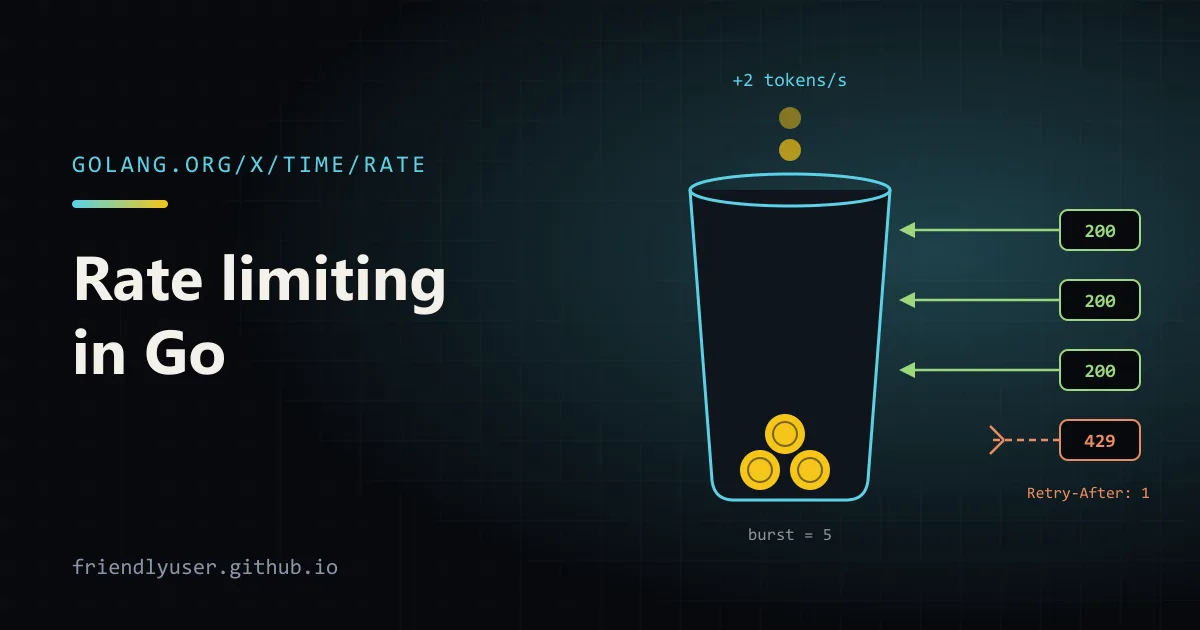
golang.org/x/time/rate is the Go team’s token-bucket rate limiter. It lives in the x/ repositories rather than the standard library, but it is the default choice for both sides of rate limiting: protecting your server from clients that send too much, and keeping your own client under a third-party API’s limit. This post covers how the bucket works, the three ways to ask it for permission, and a per-IP HTTP middleware that returns 429 Too Many Requests with a correct Retry-After.
Examples use Go 1.27 and golang.org/x/time v0.16.0, and were run on the Go playground.
The token bucket
Section titled “The token bucket”A limiter has two numbers:
r, the rate: tokens added per second, of typerate.Limit(afloat64).b, the burst: the most tokens the bucket can hold.
Each event spends one token. The bucket starts full, so a quiet client can send b requests at once, then is held to r per second until the bucket refills. A burst of 1 means strictly evenly spaced events.
api := rate.NewLimiter(10, 20) // 10 per second, bursts of 20paced := rate.NewLimiter(rate.Every(200*time.Millisecond), 1) // one every 200 ms, no burstopen := rate.NewLimiter(rate.Inf, 0) // no limit; burst is ignoredrate.Every converts an interval to a rate, which reads better for slow limits like “one every 5 minutes”. SetLimit and SetBurst change a live limiter, for example after a config reload, and a Limiter is safe for concurrent use.
Allow, Wait or Reserve
Section titled “Allow, Wait or Reserve”The limiter offers three ways to take a token, and choosing the right one is most of the design.
Allow() answers now: true if a token was available (and spends it), false otherwise. Use it when you will drop or reject the event, as a server does with excess requests.
Wait(ctx) blocks until a token is available, or returns an error if the context is cancelled first. It returns an error immediately if the wait would outlast the context’s deadline, rather than sleeping until the deadline and then failing. Use it on the client side, to pace your own outgoing calls.
Reserve() spends a token now, whether or not one is available yet, and returns a *Reservation that says how long you’d have to wait (Delay()). You then either wait that long, or call Cancel() to give the token back. Use it when you need the delay itself, for example to set Retry-After.
Each has an N variant (AllowN, WaitN, ReserveN) for events that cost more than one token, such as a batch of records or a large upload. An N greater than the burst can never succeed: WaitN returns an error and ReserveN returns a reservation whose OK() is false.
Here they are side by side:
package main
import (  "context"  "fmt"  "time"
  "golang.org/x/time/rate")
func main() {  // Allow: 1 token per second, bucket holds 3.  lim := rate.NewLimiter(1, 3)  for i := 0; i < 5; i++ {    fmt.Print(lim.Allow(), " ")  }  fmt.Println()
  // Reserve: how long until a token is available?  r := lim.Reserve()  fmt.Println("reserve ok:", r.OK(), "delay:", r.Delay().Round(time.Millisecond))  r.Cancel()
  // Wait: an outbound client limited to 5 requests per second, no burst.  out := rate.NewLimiter(5, 1)  start := time.Now()  for i := 0; i < 4; i++ {    if err := out.Wait(context.Background()); err != nil {      fmt.Println(err)    }    fmt.Print(time.Since(start).Round(10*time.Millisecond), " ")  }  fmt.Println()
  ctx, cancel := context.WithTimeout(context.Background(), 50*time.Millisecond)  defer cancel()  fmt.Println("wait with short deadline:", out.Wait(ctx))  fmt.Println("WaitN over burst:", out.WaitN(context.Background(), 2))}
Output (times rounded):
true true true false falsereserve ok: true delay: 1s0s 200ms 400ms 600mswait with short deadline: rate: Wait(n=1) would exceed context deadlineWaitN over burst: rate: Wait(n=2) exceeds limiter's burst 1The first three Allow calls drain the bucket and the next two are refused. The reservation says the next token is a second away. The Wait loop spaces calls 200 ms apart, the first one immediate because the bucket started with one token. The last two lines show Wait refusing up front instead of sleeping uselessly.
A per-client limiter for an HTTP server
Section titled “A per-client limiter for an HTTP server”One limiter for the whole server limits total traffic, which is useful as a safety valve but lets one noisy client use up everyone’s share. For fairness you want a bucket per client, usually keyed by IP address or by API key. That means a map, a mutex, and a way to forget clients so the map doesn’t grow forever:
package main
import (  "context"  "math"  "net"  "net/http"  "strconv"  "sync"  "time"
  "golang.org/x/time/rate")
type client struct {  limiter  *rate.Limiter  lastSeen time.Time}
// IPRateLimiter keeps one token bucket per client IP.type IPRateLimiter struct {  mu      sync.Mutex  clients map[string]*client  limit   rate.Limit  burst   int  ttl     time.Duration}
func NewIPRateLimiter(limit rate.Limit, burst int, ttl time.Duration) *IPRateLimiter {  return &IPRateLimiter{    clients: make(map[string]*client),    limit:   limit,    burst:   burst,    ttl:     ttl,  }}
func (l *IPRateLimiter) get(key string) *rate.Limiter {  l.mu.Lock()  defer l.mu.Unlock()  c, ok := l.clients[key]  if !ok {    c = &client{limiter: rate.NewLimiter(l.limit, l.burst)}    l.clients[key] = c  }  c.lastSeen = time.Now()  return c.limiter}
// Cleanup forgets clients that haven't been seen for ttl and returns how many it removed.func (l *IPRateLimiter) Cleanup(now time.Time) int {  l.mu.Lock()  defer l.mu.Unlock()  removed := 0  for key, c := range l.clients {    if now.Sub(c.lastSeen) > l.ttl {      delete(l.clients, key)      removed++    }  }  return removed}
// RunCleanup calls Cleanup every interval until ctx is cancelled.func (l *IPRateLimiter) RunCleanup(ctx context.Context, interval time.Duration) {  t := time.NewTicker(interval)  defer t.Stop()  for {    select {    case <-ctx.Done():      return    case now := <-t.C:      l.Cleanup(now)    }  }}
// Middleware rejects requests over the limit with 429 and a Retry-After header.func (l *IPRateLimiter) Middleware(next http.Handler) http.Handler {  return http.HandlerFunc(func(w http.ResponseWriter, r *http.Request) {    res := l.get(clientIP(r)).Reserve()    if !res.OK() {      // Only happens if burst is 0: the request can never be allowed.      http.Error(w, "rate limit misconfigured", http.StatusInternalServerError)      return    }    if d := res.Delay(); d > 0 {      res.Cancel() // we won't wait, so hand the token back      w.Header().Set("Retry-After", strconv.Itoa(int(math.Ceil(d.Seconds()))))      http.Error(w, http.StatusText(http.StatusTooManyRequests), http.StatusTooManyRequests)      return    }    next.ServeHTTP(w, r)  })}
// clientIP uses the connection's address. Behind a proxy, see the notes below.func clientIP(r *http.Request) string {  host, _, err := net.SplitHostPort(r.RemoteAddr)  if err != nil {    return r.RemoteAddr  }  return host}
Why Reserve instead of Allow: Allow only says no. Reserve says “no, but in 400 ms”, which is what Retry-After needs, and Cancel returns the token so a rejected request doesn’t make the client’s wait longer. Retry-After takes whole seconds, so the delay is rounded up.
lastSeen is updated under the same lock as the map, so Cleanup only removes clients that have been idle for the whole TTL. If one comes back later, it gets a new, full bucket, which is what its old bucket would have refilled to anyway, as long as the TTL is longer than the time to refill (burst / rate). The limiter itself is used outside the map lock, because rate.Limiter does its own locking.
Wiring it up in main:
func main() {  ctx, stop := signal.NotifyContext(context.Background(), os.Interrupt)  defer stop()
  ipl := NewIPRateLimiter(2, 5, 3*time.Minute) // 2 req/s per IP, bursts of 5  go ipl.RunCleanup(ctx, time.Minute)
  mux := http.NewServeMux()  mux.HandleFunc("GET /api/items", listItems)
  srv := &http.Server{Addr: ":8080", Handler: ipl.Middleware(mux)}  go srv.ListenAndServe()  <-ctx.Done()  srv.Shutdown(context.Background())}
(That needs os, os/signal and a listItems handler, and real code should check the errors from ListenAndServe and Shutdown.)
A test pins down the behaviour, using httptest so no server is needed. With a limit of 2 per second and a burst of 2, the third quick request from one IP is rejected while another IP is unaffected:
package main
import (  "net/http"  "net/http/httptest"  "testing"  "time")
func TestMiddleware(t *testing.T) {  ipl := NewIPRateLimiter(2, 2, 3*time.Minute)  h := ipl.Middleware(http.HandlerFunc(func(w http.ResponseWriter, r *http.Request) {}))
  send := func(ip string) *httptest.ResponseRecorder {    req := httptest.NewRequest("GET", "/", nil)    req.RemoteAddr = ip + ":51234"    rec := httptest.NewRecorder()    h.ServeHTTP(rec, req)    return rec  }
  for i, want := range []int{200, 200, 429} {    rec := send("203.0.113.7")    if rec.Code != want {      t.Fatalf("request %d: got %d, want %d", i+1, rec.Code, want)    }    if want == 429 && rec.Header().Get("Retry-After") != "1" {      t.Errorf("Retry-After = %q, want 1", rec.Header().Get("Retry-After"))    }  }  if rec := send("198.51.100.4"); rec.Code != 200 {    t.Errorf("other client got %d, want 200", rec.Code)  }
  if n := ipl.Cleanup(time.Now().Add(4 * time.Minute)); n != 2 {    t.Errorf("Cleanup removed %d clients, want 2", n)  }}
The rejected request gets Retry-After: 1: the next token is about half a second away, rounded up to a whole second.
Choosing the key
Section titled “Choosing the key”The IP in r.RemoteAddr is the address of whoever opened the TCP connection. Behind a load balancer or reverse proxy, that is the proxy, and every client shares one bucket.
- If you’re behind a proxy you control, read the client IP from the header it sets (
X-Forwarded-For,X-Real-IP, or the provider’s own), and only trust that header from the proxy’s addresses. Anyone can sendX-Forwarded-Fordirectly, and a limiter that trusts it can be bypassed by sending a different value with each request. - For authenticated APIs, key by API key or user ID instead. It is fairer (an office behind one NAT address isn’t one client) and harder to dodge.
- For IPv6, consider keying by the /64 prefix, since one client can usually choose from a whole /64 of addresses.
Gotchas
Section titled “Gotchas”- The limiter is in memory. With three replicas behind a load balancer, each one allows the full rate, so the effective limit is three times what you configured, and it resets on deploy. For a hard global limit you need shared state, such as Redis, or limiting at the gateway. In-process limiting is still the right first layer, because it’s cheap and protects each instance.
- A huge burst defeats the limit for a while. The bucket starts full, so
NewLimiter(1, 1000)lets a new client send 1,000 requests at once. Waitholds goroutines. On a server, blocking request goroutines inWaituntil a token arrives lets a flood of slow requests tie up memory and connections. Reject with 429 instead, and saveWaitfor outbound clients.AllowNandReserveNtake atime.Time; passtime.Now(). The explicit time exists for tests and for replaying events.- For log spam, use
rate.Sometimes.rate.Sometimes{First: 3, Interval: time.Minute}runs a function the first 3 times and then at most once a minute, which is a tidy way to stop one error from flooding the logs.
Further reading
Section titled “Further reading”golang.org/x/time/ratedocumentation- Token bucket (Wikipedia)
- RFC 9110, section 10.2.3 defines
Retry-After - RFC 6585, section 4 defines
429 Too Many Requests
© 2026 David Li · Home · Blog · RSS ·Classic site · Built with Astro, Starlight and three.js · Logos:Font Awesome Free (CC BY 4.0)