Structured logging in Go with log/slog
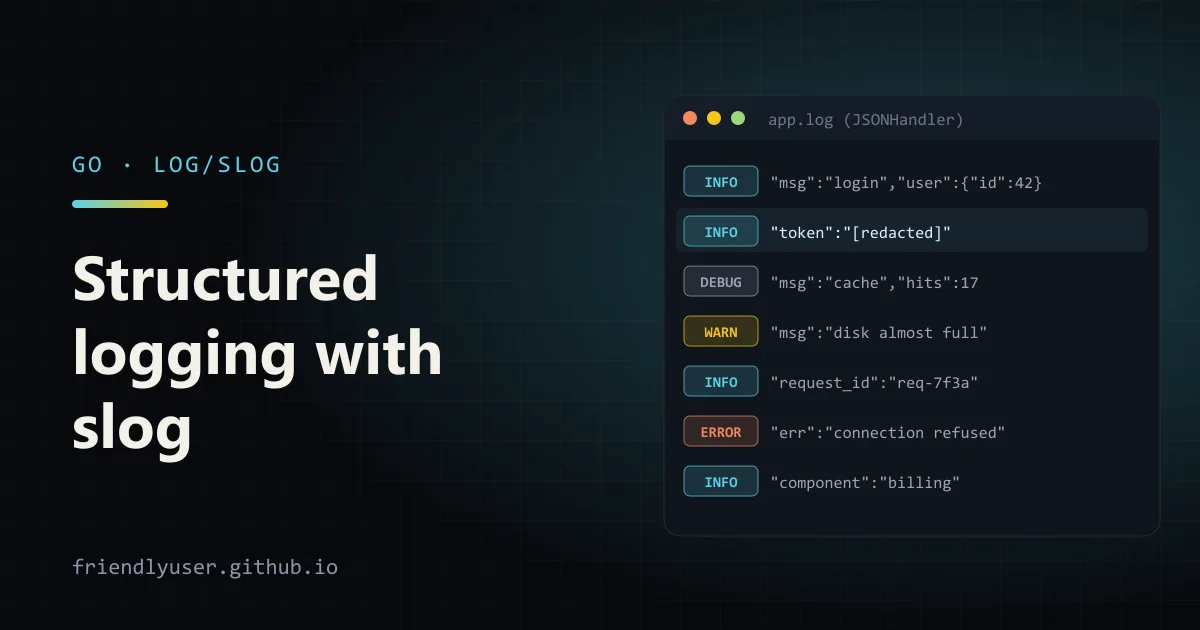
log/slog is the structured logger in Go’s standard library. Every log call produces a record with a message, a level and typed key-value attributes, and a handler decides how to write it: as key=value text for humans, or as JSON for a log pipeline. It has been in the standard library since Go 1.21, so for most services there is no longer a reason to pull in a third-party logger just to get structured output.
Examples use Go 1.26 and were run on the Go playground.
The basics
Section titled “The basics”The package-level functions log through a default logger:
slog.Info("order placed", "order_id", 1001, "items", 3, "took", 42*time.Millisecond)Until you configure anything, the default logger writes through the old log package to stderr:
2026/02/24 16:00:00 INFO order placed order_id=1001 items=3 took=42msThe arguments after the message alternate key and value. That is short, but easy to get wrong. With an odd number of arguments, the last one is logged under the key !BADKEY. go vet catches this (“call to slog.Logger.Info missing a final value”), so keep vet in CI.
The typed form avoids the problem and allocates less:
slog.LogAttrs(ctx, slog.LevelInfo, "order placed", slog.Int("order_id", 1001), slog.Duration("took", 42*time.Millisecond),)slog.String, slog.Int, slog.Bool, slog.Time, slog.Duration and slog.Any all build an slog.Attr. You can mix Attr values and key-value pairs in the ordinary calls too.
Handlers: text or JSON
Section titled “Handlers: text or JSON”To change the output, create a logger with a handler and make it the default:
logger := slog.New(slog.NewJSONHandler(os.Stdout, &slog.HandlerOptions{ Level: slog.LevelDebug, AddSource: true, // adds the source file and line of the log call}))slog.SetDefault(logger)The two built-in handlers write the same record differently:
slog.NewTextHandlerwritestime=... level=INFO msg="order placed" order_id=1001. Good for local development and for logs a person reads withgrep.slog.NewJSONHandlerwrites one JSON object per line. Use it when logs go to Loki, Elasticsearch, CloudWatch or anything else that indexes fields.
slog.SetDefault also redirects the old log package. After it, log.Printf calls from your code and from libraries go through your handler at level INFO, so you get one consistent format.
HandlerOptions.ReplaceAttr is a hook that sees every attribute before it is written. It can rename keys (msg to message for a pipeline that expects that), drop the timestamp in tests, or change how values are formatted.
Levels and LevelVar
Section titled “Levels and LevelVar”There are four built-in levels: LevelDebug (-4), LevelInfo (0), LevelWarn (4) and LevelError (8). They are integers, so a custom level such as slog.Level(12) sorts above errors. A handler drops records below its configured level, and the default is Info.
HandlerOptions.Level takes a slog.Leveler. Pass a *slog.LevelVar instead of a constant and you can change the level while the program runs:
var level = new(slog.LevelVar) // zero value is Info
logger := slog.New(slog.NewJSONHandler(os.Stdout, &slog.HandlerOptions{Level: level}))
// Later, from an admin endpoint, a signal handler or a config reload:level.Set(slog.LevelDebug)
LevelVar is safe to use from multiple goroutines, so an HTTP handler can flip it while requests are being logged.
With and groups
Section titled “With and groups”logger.With(...) returns a child logger that adds the same attributes to every record. Use it for request-scoped or component-scoped fields:
billing := logger.With("component", "billing")billing.Info("invoice created", "id", 1001)Groups nest attributes under a key. slog.Group("http", "method", "GET", "status", 200) is a single grouped attribute, and logger.WithGroup("invoice") puts every attribute added later under invoice. In JSON that becomes a nested object, and in text the keys become invoice.id=1001.
LogValuer: redaction where the type is defined
Section titled “LogValuer: redaction where the type is defined”The safest place to stop a secret from being logged is the type that holds it. A type that implements slog.LogValuer decides how it is logged, wherever it ends up:
type Token string
func (Token) LogValue() slog.Value { return slog.StringValue("[redacted]") }
type User struct {  ID       int  Email    string  Password string}
func (u User) LogValue() slog.Value {  return slog.GroupValue(    slog.Int("id", u.ID),    slog.String("email_domain", domain(u.Email)),  )}
Now slog.Info("login", "user", u, "token", tok) logs the user’s ID and email domain, and never the password or the token, even if someone adds "user", u to a log call two years from now. LogValue is also called lazily, so an expensive representation is only computed if the record is actually written.
A context-aware handler
Section titled “A context-aware handler”slog.InfoContext(ctx, ...) passes the context to the handler, but the built-in handlers ignore it. To log a request ID or a trace ID from the context, wrap the handler:
type ctxKey struct{}
type ContextHandler struct {  slog.Handler}
func (h ContextHandler) Handle(ctx context.Context, r slog.Record) error {  if id, ok := ctx.Value(ctxKey{}).(string); ok {    r.AddAttrs(slog.String("request_id", id))  }  return h.Handler.Handle(ctx, r)}
// WithAttrs and WithGroup must re-wrap, or logger.With(...) drops the wrapper.func (h ContextHandler) WithAttrs(attrs []slog.Attr) slog.Handler {  return ContextHandler{h.Handler.WithAttrs(attrs)}}
func (h ContextHandler) WithGroup(name string) slog.Handler {  return ContextHandler{h.Handler.WithGroup(name)}}
Embedding slog.Handler gives you Enabled for free. The two re-wrapping methods are the part people forget. Without them, logger.With("component", "billing") calls the embedded handler’s WithAttrs, gets back a plain JSON handler, and every log from that child logger silently loses its request ID.
In an HTTP server, a middleware puts the ID in the context (context.WithValue(r.Context(), ctxKey{}, id)), and handlers log with slog.InfoContext(r.Context(), ...).
A complete program
Section titled “A complete program”This puts the pieces together. Add ContextHandler, Token, User and domain from above to the same main.go:
package main
import (  "context"  "log/slog"  "os")
func domain(email string) string {  for i := len(email) - 1; i >= 0; i-- {    if email[i] == '@' {      return email[i+1:]    }  }  return ""}
func main() {  level := new(slog.LevelVar) // defaults to Info
  opts := &slog.HandlerOptions{    Level: level,    // Drop the timestamp so the output below is stable.    ReplaceAttr: func(groups []string, a slog.Attr) slog.Attr {      if a.Key == slog.TimeKey && len(groups) == 0 {        return slog.Attr{}      }      return a    },  }
  logger := slog.New(ContextHandler{slog.NewJSONHandler(os.Stdout, opts)})  slog.SetDefault(logger)
  ctx := context.WithValue(context.Background(), ctxKey{}, "req-7f3a")
  u := User{ID: 42, Email: "ana@example.com", Password: "hunter2"}  slog.InfoContext(ctx, "login", "user", u, "token", Token("abc123"))
  reqLog := logger.With("component", "billing").WithGroup("invoice")  reqLog.InfoContext(ctx, "created", slog.Int("id", 1001), slog.Float64("total", 59.9))
  slog.Debug("not shown: level is Info")  level.Set(slog.LevelDebug)  slog.Debug("shown after level.Set", "cache_hits", 17)
  text := slog.New(slog.NewTextHandler(os.Stdout, opts))  text.Warn("disk almost full", "mount", "/var", "used_pct", 91)}
The output:
{"level":"INFO","msg":"login","user":{"id":42,"email_domain":"example.com"},"token":"[redacted]","request_id":"req-7f3a"}{"level":"INFO","msg":"created","component":"billing","invoice":{"id":1001,"total":59.9,"request_id":"req-7f3a"}}{"level":"DEBUG","msg":"shown after level.Set","cache_hits":17}level=WARN msg="disk almost full" mount=/var used_pct=91Look at the second line: request_id landed inside the invoice group. Attributes added in Handle go into whatever group is open, because the handler can’t tell them apart from the caller’s. If your log pipeline expects request_id at the top level, either avoid WithGroup on request loggers, or add the request ID with logger.With("request_id", id) in the middleware and pass that logger down instead of reading it from the context.
Logging to two places
Section titled “Logging to two places”Go 1.26 added slog.NewMultiHandler, which sends each record to several handlers. Each handler keeps its own level, so you can write warnings to the console and everything to a file:
logger := slog.New(slog.NewMultiHandler( slog.NewTextHandler(os.Stderr, &slog.HandlerOptions{Level: slog.LevelWarn}), slog.NewJSONHandler(file, &slog.HandlerOptions{Level: slog.LevelDebug}),))On Go 1.25 and earlier you need a small fan-out handler of your own, or a third-party one.
Gotchas
Section titled “Gotchas”- Keep
go veton. It checks key-value pairs in slog calls, which is the main weakness of the untyped API. slog.Anywith a struct logs every exported field. That includes fields you add later. ImplementLogValueron anything that can hold personal data or credentials.- Errors. Log them as
"err", err. Both built-in handlers write the result ofError(), so the JSON handler gives"err":"connection refused"rather than an empty object. - Tests. Use
slog.New(slog.DiscardHandler)(Go 1.24+) to silence logs in tests. If you write your own handler, run it throughtesting/slogtest, which checks the rules a handler must follow (ignoring empty attributes, handling groups, and so on). - Don’t log in hot loops at Debug and hope the level saves you. Arguments are still evaluated before the level check. Guard expensive work with
logger.Enabled(ctx, slog.LevelDebug), or useLogValuerso the work happens only when the record is written.
Further reading
Section titled “Further reading”© 2026 David Li · Home · Blog · RSS ·Classic site · Built with Astro, Starlight and three.js · Logos:Font Awesome Free (CC BY 4.0)