Shipping a single Go binary with embed
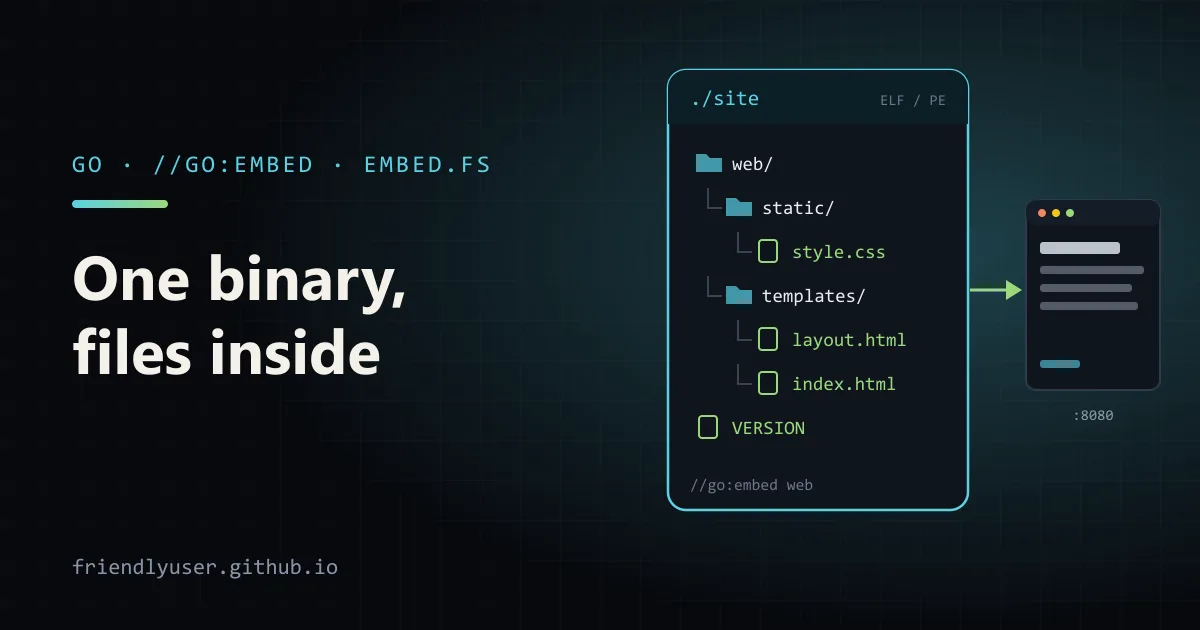
The embed package lets you compile files into a Go binary: CSS, JavaScript, HTML templates, SQL migrations, a default config. The result is one file you can copy to a server or into a FROM scratch container image, with no “forgot to deploy the templates folder” class of bug. This post builds a small web app that serves embedded static files and templates, then adds a -dev flag that reads the same files from disk so you can edit them without rebuilding.
Examples use Go 1.26. The full app was built and run on the Go playground, with requests sent through httptest.
The directive
Section titled “The directive”A //go:embed comment directly above a package-level variable tells the compiler to fill it with file contents at build time. There are three variable types you can use:
import "embed"
//go:embed VERSIONvar version string // one file, as a string
//go:embed favicon.icovar favicon []byte // one file, as bytes
//go:embed webvar embedded embed.FS // files and directories, as a read-only file system
The embed package must be imported even when you only embed into a string or []byte. In that case nothing from the package is referenced, so use a blank import: import _ "embed".
The rules worth knowing before you hit them:
- Patterns are relative to the directory of the source file, use forward slashes, and can’t contain
.or..path elements or point outside the module. To embed a top-levelweb/from a package incmd/server, move the embedding to a package in the module root, or move the files. - Patterns can be file names, directory names, or globs (
templates/*.html). Several patterns can go on one line, or on several//go:embedlines above the same variable. - Embedding a directory includes its files recursively, except names that start with
.or_. Prefix the pattern withall:(//go:embed all:web) to include them. That exclusion keeps.DS_Storeand editor swap files out, and also any.well-knowndirectory, which surprises people. - A pattern that matches nothing is a build error, which is what you want.
- The directive works only on package-level variables, not inside functions.
The app
Section titled “The app”The layout:
site/├── go.mod├── main.go├── VERSION└── web/ ├── static/ │ └── style.css └── templates/ ├── index.html └── layout.htmlVERSION contains 1.4.0. The templates define a layout and a page that fills it in. web/templates/layout.html:
{{define "layout"}}<!doctype html><html><head> <title>{{.Title}}</title> <link rel="stylesheet" href="/static/style.css"></head><body> {{block "content" .}}{{end}} <footer>v{{.Version}}</footer></body></html>{{end}}web/templates/index.html:
{{template "layout" .}}{{define "content"}} <h1>{{.Title}}</h1> <ul>{{range .Items}}<li>{{.}}</li>{{end}}</ul>{{end}}web/static/style.css can be any CSS. And main.go, after go mod init example.com/site:
package main
import (  "embed"  "flag"  "html/template"  "io/fs"  "log"  "net/http"  "os"  "strings")
//go:embed webvar embedded embed.FS
//go:embed VERSIONvar version string
type server struct {  files fs.FS              // root of the web/ directory, embedded or on disk  tmpl  *template.Template // parsed once in production, nil in dev mode}
func (s *server) templates() (*template.Template, error) {  if s.tmpl != nil {    return s.tmpl, nil  }  // Dev mode: parse on every request so template edits show up on reload.  return template.ParseFS(s.files, "templates/*.html")}
func (s *server) index(w http.ResponseWriter, r *http.Request) {  t, err := s.templates()  if err != nil {    http.Error(w, err.Error(), http.StatusInternalServerError)    return  }  data := map[string]any{    "Title":   "Inventory",    "Items":   []string{"lamp", "desk", "chair"},    "Version": strings.TrimSpace(version),  }  if err := t.ExecuteTemplate(w, "index.html", data); err != nil {    log.Println("render:", err)  }}
func newServer(dev bool) (*server, error) {  var files fs.FS  if dev {    files = os.DirFS("web")  } else {    sub, err := fs.Sub(embedded, "web")    if err != nil {      return nil, err    }    files = sub  }  s := &server{files: files}  if !dev {    t, err := template.ParseFS(files, "templates/*.html")    if err != nil {      return nil, err    }    s.tmpl = t  }  return s, nil}
func (s *server) routes() (http.Handler, error) {  static, err := fs.Sub(s.files, "static")  if err != nil {    return nil, err  }  mux := http.NewServeMux()  mux.HandleFunc("GET /{$}", s.index)  mux.Handle("GET /static/", http.StripPrefix("/static/", http.FileServerFS(static)))  return mux, nil}
func main() {  dev := flag.Bool("dev", false, "serve web/ from disk instead of the embedded copy")  addr := flag.String("addr", "localhost:8080", "listen address")  flag.Parse()
  s, err := newServer(*dev)  if err != nil {    log.Fatal(err)  }  h, err := s.routes()  if err != nil {    log.Fatal(err)  }  log.Printf("version %s, dev=%v, listening on http://%s", strings.TrimSpace(version), *dev, *addr)  log.Fatal(http.ListenAndServe(*addr, h))}
Run it with go run . and open http://localhost:8080/. The page renders the three items with v1.4.0 in the footer, and /static/style.css is served as text/css; charset=utf-8. Then build it with go build, copy the binary to an empty directory, and run it from there: everything still works, because nothing is read from disk.
How the pieces fit
Section titled “How the pieces fit”fs.Sub strips the prefix
Section titled “fs.Sub strips the prefix”//go:embed web keeps the directory name, so the embedded paths are web/static/style.css and web/templates/index.html. fs.Sub(embedded, "web") returns an fs.FS rooted at web/, so the rest of the code uses static/style.css and templates/*.html, exactly the paths that os.DirFS("web") produces. That is what makes the dev switch a one-line change: both branches give the server the same kind of value with the same paths.
The same trick is applied again for static files: fs.Sub(s.files, "static") so that the URL /static/style.css, after http.StripPrefix, maps to style.css in the sub-filesystem.
http.FileServerFS
Section titled “http.FileServerFS”http.FileServerFS (Go 1.22) takes an fs.FS directly. On older code you will see http.FileServer(http.FS(fsys)), which does the same thing with an adapter. The file server sets Content-Type from the file extension, handles Range requests, and serves index.html for directory paths.
Templates from an FS
Section titled “Templates from an FS”template.ParseFS(fsys, "templates/*.html") parses every match and names each template after its file’s base name, which is why the handler calls ExecuteTemplate(w, "index.html", data). index.html invokes the layout template, which is defined in layout.html, and fills in the content block. html/template escapes {{.}} for its context, so an item named <script> comes out as text.
In production the templates are parsed once at startup, and a broken template stops the program before it serves traffic. In dev mode they are parsed on every request. That’s slow but makes an edit visible on the next reload, which is the point of dev mode.
Dev mode
Section titled “Dev mode”go run . -devWith -dev, os.DirFS("web") reads from the working directory, so edit style.css or a template, reload the browser, and see the change without restarting. Run it from the directory that contains web/. A Go code change still needs a restart; pair dev mode with a file-watching tool if you want that too.
An alternative is a build tag: a dev.go with //go:build dev that sets the FS to os.DirFS, and a prod.go with //go:build !dev that uses the embedded one. That keeps the dev code out of the production binary completely. The flag is simpler, and reading from disk only happens if someone passes -dev.
Gotchas
Section titled “Gotchas”- No modification times. Files in an
embed.FShave a zeroModTime, sohttp.FileServerFSsends noLast-Modifiedheader and can’t answer conditional requests with304 Not Modified. Every page load downloads the CSS again. For real caching, put the version in the URL (/static/style.css?v=1.4.0, or a hashed file name from your asset build) and set a longCache-Controlin a small wrapper around the file server. - Directory listings. A request for
/static/returns an HTML list of the files in that directory. If you don’t want that, wrap the handler and return 404 for paths that end in/, or put anindex.htmlin each directory. - Hidden files are skipped. With
//go:embed web,web/static/.hiddenis not embedded and the server returns 404 for it. Useall:webif you need dotfiles, and remember that this also pulls in anything else hidden in that tree. VERSIONhas a trailing newline if your editor adds one.strings.TrimSpacehandles it. For build metadata, consider-ldflags "-X main.version=..."orruntime/debug.ReadBuildInfo, which includes the VCS revision without any file.- Binary size. Embedded files are stored uncompressed in the binary. A few hundred kilobytes of CSS and templates doesn’t matter; a gigabyte of video does. Pre-compress large assets or keep them on a CDN.
- embed.FS is read-only and safe for concurrent use. It implements
fs.ReadFileFSandfs.ReadDirFS, sofs.ReadFileandfs.WalkDirwork on it, which is handy for embedded SQL migrations.
Further reading
Section titled “Further reading”embedpackage documentation, including the full pattern rulesio/fs:fs.Sub,fs.WalkDirand the interfaceshttp.FileServerFStemplate.ParseFS
© 2026 David Li · Home · Blog · RSS ·Classic site · Built with Astro, Starlight and three.js · Logos:Font Awesome Free (CC BY 4.0)