Iterators in Go: range over functions and the iter package
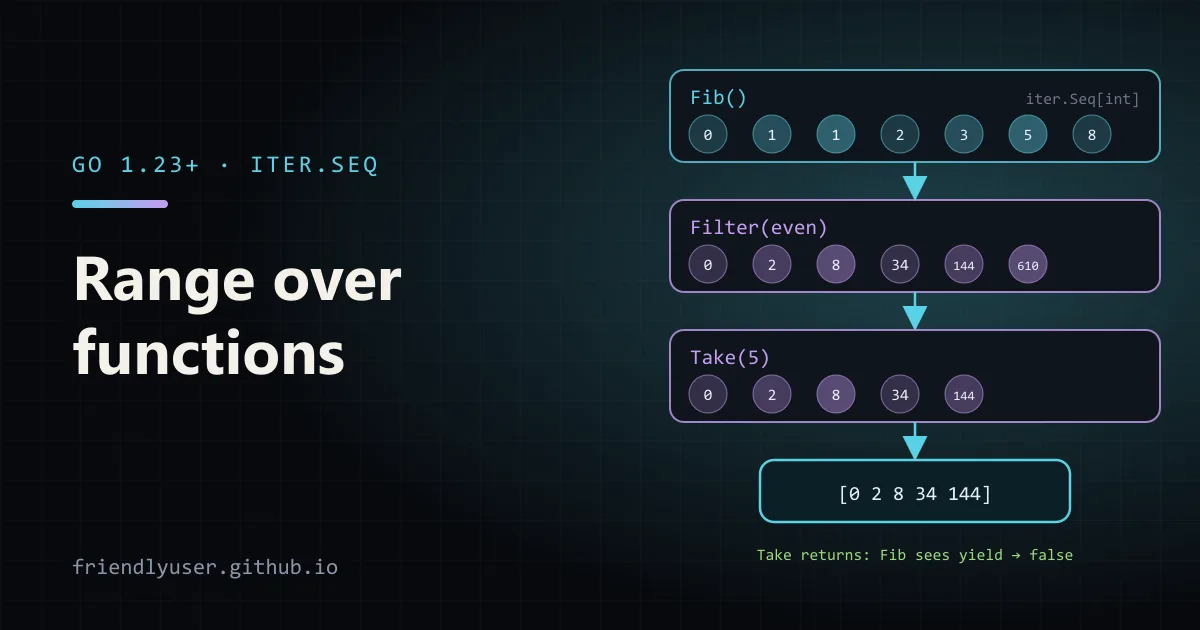
Since Go 1.23, a for ... range loop can range over a function. That gives Go a standard iterator shape: a function that calls yield once per value. The iter package names the types, and slices, maps and strings return and accept them. Use iterators when the caller should be able to loop over something without you building a slice first: an infinite or lazy sequence, a tree, rows from a file, or the keys of a container type that shouldn’t expose its internals.
Examples use Go 1.26 and were run on the Go playground.
The two types
Section titled “The two types”package iter
type Seq[V any] func(yield func(V) bool)type Seq2[K, V any] func(yield func(K, V) bool)A Seq yields one value per step and a Seq2 yields two, usually an index or key with a value, or a value with an error. You don’t call these functions yourself; you range over them:
for v := range seq { ... } // iter.Seq[V]for k, v := range seq2 { ... } // iter.Seq2[K, V]The compiler turns the loop body into the yield function. Each call to yield runs the body once. yield returns true to ask for more, and false when the loop has ended early because of break, return or a goto out of the loop.
Writing a generator
Section titled “Writing a generator”The simplest iterator never ends on its own:
// Fib yields Fibonacci numbers forever. The caller decides when to stop.func Fib() iter.Seq[int] { return func(yield func(int) bool) { a, b := 0, 1 for { if !yield(a) { return } a, b = b, a+b } }}The if !yield(a) { return } check is the whole contract. When the caller breaks, yield returns false and the iterator must stop. If it ignores that and calls yield again, the program panics:
panic: runtime error: range function continued iteration after function for loop body returned falseSo every yield call in an iterator needs its result checked. In a recursive iterator, the false has to travel all the way up. A binary search tree shows the pattern:
type Tree[K cmp.Ordered] struct {  Left, Right *Tree[K]  Key         K}
func (t *Tree[K]) Insert(k K) *Tree[K] {  if t == nil {    return &Tree[K]{Key: k}  }  if k < t.Key {    t.Left = t.Left.Insert(k)  } else {    t.Right = t.Right.Insert(k)  }  return t}
// All yields keys in order. push returns false once the consumer stops,// and that false is passed all the way up the recursion.func (t *Tree[K]) All() iter.Seq[K] {  return func(yield func(K) bool) {    t.push(yield)  }}
func (t *Tree[K]) push(yield func(K) bool) bool {  if t == nil {    return true  }  return t.Left.push(yield) && yield(t.Key) && t.Right.push(yield)}
The && chain short-circuits: once any yield returns false, nothing to its right runs, and each level of the recursion returns false to its parent. This is the case where iterators beat the alternatives most clearly. Before Go 1.23 you would build a slice of every key, use a callback with its own stop protocol, or use a goroutine and a channel, which leaks if the consumer stops reading.
Cleanup with defer
Section titled “Cleanup with defer”Because the iterator is an ordinary function call, defer inside it runs when the loop ends, including on early break. That makes resource-owning iterators safe:
// FileLines yields each line of a file. The file is closed when the loop ends,// including when the caller breaks out early.func FileLines(path string) iter.Seq2[string, error] {  return func(yield func(string, error) bool) {    f, err := os.Open(path)    if err != nil {      yield("", err)      return    }    defer f.Close()
    sc := bufio.NewScanner(f)    for sc.Scan() {      if !yield(sc.Text(), nil) {        return      }    }    if err := sc.Err(); err != nil {      yield("", err)    }  }}
Seq2[string, error] is the common way to report errors from an iterator. The caller checks err on each step:
for line, err := range FileLines("app.log") { if err != nil { return err } if strings.HasPrefix(line, "ERROR") { fmt.Println(line) break // f.Close still runs }}Adapters: Filter and Take
Section titled “Adapters: Filter and Take”The standard library doesn’t include Filter or Map for iterators, but they are short to write, and they compose without building intermediate slices:
func Filter[V any](seq iter.Seq[V], keep func(V) bool) iter.Seq[V] {  return func(yield func(V) bool) {    for v := range seq {      if keep(v) && !yield(v) {        return      }    }  }}
func Take[V any](seq iter.Seq[V], n int) iter.Seq[V] {  return func(yield func(V) bool) {    if n <= 0 {      return    }    i := 0    for v := range seq {      if !yield(v) {        return      }      i++      if i == n {        return      }    }  }}
Take(Filter(Fib(), isEven), 5) produces five values and stops Fib, even though Fib would run forever. Returning from the range loop inside Take makes Fib’s yield return false.
What the standard library gives you
Section titled “What the standard library gives you”Go 1.23 added iterator functions to slices and maps, and 1.24 added more to strings and bytes:
| Function | Returns / does |
|---|---|
slices.All(s) | Seq2[int, E] of index and value |
slices.Values(s) | Seq[E] of values |
slices.Backward(s) | Seq2[int, E] from the end |
slices.Collect(seq) | a new slice from any Seq |
slices.Sorted(seq) | a new sorted slice from any Seq of ordered values |
slices.Chunk(s, n) | Seq of sub-slices of up to n elements |
maps.Keys(m), maps.Values(m), maps.All(m) | iterators over a map (in unspecified order) |
maps.Collect(seq2) | a new map from a Seq2 |
strings.Lines(s) | Seq[string] of lines, each keeping its \n (Go 1.24) |
strings.SplitSeq, strings.FieldsSeq | lazy versions of Split and Fields (Go 1.24) |
maps.Keys is the one that catches people porting old code. It returns an iterator, not a slice. slices.Sorted(maps.Keys(m)) is the idiomatic way to get sorted keys now.
Pull iterators: iter.Pull
Section titled “Pull iterators: iter.Pull”A range loop is push-style: the iterator drives, and your loop body is called. Sometimes you need to step through two sequences at your own pace, for example to merge two sorted streams. iter.Pull converts a push iterator into a next function:
// Merge combines two sorted sequences into one sorted sequence, using iter.Pull// to step through both at its own pace.func Merge[V cmp.Ordered](a, b iter.Seq[V]) iter.Seq[V] {  return func(yield func(V) bool) {    nextA, stopA := iter.Pull(a)    defer stopA()    nextB, stopB := iter.Pull(b)    defer stopB()
    va, okA := nextA()    vb, okB := nextB()    for okA || okB {      if okA && (!okB || va <= vb) {        if !yield(va) {          return        }        va, okA = nextA()      } else {        if !yield(vb) {          return        }        vb, okB = nextB()      }    }  }}
next returns the next value and true, or the zero value and false once the sequence is done. Always call stop (a defer is easiest): it tells the underlying iterator to finish, which runs its deferred cleanup. iter.Pull costs more than a range loop, because the runtime runs the iterator as a separate coroutine and switches to it on each next. Use it when you need two sequences in lockstep, not as the default.
Putting it together
Section titled “Putting it together”With Fib, Tree, Filter, Take and Merge from above in the same main.go:
package main
import (  "cmp"  "fmt"  "iter"  "maps"  "slices"  "strings")
func main() {  for i, f := range slices.All(slices.Collect(Take(Fib(), 8))) {    fmt.Print(i, ":", f, " ")  }  fmt.Println()
  evenFibs := Take(Filter(Fib(), func(n int) bool { return n%2 == 0 }), 5)  fmt.Println("even:", slices.Collect(evenFibs))
  var root *Tree[string]  for _, w := range strings.Fields("pear fig apple kiwi banana cherry") {    root = root.Insert(w)  }  for w := range root.All() {    if w > "c" {      break // push sees yield return false and unwinds    }    fmt.Print(w, " ")  }  fmt.Println()
  odds := slices.Values([]int{1, 5, 9, 13})  evens := slices.Values([]int{2, 4, 6, 20})  fmt.Println("merged:", slices.Collect(Merge(odds, evens)))
  stock := map[string]int{"fig": 3, "apple": 12, "kiwi": 0}  fmt.Println("keys:", slices.Sorted(maps.Keys(stock)))
  for line := range strings.Lines("first\nsecond\n") {    fmt.Printf("%q ", line)  }  fmt.Println()}
Output:
0:0 1:1 2:1 3:2 4:3 5:5 6:8 7:13even: [0 2 8 34 144]apple bananamerged: [1 2 4 5 6 9 13 20]keys: [apple fig kiwi]"first\n" "second\n"Gotchas
Section titled “Gotchas”- Check every
yield. Ignoring afalsepanics at run time, and only on the path where a caller breaks early, so it can survive tests that always loop to the end. Add a test that breaks after the first value. - Single-use or reusable?
Fib()returns a fresh sequence each time you call it. An iterator that reads from a file or a network stream can usually be ranged over only once. Say which in the doc comment. - Don’t return an iterator when a slice is what callers want. If every caller does
slices.Collect(x.All()), return the slice. Iterators pay off for lazy, large, infinite or resource-backed sequences, and for hiding a container’s internals. - Map order is still random.
maps.Keysandmaps.Alliterate in unspecified order, like ranging over the map directly. Sort if the order matters. - Mutating while iterating. Ranging over
slices.All(s)while appending tosbehaves like the equivalentfor i := range sloop. For your own containers, decide and document what happens if the container changes mid-iteration. - Go version. Range-over-func needs
go 1.23or later ingo.mod. With an oldergoline, the compiler rejects the loop even on a newer toolchain.
Further reading
Section titled “Further reading”iterpackage documentation, which defines the iterator conventions- Range Over Function Types (Go blog)
- For statements with range clause in the language spec
slicesandmapspackage docs
© 2026 David Li · Home · Blog · RSS ·Classic site · Built with Astro, Starlight and three.js · Logos:Font Awesome Free (CC BY 4.0)