Records and pattern matching in modern C#
Records are C# types built for data: you declare the fields, and the compiler writes the constructor, value-based equality, ToString, deconstruction and non-destructive copying. Pattern matching is the other half. A switch expression can test the shape of a record (its properties, the length of a list, whether a number is in a range) and pick a result without a ladder of if statements. Together they make domain rules short and easy to check.
This post walks through both with one runnable example: an order with an address and line items, and a shipping-price function written as a single switch. The code uses C# 13 on .NET 9; everything shown has been in the language since C# 11 and works the same in C# 14.
The types
Section titled “The types”Put these at the bottom of Program.cs in a new console app (dotnet new console -n Records):
public record Address(string Street, string City, string Country);
public record Line(string Sku, int Quantity, decimal UnitPrice){    public decimal Amount => Quantity * UnitPrice;}
public record Order(int Id, string Email, Address Address, List<Line> Lines){    public decimal Total => Lines.Sum(l => l.Amount);}
public readonly record struct Point(int X, int Y);
record Address(string Street, string City, string Country) is a positional record. From that one line the compiler generates:
- a constructor taking the three values;
- a public
init-only property for each parameter, so the object is immutable after construction; Equals,GetHashCode,==and!=based on the values of all fields;- a
ToStringthat printsAddress { Street = ..., City = ..., Country = ... }; - a
Deconstructmethod, sovar (street, city, _) = address;works; - a hidden copy constructor that
withexpressions use.
You can add members in a body, like the computed Amount and Total above. A computed property with no backing field doesn’t take part in equality; only fields do.
record class vs record struct
Section titled “record class vs record struct”record on its own means record class: a reference type, allocated on the heap, with value-based equality bolted on. C# 10 added record struct, a value type with the same generated members. They differ in more than allocation:
record / record class | record struct | readonly record struct | |
|---|---|---|---|
| Kind | reference type | value type | value type |
| Positional properties | get; init; | get; set; (mutable) | get; init; |
| Inheritance | can inherit from another record | no | no |
null | can be null | can’t (unless Point?) | can’t |
The middle column catches people: a positional record struct has settable properties. var mp = new MutablePoint(1, 2); mp.X = 9; compiles and prints MutablePoint { X = 9, Y = 2 }. If you want an immutable value type, write readonly record struct, as Point does above.
I use record class for domain objects and DTOs, and readonly record struct for small values such as coordinates, money amounts or IDs. Those are usually under 16 bytes or so, are created in large numbers, and gain from not being allocated individually.
with-expressions and value equality
Section titled “with-expressions and value equality”Add this at the top of Program.cs:
var a = new Address("12 Main St", "Halifax", "CA");var order = new Order(1001, "alice@example.com", a, [new Line("BOOK", 2, 15.00m), new Line("PEN", 10, 1.25m)]);
var copy = order with { Id = 1002 };Console.WriteLine(copy.Address == order.Address);                  // True: same Address valueConsole.WriteLine(ReferenceEquals(copy.Lines, order.Lines));       // True: with is a shallow copy
var same = new Order(1001, "alice@example.com", new Address("12 Main St", "Halifax", "CA"), order.Lines);Console.WriteLine(order == same);                                  // True: equal fieldsvar sameLinesNewList = order with { Lines = [.. order.Lines] };Console.WriteLine(order == sameLinesNewList);                      // False: List compared by reference
Console.WriteLine(a);                                              // generated ToStringvar (street, city, _) = a;                                         // positional deconstructionConsole.WriteLine($"{street} / {city}");
var p1 = new Point(1, 2);var p2 = p1 with { Y = 5 };Console.WriteLine($"{p1} {p2} {p1 == new Point(1, 2)}");
Output:
TrueTrueTrueFalseAddress { Street = 12 Main St, City = Halifax, Country = CA }12 Main St / HalifaxPoint { X = 1, Y = 2 } Point { X = 1, Y = 5 } TrueTwo lines deserve a closer look.
with is a shallow copy. order with { Id = 1002 } copies every field and then sets Id. The new order shares the same List<Line> instance as the old one. Add a line to one and the other sees it. If a record holds a mutable collection, either replace the collection in the with (with { Lines = [.. order.Lines, newLine] }) or use an immutable collection type.
Equality doesn’t look inside collections. Generated equality compares each field with EqualityComparer<T>.Default. For Address that’s another record, so it compares values. For List<Line>, it’s reference equality. Two orders with identical lines in different lists are not equal, which is the False above. If you need deep equality, override Equals(Order? other) and GetHashCode, or store the lines in a type with value semantics.
Equality and inheritance
Section titled “Equality and inheritance”Records can inherit from records, and equality takes the runtime type into account. new Animal("Rex") == new Dog("Rex") is false when Dog derives from Animal, even though every field matches. The compiler generates an EqualityContract property that returns the record’s runtime type and compares it first. That’s usually what you want; just don’t expect a base-typed list to deduplicate derived records with the same data.
Pattern matching in switch expressions
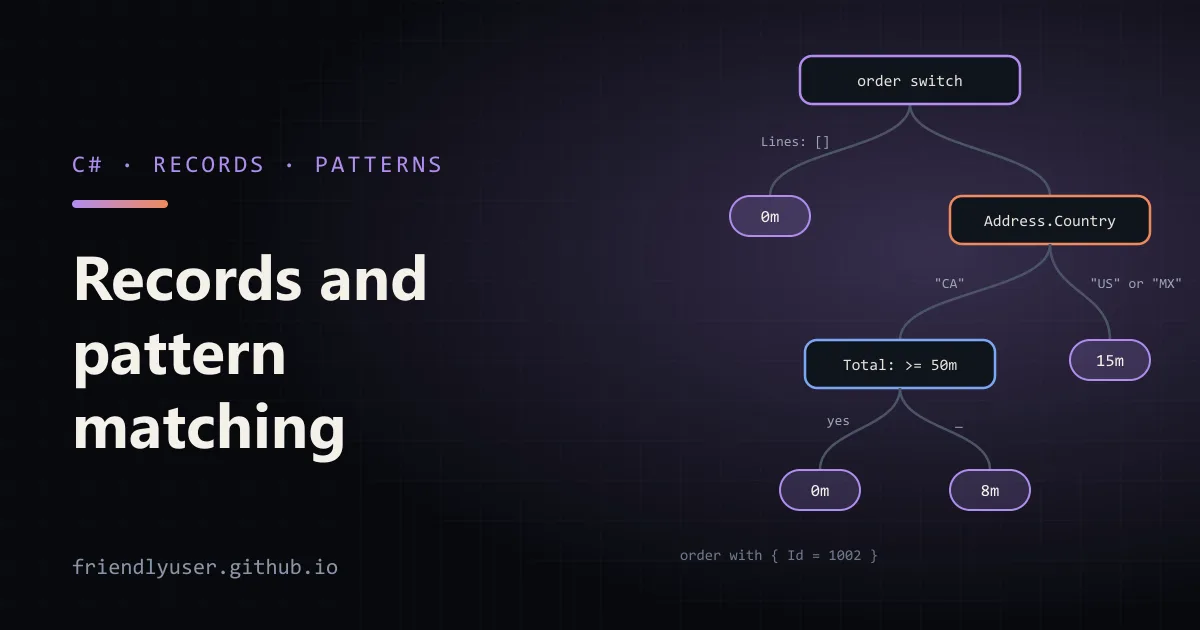
Section titled “Pattern matching in switch expressions”Now the shipping rules. Free shipping for empty orders and gift cards, free in Canada over $50, flat rates otherwise:
static decimal Shipping(Order order) => order switch{ { Lines: [] } => 0m, { Lines: [{ Sku: "GIFTCARD" }] } => 0m, // list pattern + property pattern { Address.Country: "CA", Total: >= 50m } => 0m, // extended property + relational { Address.Country: "CA" } => 8m, { Address.Country: "US" or "MX" } => 15m, { Total: > 500m } => 25m, _ => 40m,};Each arm is a pattern, and arms are checked top to bottom. The patterns used:
- Property patterns (
{ Lines: ..., Total: ... }) test properties of the object. All listed properties must match. - Extended property patterns (
Address.Country: "CA", C# 10) reach into nested properties without writing{ Address: { Country: "CA" } }. - Relational patterns (
>= 50m,> 500m, C# 9) compare against a constant. - Logical patterns (
"US" or "MX", plusandandnot, C# 9) combine patterns. - List patterns (
[],[{ Sku: "GIFTCARD" }], C# 11) match a list’s length and elements.[]is “empty”;[x]is “exactly one element, matching x”. - The discard
_matches anything.
Order matters. The "CA" rule with Total: >= 50m must come before the general "CA" rule, or it would never be reached. The compiler helps here: an arm that can never match because earlier arms cover it is error CS8510. A switch that doesn’t cover every input gets warning CS8509. At runtime an unmatched value throws SwitchExpressionException.
List patterns with slices
Section titled “List patterns with slices”List patterns get more useful with the slice pattern .., which matches any number of elements and can capture them:
static string Describe(List<Line> lines) => lines switch{ [] => "empty", [var only] => $"just {only.Sku}", [var first, .., var last] when first.Sku == last.Sku => "starts and ends with the same item", [var first, .. var rest] => $"{first.Sku} and {rest.Count} more",};.. var rest captures the remaining elements as a new List<Line>. To build it, the compiler calls the type’s range indexer or its Slice(start, length) method; List<T> has had Slice since .NET 8. The when clause adds a condition that patterns can’t express, such as comparing two captured values.
List patterns work on anything with a Length or Count and an indexer: arrays, List<T>, Span<T>, string. The slice pattern needs a range indexer or Slice method too.
Type and relational patterns together
Section titled “Type and relational patterns together”Patterns aren’t just for records. This classifies arbitrary values:
static string Classify(object? value) => value switch{ null => "nothing", 0 => "zero", int n and < 0 => $"negative int {n}", int and (>= 1 and <= 9) => "single digit", int n => $"int {n}", string { Length: > 0 } s => $"text '{s}'", not (int or string) => $"other {value.GetType().Name}", _ => "empty string",};Then run both functions:
foreach (var o in new[]{    order,    order with { Address = a with { Country = "US" } },    order with { Lines = [] },    order with { Lines = [new Line("GIFTCARD", 1, 50m)] },    order with { Address = a with { Country = "JP" }, Lines = [new Line("BOOK", 40, 15m)] },}){    Console.WriteLine($"{o.Id}: {Shipping(o),6:F2} | {Describe(o.Lines)}");}
foreach (var c in new object[] { 0, 7, -3, 250, "hi", 3.5, null! })    Console.WriteLine($"{c ?? "null",-5} -> {Classify(c)}");
1001: 8.00 | BOOK and 1 more1001: 15.00 | BOOK and 1 more1001: 0.00 | empty1001: 0.00 | just GIFTCARD1001: 25.00 | just BOOK0 -> zero7 -> single digit-3 -> negative int -3250 -> int 250hi -> text 'hi'3.5 -> other Doublenull -> nothingThe first order totals $42.50, so it misses the free-shipping threshold and pays the Canadian flat rate. The last one goes to Japan with a $600 total and hits the > 500m rule.
Notice the nested with in order with { Address = a with { Country = "US" } }. Since C# 10, with also works on structs and anonymous types.
Gotchas
Section titled “Gotchas”- Records are not automatically immutable. Positional properties are
init-only, but a record can hold aList<T>, an array, or a property you declared withset. Equality and hash codes computed from mutable state break dictionaries and sets when the state changes. - Don’t use records as EF Core entities if you rely on change tracking. EF Core tracks entities by reference identity, while records redefine equality by value, and
withcreates new instances that EF doesn’t know about. Records work well for DTOs and read models. ToStringprints everything, including fields you’d rather not log, like emails and tokens. OverridePrintMembersorToStringon records that hold sensitive data.- Pattern order is semantics. Reordering arms in a
switchchanges behaviour. A test per rule is cheap insurance. - Patterns only compare against constants.
{ Total: > limit }with a variablelimitdoesn’t compile; use awhenclause.
Further reading
Section titled “Further reading”© 2026 David Li · Home · Blog · RSS ·Classic site · Built with Astro, Starlight and three.js · Logos:Font Awesome Free (CC BY 4.0)