Free-threaded Python 3.14: running threads without the GIL
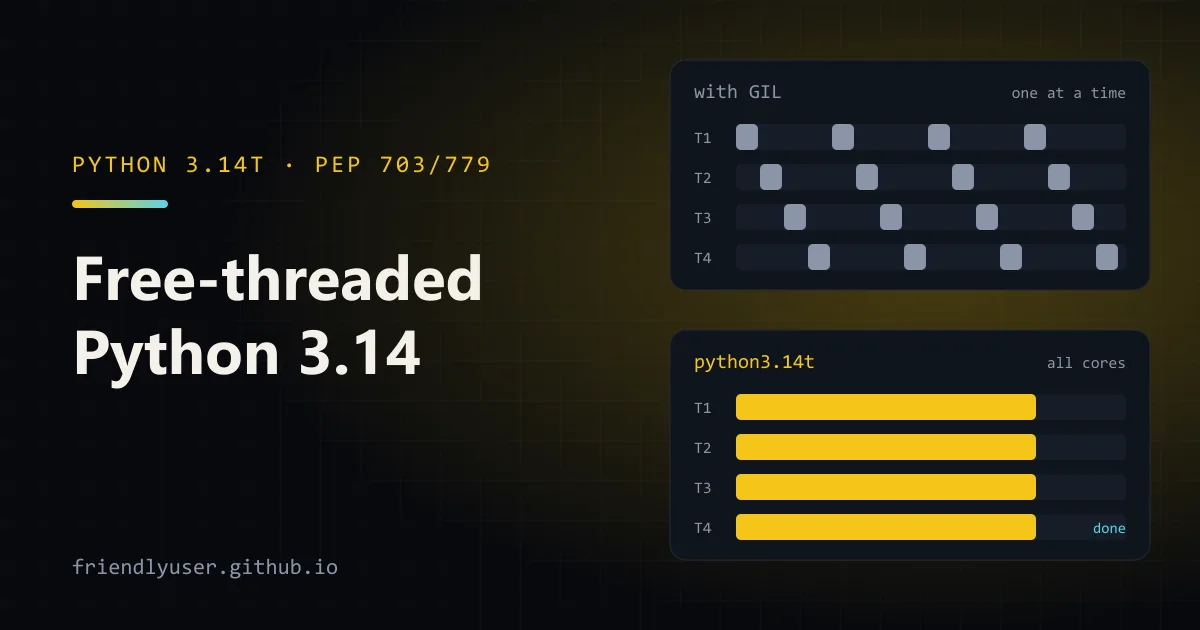
CPython’s global interpreter lock (GIL) lets only one thread run Python bytecode at a time, so threads have never helped CPU-bound pure-Python code. The free-threaded build removes the GIL, which means a ThreadPoolExecutor can now keep several cores busy without moving to multiprocessing and paying for pickling and separate processes.
This post covers where free-threading stands in Python 3.14, how to install it, how to check that the GIL is really off, a benchmark you can run yourself, and what to watch for with C extensions. Examples were run with CPython 3.14 (both the default and the 3.14t build) installed through uv.
Where it stands: PEP 703 and PEP 779
Section titled “Where it stands: PEP 703 and PEP 779”PEP 703 proposed making the GIL optional. It was accepted with a phased plan:
- Experimental (Python 3.13): a separate free-threaded build, opt-in, with known performance gaps.
- Supported (Python 3.14): still a separate build and still opt-in, but officially supported rather than experimental.
- Default: some future release, if the ecosystem and performance justify it. No version has been picked.
PEP 779 set the criteria for moving from phase 1 to phase 2 (performance, memory use, and stability targets) and was accepted for 3.14. So in 3.14 the free-threaded build is a supported configuration you can deploy, but python on most systems is still the normal build with the GIL. You have to choose the free-threaded interpreter explicitly. It installs as python3.14t (the t suffix) next to the regular one.
The other notable 3.14 change is that the specializing adaptive interpreter (the part of CPython that rewrites hot bytecode into faster specialized forms) now works in the free-threaded build. In 3.13 it was disabled there, which is the main reason 3.13t was much slower on single-threaded code.
Installing a free-threaded build
Section titled “Installing a free-threaded build”With uv:
uv python install 3.14tuv run --python 3.14t python -c "import sys; print(sys.version)"The version string says so explicitly, for example 3.14.x free-threading build (main, ...).
Other options:
- python.org installers for Windows and macOS can install the free-threaded binaries alongside the normal ones (it’s an optional component, off by default).
- pyenv uses the same suffix:
pyenv install 3.14t. - From source, configure with
./configure --disable-gil.
Create a virtual environment from that interpreter like any other: uv venv --python 3.14t or python3.14t -m venv .venv. Packages you install there need wheels built for the free-threaded ABI, which carry a cp314t tag.
Checking whether the GIL is actually off
Section titled “Checking whether the GIL is actually off”There are two separate questions: was this interpreter built without the GIL, and is the GIL disabled right now? The second can change at runtime.
import sysimport sysconfig
print("free-threaded build:", bool(sysconfig.get_config_var("Py_GIL_DISABLED")))print("GIL enabled right now:", sys._is_gil_enabled())
On the free-threaded build this prints True and False. On the regular build it prints False and True.
sys._is_gil_enabled() has the underscore because it’s a CPython-specific helper, but it’s documented and is the way to check. You can also force the GIL back on in a free-threaded interpreter with PYTHON_GIL=1 or python -X gil=1, which is handy for comparing the same build with and without it.
A CPU-bound benchmark you can time yourself
Section titled “A CPU-bound benchmark you can time yourself”This counts primes with trial division, split across a thread pool. It’s pure Python with no I/O, which is exactly the case the GIL used to serialize.
import sysimport sysconfigimport timefrom concurrent.futures import ThreadPoolExecutor

def count_primes(start: int, stop: int) -> int:    """Deliberately naive, pure-Python, CPU-bound work."""    found = 0    for n in range(max(start, 2), stop):        for d in range(2, int(n**0.5) + 1):            if n % d == 0:                break        else:            found += 1    return found

def run(workers: int, limit: int = 2_000_000) -> float:    step = limit // workers    chunks = [(i * step, (i + 1) * step) for i in range(workers)]    t0 = time.perf_counter()    with ThreadPoolExecutor(max_workers=workers) as pool:        total = sum(pool.map(lambda c: count_primes(*c), chunks))    elapsed = time.perf_counter() - t0    print(f"{workers} thread(s): {total} primes in {elapsed:.2f}s")    return elapsed

if __name__ == "__main__":    print(sys.version)    print("free-threaded build:", bool(sysconfig.get_config_var("Py_GIL_DISABLED")))    print("GIL enabled right now:", sys._is_gil_enabled())    base = run(1)    for n in (2, 4, 8):        print(f"  speedup vs 1 thread: {base / run(n):.2f}x")
Run it on both builds:
uv run --no-project --python 3.14 bench.pyuv run --no-project --python 3.14t bench.pyOn the regular build every run takes about the same time no matter how many threads you add, because only one thread executes bytecode at a time. On the free-threaded build the wall-clock time drops as you add threads, up to the number of physical cores.
When I ran it on a 16-thread Windows desktop that was also busy with other work, the regular build took about 5 seconds whether it used 1 thread or 8. The free-threaded build finished the 8-thread run in about 1.3 seconds. Single-thread timings on that machine swung by more than 30% between runs, so I won’t quote a single-thread overhead or a precise speedup from it. Run the script yourself, more than once, on a quiet machine.
Two things affect what you’ll see:
- The chunks aren’t equal work. Bigger numbers take longer to test, so the last chunk is the slowest and sets the total time. Real workloads often have the same problem; a pool with many small tasks balances better than one task per thread.
- Hyperthreads aren’t cores. Going past the physical core count usually adds little.
Single-thread overhead
Section titled “Single-thread overhead”Removing the GIL isn’t free. Reference counting uses a biased scheme with atomic operations for objects shared between threads, built-in containers carry per-object locks, and the build uses the mimalloc allocator. The Python 3.14 “What’s New” puts the single-threaded penalty at roughly 5 to 10% on the pyperformance suite, depending on platform and compiler, down from much larger numbers in 3.13. Memory use is also somewhat higher.
That means the free-threaded build is a win when your program can actually use several threads for Python-level work. A single-threaded script, or a web app that already scales with processes, gains nothing and pays the overhead.
Your code still needs locks
Section titled “Your code still needs locks”The GIL never made your code thread-safe; it only made some races rare. Without it, they show up quickly. A shared counter is the classic case:
import threading
counter = 0lock = threading.Lock()

def unsafe(n):    global counter    for _ in range(n):        counter += 1  # read, add, write: three steps, not one

def safe(n):    global counter    for _ in range(n):        with lock:            counter += 1

for fn in (unsafe, safe):    counter = 0    threads = [threading.Thread(target=fn, args=(200_000,)) for _ in range(8)]    for t in threads:        t.start()    for t in threads:        t.join()    print(f"{fn.__name__}: {counter} (expected {8 * 200_000})")
On the 3.14t build, one run printed:
unsafe: 331786 (expected 1600000)safe: 1600000 (expected 1600000)On the regular 3.14 build the unsafe version happened to print the right total in that run, which is exactly why these bugs survive for years. The GIL makes lost updates unlikely; it doesn’t rule them out.
What the free-threaded build does guarantee is that the interpreter itself won’t crash or corrupt objects: list.append, dict assignment and similar single operations on built-in types are internally locked. Compound operations (“check then set”, “read then increment”, iterating while another thread mutates) need your own threading.Lock, a queue.Queue, or a design where threads don’t share mutable state at all.
C extensions and the GIL coming back
Section titled “C extensions and the GIL coming back”Pure-Python packages work unchanged. Packages with compiled code need two things:
- A wheel for the free-threaded ABI (
cp314t). The regularcp314wheels won’t install, and the stable ABI (abi3) wheels aren’t supported on free-threaded builds in 3.14. If nocp314twheel exists, pip or uv will try to build from source. - A declaration that the module is safe without the GIL. Extensions using multi-phase init set the
Py_mod_gilslot toPy_MOD_GIL_NOT_USED; single-phase modules callPyUnstable_Module_SetGIL(). Cython and pybind11 have options for this.
If you import an extension that hasn’t made that declaration, the interpreter re-enables the GIL for the whole process and emits a RuntimeWarning naming the module. Your program keeps working, just without parallelism, so check sys._is_gil_enabled() after your imports, not only at startup:
import sys
import numpy  # and whatever else your program imports
if sys._is_gil_enabled():    raise SystemExit("an imported extension turned the GIL back on")
You can keep the GIL off anyway with PYTHON_GIL=0 or -X gil=0, but that’s a bet that the extension’s C code is thread-safe without having been designed for it. I wouldn’t do that in production.
Many of the big compiled packages ship cp314t wheels (NumPy does, for example: uv run --python 3.14t --with numpy installed one and the GIL stayed off). For the rest, the community tracker at py-free-threading.github.io lists compatibility status and porting advice.
When to use it, and when not
Section titled “When to use it, and when not”Reach for 3.14t when:
- You have CPU-bound Python work that splits into independent pieces, and
multiprocessinghurts because the data is large, expensive to pickle, or shared. - You already use threads (for I/O, or a C library that releases the GIL) and want the Python-level parts to run in parallel too.
Stay on the regular build when:
- Your code is single-threaded or I/O-bound with
asyncio. You’d pay the overhead for nothing. - A dependency has no free-threaded wheel, or re-enables the GIL on import.
- You need
abi3wheels or a deployment platform that only offers the default build.
Python 3.14 also added concurrent.futures.InterpreterPoolExecutor (multiple interpreters in one process, each with its own GIL). It’s another way to get parallelism without processes, with stronger isolation and no shared objects. If your threads don’t need to share Python objects, it’s worth comparing.
Further reading
Section titled “Further reading”- Python support for free threading (the official HOWTO)
- C API extension support for free threading
- PEP 703 and PEP 779
- What’s New in Python 3.14
© 2026 David Li · Home · Blog · RSS ·Classic site · Built with Astro, Starlight and three.js · Logos:Font Awesome Free (CC BY 4.0)