Change data capture in Postgres with logical replication slots
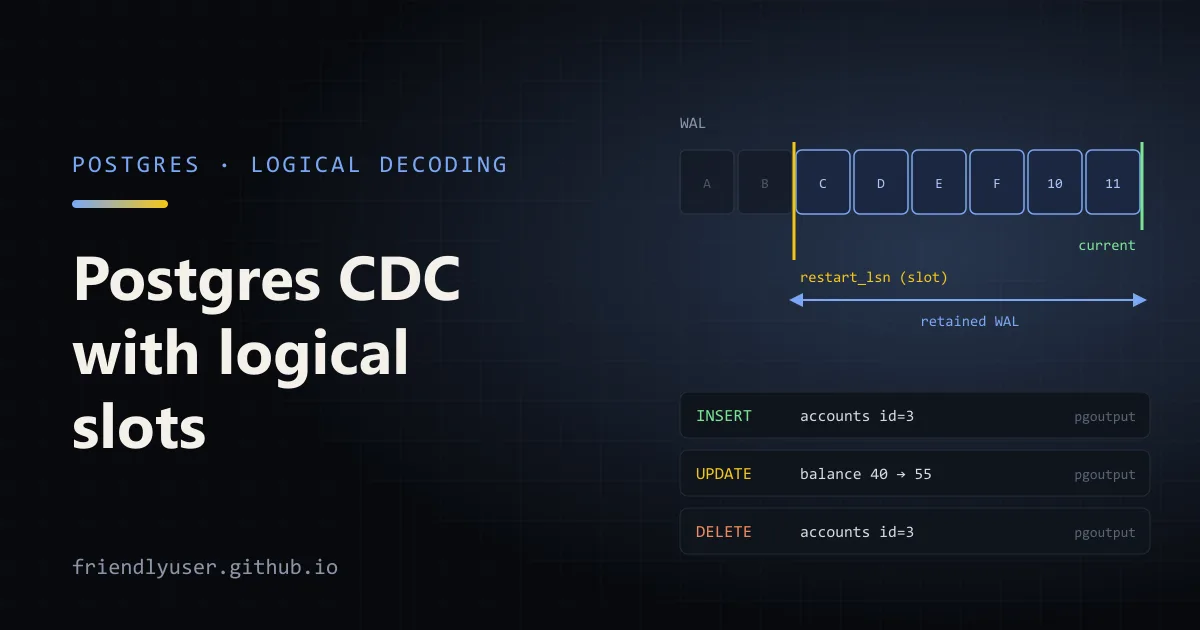
Change data capture (CDC) means getting every insert, update and delete from a database as a stream of events, in commit order, without polling tables or adding triggers. In Postgres the built-in way to do that is logical decoding: Postgres reads its own write-ahead log (WAL), turns the physical changes back into row-level events, and hands them to a consumer through a replication slot that remembers how far the consumer has read.
This is what Debezium and most managed CDC services use underneath. Knowing how the pieces fit, and how a slot can fill your disk, is worth it even if you never write your own consumer. This post walks through it with SQL you can run in a local container and a small Python consumer. The Docker commands use the postgres:18 image; the SQL and Python were run against PostgreSQL 16, and everything used here has been available since PostgreSQL 13.
A local Postgres with logical decoding
Section titled “A local Postgres with logical decoding”Logical decoding needs wal_level = logical, which makes Postgres write enough information into the WAL to reconstruct rows. The default, replica, isn’t enough, and changing it needs a restart. With Docker you can pass it on the command line:
docker run -d --name pg-cdc \  -e POSTGRES_PASSWORD=postgres -p 5432:5432 \  postgres:18 -c wal_level=logical -c max_slot_wal_keep_size=10GB
docker exec -it pg-cdc psql -U postgres
max_slot_wal_keep_size is explained in the section on disk usage below; set it from day one. On an existing server, use ALTER SYSTEM SET wal_level = logical; and restart. Check with SHOW wal_level;.
Create a table to watch:
CREATE TABLE accounts ( id int PRIMARY KEY, owner text NOT NULL, balance numeric(12,2) NOT NULL);Slots and the test_decoding plugin
Section titled “Slots and the test_decoding plugin”A logical replication slot is a named, persistent cursor into the WAL. It has two jobs: it records the position the consumer has confirmed, and it stops Postgres from deleting WAL the consumer hasn’t read yet. Each slot uses an output plugin that decides what the decoded changes look like.
test_decoding ships with Postgres as a contrib module (it’s in the Docker image) and produces human-readable text. It’s meant for testing, which makes it perfect for seeing what’s going on:
SELECT * FROM pg_create_logical_replication_slot('demo_slot', 'test_decoding');
INSERT INTO accounts VALUES (1, 'ada', 100.00), (2, 'grace', 250.00);UPDATE accounts SET balance = balance - 30 WHERE id = 1;DELETE FROM accounts WHERE id = 2;
The slot only sees changes made after it was created. Now read them. There are two functions, and the difference matters:
pg_logical_slot_peek_changes(slot, upto_lsn, upto_nchanges)returns changes without consuming them. Call it twice and you get the same rows.pg_logical_slot_get_changes(...)returns changes and advances the slot, so they’re gone.
SELECT lsn, xid, data FROM pg_logical_slot_peek_changes('demo_slot', NULL, NULL);The output looks like this (illustrative: the LSNs and transaction IDs will differ on your machine):
lsn | xid | data-----------+-----+--------------------------------------------------------------------------- 0/1A3C2D0 | 750 | BEGIN 750 0/1A3C2D0 | 750 | table public.accounts: INSERT: id[integer]:1 owner[text]:'ada' balance[numeric]:100.00 0/1A3C3B8 | 750 | table public.accounts: INSERT: id[integer]:2 owner[text]:'grace' balance[numeric]:250.00 0/1A3C470 | 750 | COMMIT 750 0/1A3C470 | 751 | BEGIN 751 0/1A3C470 | 751 | table public.accounts: UPDATE: id[integer]:1 owner[text]:'ada' balance[numeric]:70.00 0/1A3C4F0 | 751 | COMMIT 751 0/1A3C4F0 | 752 | BEGIN 752 0/1A3C4F0 | 752 | table public.accounts: DELETE: id[integer]:2 0/1A3C560 | 752 | COMMIT 752Each row has the LSN (log sequence number, a position in the WAL), the transaction ID, and the change. Changes arrive grouped by transaction, in commit order, and only for committed transactions; a rolled-back transaction never appears.
Notice what’s missing: the UPDATE shows only the new row, and the DELETE shows only the primary key. That’s controlled by the table’s replica identity.
REPLICA IDENTITY: what the old row contains
Section titled “REPLICA IDENTITY: what the old row contains”REPLICA IDENTITY decides which columns of the old row are written to the WAL for updates and deletes:
| Setting | Old row in the WAL |
|---|---|
DEFAULT | primary key columns only, and only on update if the key changed |
USING INDEX idx | the columns of a unique, non-null index |
FULL | every column |
NOTHING | nothing |
DEFAULT is enough to identify the row. If your consumer needs the previous values (for an audit log, or to compute “balance changed from 100 to 70”), switch to FULL:
ALTER TABLE accounts REPLICA IDENTITY FULL;FULL writes the entire old row into the WAL for every update and delete, so it increases WAL volume on write-heavy tables. Use it where you need it, not everywhere.
There’s a trap with tables that have no primary key. Once such a table is in a publication that publishes updates (next section), Postgres refuses to update it at all:
ERROR: cannot update table "notes" because it does not have a replica identity and publishes updatesHINT: To enable updating the table, set REPLICA IDENTITY using ALTER TABLE.That error shows up in the application, not in the CDC pipeline, so add primary keys (or set REPLICA IDENTITY FULL) before you add tables to a publication.
Publications and pgoutput for real consumers
Section titled “Publications and pgoutput for real consumers”test_decoding reports every table and its text format isn’t a stable interface. Real consumers use pgoutput, the plugin built into Postgres for native logical replication, together with a publication that lists which tables (and which operations) to publish:
CREATE PUBLICATION cdc_pub FOR TABLE accounts;-- or: FOR ALL TABLES, or FOR TABLES IN SCHEMA app-- optionally: WITH (publish = 'insert, update, delete')
SELECT * FROM pg_create_logical_replication_slot('cdc_slot', 'pgoutput');
pgoutput emits a documented binary protocol: a Relation message describing a table’s columns, then Begin, Insert/Update/Delete, and Commit messages. Tools such as Debezium, Postgres’s own subscriptions (CREATE SUBSCRIPTION), and most managed CDC services consume it over the streaming replication protocol. You can also read it with SQL, using the _binary_ variants of the peek and get functions and passing the protocol version and publication names as options:
SELECT lsn, xid, length(data)FROM pg_logical_slot_peek_binary_changes( 'cdc_slot', NULL, NULL, 'proto_version', '1', 'publication_names', 'cdc_pub');A small Python consumer
Section titled “A small Python consumer”To see the whole loop, here’s a consumer that polls a pgoutput slot with psycopg 3, decodes the messages, and only then advances the slot. First, a minimal decoder for the protocol version 1 messages it needs, following the message format docs:
"""Minimal decoder for pgoutput protocol version 1 messages."""import structfrom dataclasses import dataclass, field

@dataclassclass Relation:    schema: str    name: str    columns: list[str] = field(default_factory=list)

class Reader:    def __init__(self, data: bytes):        self.data, self.pos = data, 0
    def take(self, fmt: str):        values = struct.unpack_from("!" + fmt, self.data, self.pos)        self.pos += struct.calcsize("!" + fmt)        return values[0] if len(values) == 1 else values
    def string(self) -> str:        end = self.data.index(b"\0", self.pos)        s = self.data[self.pos:end].decode()        self.pos = end + 1        return s
    def tuple_data(self) -> list[str | None]:        values = []        for _ in range(self.take("h")):            kind = self.take("c")            if kind == b"t":                      # text value                n = self.take("i")                values.append(self.data[self.pos:self.pos + n].decode())                self.pos += n            else:                                 # b"n" null, b"u" unchanged TOAST                values.append(None)        return values

class Decoder:    def __init__(self):        self.relations: dict[int, Relation] = {}
    def decode(self, data: bytes) -> dict | None:        r = Reader(data)        kind = r.take("c")        if kind == b"B":            final_lsn, ts, xid = r.take("qqi")            return {"op": "begin", "xid": xid}        if kind == b"C":            return {"op": "commit"}        if kind == b"R":            oid = r.take("i")            rel = Relation(r.string(), r.string())            r.take("c")                           # replica identity setting            for _ in range(r.take("h")):                r.take("c")                       # flags (1 = part of the key)                rel.columns.append(r.string())                r.take("ii")                      # type oid, type modifier            self.relations[oid] = rel            return None        if kind in (b"I", b"U", b"D"):            rel = self.relations[r.take("i")]            row = lambda vals: dict(zip(rel.columns, vals))            event = {"table": f"{rel.schema}.{rel.name}"}            if kind == b"I":                r.take("c")                       # b"N"                return {"op": "insert", **event, "new": row(r.tuple_data())}            marker = r.take("c")            old = None            if marker in (b"K", b"O"):            # key only, or full old row                old = row(r.tuple_data())                if kind == b"U":                    marker = r.take("c")          # now b"N"            if kind == b"D":                return {"op": "delete", **event, "old": old}            return {"op": "update", **event, "old": old, "new": row(r.tuple_data())}        return None                               # origin, type, truncate, ...
Values arrive as text, exactly as Postgres would print them; converting them to Python types by column type is left out to keep this short. Then the polling loop:
import jsonimport osimport time
import psycopg
from pgoutput import Decoder
DSN = os.environ.get("DATABASE_URL", "postgresql://postgres:postgres@localhost:5432/postgres")SLOT, PUBLICATION = "cdc_slot", "cdc_pub"
PEEK = """    SELECT lsn, data    FROM pg_logical_slot_peek_binary_changes(        %s, %s, %s, 'proto_version', '1', 'publication_names', %s)"""

def poll_once(conn: psycopg.Connection, decoder: Decoder, batch: int = 1000) -> int:    upto = conn.execute("SELECT pg_current_wal_lsn()").fetchone()[0]    rows = conn.execute(PEEK, (SLOT, upto, batch, PUBLICATION)).fetchall()    for lsn, data in rows:        event = decoder.decode(bytes(data))        if event and event["op"] not in ("begin", "commit"):            print(lsn, json.dumps(event))  # deliver it somewhere real here    # Only after handling the batch, let Postgres discard the WAL behind it.    # If the batch limit cut us short, stop at the last change we saw;    # otherwise everything up to `upto` has been seen, even with no rows.    done_to = rows[-1][0] if len(rows) >= batch else upto    conn.execute("SELECT pg_replication_slot_advance(%s, %s)", (SLOT, done_to))    return len(rows)

def main() -> None:    decoder = Decoder()    with psycopg.connect(DSN, autocommit=True) as conn:        while True:            if poll_once(conn, decoder) == 0:                time.sleep(1)

if __name__ == "__main__": main()pip install "psycopg[binary]"python consumer.pyAfter ALTER TABLE accounts REPLICA IDENTITY FULL, inserting, updating and deleting a third account printed:
0/14EE5C8 {"op": "insert", "table": "public.accounts", "new": {"id": "3", "owner": "linus", "balance": "40.00"}}0/14EE680 {"op": "update", "table": "public.accounts", "old": {"id": "3", "owner": "linus", "balance": "40.00"}, "new": {"id": "3", "owner": "linus", "balance": "55.00"}}0/14EE718 {"op": "delete", "table": "public.accounts", "old": {"id": "3", "owner": "linus", "balance": "55.00"}}Before that change, with REPLICA IDENTITY DEFAULT, the consumer printed "old": null for the update of account 1 and only the key for the delete of account 2: {"id": "2", "owner": null, "balance": null}.
The design choices that matter:
- Peek, process, then advance. If the process crashes after delivering events but before advancing, the next run sees them again. That’s at-least-once delivery; make the downstream idempotent (upsert by primary key and LSN). Using
get_changesinstead would advance first and lose events on a crash. - Advance even when nothing matched. The slot holds back WAL for all tables, not just the published ones. After a bulk insert of 500,000 rows into an unrelated table, a slot for the quiet
accountstable still held 46 MB of WAL when its consumer only advanced on receiving rows, because no rows ever arrived. Capturingpg_current_wal_lsn()before peeking and advancing to it when the batch wasn’t cut short fixes that. - Batches end on transaction boundaries.
upto_nchangesstops after the transaction that crosses the limit, so a batch never contains half a transaction.
Polling through SQL is fine for low volumes and for understanding the mechanics. For production, use the streaming replication protocol (Debezium, pg_recvlogical, or psycopg2’s LogicalReplicationConnection), which pushes changes as they commit and lets the consumer confirm positions with feedback messages.
Slot retention can fill the disk
Section titled “Slot retention can fill the disk”This is the operational risk of CDC. A slot guarantees that Postgres keeps every WAL segment from the slot’s restart_lsn onwards. If the consumer stops (crashed, paused, decommissioned, or someone created a slot to try something and forgot it), WAL keeps accumulating on the primary until the disk is full and the database stops accepting writes.
Watch your slots:
SELECT slot_name, plugin, active, wal_status, pg_size_pretty(pg_wal_lsn_diff(pg_current_wal_lsn(), restart_lsn)) AS retained_wal, pg_size_pretty(safe_wal_size) AS safe_wal_sizeFROM pg_replication_slots;After creating an unused slot and writing 500,000 rows into another table:
slot_name | active | wal_status | retained_wal | safe_wal_size----------------+--------+------------+--------------+--------------- cdc_slot | f | reserved | 46 MB | 989 MB forgotten_slot | f | reserved | 46 MB | 989 MB(That server had max_slot_wal_keep_size = 1GB.) Defences, roughly in order of importance:
- Set
max_slot_wal_keep_size. It caps how much WAL a slot may hold. A slot that falls further behind is invalidated (wal_statusbecomeslost) instead of taking the database down. The consumer then has to resynchronize from a snapshot, which is painful but recoverable; a full disk on the primary is worse. The default is-1, unlimited. - Alert on
retained_waland on slots withactive = falsefor longer than you expect. - Drop slots you don’t need:
SELECT pg_drop_replication_slot('forgotten_slot');. Slots survive restarts and aren’t tied to any connection, so they’re easy to forget. - On PostgreSQL 18 and later,
idle_replication_slot_timeoutcan also invalidate slots that have been inactive for too long.
Slots also prevent VACUUM from removing rows that the slot might still need to decode (the slot’s catalog_xmin holds back cleanup of the system catalogs), which is another reason not to leave idle slots around.
Gotchas
Section titled “Gotchas”- DDL isn’t replicated. Logical decoding emits row changes, not
ALTER TABLE. Consumers see a newRelationmessage with the new columns after a schema change, but have to handle it themselves. - TRUNCATE is published by
pgoutputas its own message type (if the publication includes it), not as one delete per row. - Sequences aren’t decoded. If a downstream copy needs sequence values, copy them separately.
- Slots don’t follow failover by default. On older versions a logical slot exists only on the primary. PostgreSQL 17 added failover slots that can be synchronized to standbys; check what your managed provider supports before relying on CDC across a failover.
- Initial load. A slot only captures changes from the moment it’s created. For a full copy plus changes, take a snapshot consistent with the slot’s starting point.
CREATE_REPLICATION_SLOT ... EXPORT_SNAPSHOTon a replication connection is how Debezium and native subscriptions do it.
Further reading
Section titled “Further reading”- Logical decoding and its examples
- test_decoding
- CREATE PUBLICATION and REPLICA IDENTITY in ALTER TABLE
- Logical replication message formats
- Replication settings, including
max_slot_wal_keep_size - Debezium PostgreSQL connector
© 2026 David Li · Home · Blog · RSS ·Classic site · Built with Astro, Starlight and three.js · Logos:Font Awesome Free (CC BY 4.0)