Linting and formatting Python with Ruff
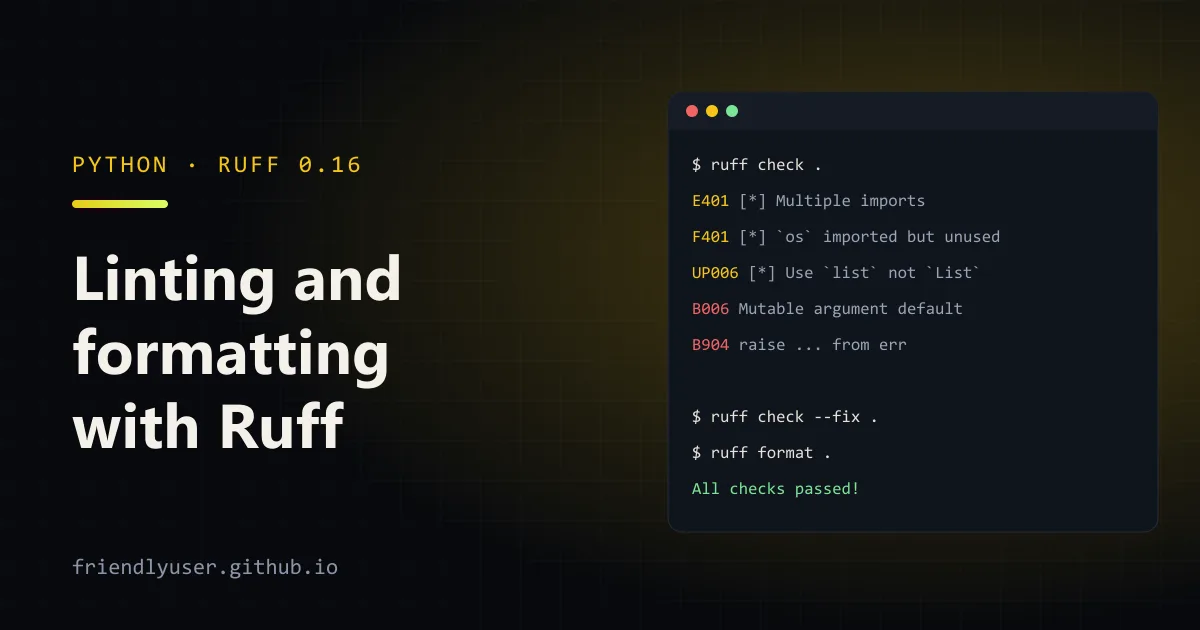
Ruff is a Python linter and formatter from Astral, shipped as a single binary. One tool replaces Flake8 and many of its plugins, isort, pyupgrade and Black, reads its configuration from pyproject.toml, and is fast enough to run on every save. Most projects adopt it for the speed and keep it because there is only one tool to configure.
This post sets up Ruff on a small package: choosing rule sets, fixing what it finds, formatting, per-file exceptions, and wiring it into CI. Examples use Ruff 0.16.4. That matters, because 0.16.0 (July 23, 2026) changed the default rule set; more on that below.
Running it
Section titled “Running it”You don’t need to add Ruff to a project to try it:
uvx ruff check .uvx ruff format .For a project, pin it as a dev dependency so everyone runs the same version: uv add --dev ruff or pip install ruff==0.16.4. Ruff has two subcommands that matter: ruff check (the linter) and ruff format (the formatter). They are configured separately and run separately.
A file with problems
Section titled “A file with problems”Here is src/shop/orders.py, written in an older style with a few real bugs mixed in:
import os, sysimport jsonfrom typing import List, Optional, Dict

def load_orders(path: str, cache: Dict[str, list] = {}) -> List[dict]:    if path in cache:        return cache[path]    f = open(path)    data = json.load(f)    cache[path] = data    return data

def total(orders: List[dict], currency: Optional[str] = None) -> float:    result = 0    for o in orders:        if currency != None and o["currency"] != currency:            continue        result += o['amount']    return result

def summary(orders):    try:        t = total(orders)    except Exception:        raise ValueError("bad orders")    return "Total: {}".format(t)
And a test that uses a star import:
from shop.orders import *

def test_total():    assert total([{"amount": 2, "currency": "CAD"}]) == 2
Choosing rules
Section titled “Choosing rules”Every Ruff rule has a code made of a prefix and a number. The prefix is the linter the rule came from:
| Prefix | Origin | What it catches |
|---|---|---|
E | pycodestyle errors | Style errors such as == None, several imports on one line |
F | Pyflakes | Unused imports and variables, undefined names, star imports |
I | isort | Unsorted or badly grouped imports |
UP | pyupgrade | Old syntax that has a newer equivalent for your target Python |
B | flake8-bugbear | Likely bugs: mutable defaults, raise without from in except |
Before 0.16, Ruff with no configuration enabled 59 rules (E4, E7, E9 and F). Since 0.16.0 the default set has 413 rules, including many from B, UP and Ruff’s own RUF category, and 18 of the more opinionated E and F rules (E711 and F403, for example) were taken out of the default. The full list is on the Default Rules page.
I would still write the rule selection down explicitly. It makes the project’s choices visible in review, and an upgrade of Ruff will not silently change what is checked. Add this to pyproject.toml:
[project]name = "shop"version = "0.1.0"requires-python = ">=3.12"
[tool.ruff]line-length = 100
[tool.ruff.lint]select = ["E", "F", "I", "UP", "B"]
select replaces the default set entirely. If you would rather keep the defaults and add to them, use extend-select instead. Ruff reads the target Python version from requires-python, which is what tells the UP rules that list[dict] and str | None are safe to use.
Now run the linter. The default output shows a code frame and the proposed fix for every problem; --output-format concise gives one line each:
ruff check --output-format concise .src\shop\orders.py:1:1: E401 [*] Multiple imports on one linesrc\shop\orders.py:1:1: I001 [*] Import block is un-sorted or un-formattedsrc\shop\orders.py:1:8: F401 [*] `os` imported but unusedsrc\shop\orders.py:1:12: F401 [*] `sys` imported but unusedsrc\shop\orders.py:3:1: UP035 `typing.List` is deprecated, use `list` insteadsrc\shop\orders.py:3:1: UP035 `typing.Dict` is deprecated, use `dict` insteadsrc\shop\orders.py:6:35: UP006 [*] Use `dict` instead of `Dict` for type annotationsrc\shop\orders.py:6:53: B006 Do not use mutable data structures for argument defaultssrc\shop\orders.py:6:60: UP006 [*] Use `list` instead of `List` for type annotationsrc\shop\orders.py:15:19: UP006 [*] Use `list` instead of `List` for type annotationsrc\shop\orders.py:15:41: UP045 [*] Use `X | None` for type annotationssrc\shop\orders.py:18:24: E711 Comparison to `None` should be `cond is not None`src\shop\orders.py:28:9: B904 Within an `except` clause, raise exceptions with `raise ... from err` or `raise ... from None` to distinguish them from errors in exception handlingsrc\shop\orders.py:29:12: UP032 [*] Use f-string instead of `format` calltests\test_orders.py:1:1: F403 `from shop.orders import *` used; unable to detect undefined namestests\test_orders.py:5:12: F405 `total` may be undefined, or defined from star importsFound 16 errors.[*] 9 fixable with the `--fix` option (2 hidden fixes can be enabled with the `--unsafe-fixes` option).(The paths use backslashes because this was run on Windows.) To learn what a rule is about, ruff rule B904 prints its documentation, including why it matters and an example of the fix.
Fixing: safe and unsafe
Section titled “Fixing: safe and unsafe”Rules marked [*] have a fix Ruff considers safe: it does not change what the code does. Apply them all with:
ruff check --fix .src\shop\orders.py:4:53: B006 Do not use mutable data structures for argument defaultssrc\shop\orders.py:16:24: E711 Comparison to `None` should be `cond is not None`src\shop\orders.py:26:9: B904 Within an `except` clause, raise exceptions with `raise ... from err` or `raise ... from None` to distinguish them from errors in exception handlingtests\test_orders.py:1:1: F403 `from shop.orders import *` used; unable to detect undefined namestests\test_orders.py:5:12: F405 `total` may be undefined, or defined from star importsFound 16 errors (11 fixed, 5 remaining).No fixes available (2 hidden fixes can be enabled with the `--unsafe-fixes` option).Eleven problems went away: the imports were split, sorted and pruned, List, Dict and Optional became list, dict and str | None, and .format() became an f-string.
The two “hidden” fixes are unsafe: they might change behaviour. Look at them before applying:
ruff check --unsafe-fixes --diff .def load_orders(path: str, cache: dict[str, list] = {}) -> list[dict]:def load_orders(path: str, cache: dict[str, list] = None) -> list[dict]: if cache is None: cache = {} if path in cache: return cache[path]... if currency != None and o["currency"] != currency: if currency is not None and o["currency"] != currency:The E711 fix is fine here. It is marked unsafe because != None calls __ne__, which a class can override, while is not None does not. The B006 fix shows why “unsafe” exists. The mutable default in load_orders is a bug in most code, but in this function the shared dict is being used, deliberately or not, as a cache across calls. The fix would quietly turn the cache off, and it would also leave the annotation wrong (dict[str, list] = None should be dict[str, list] | None). Unsafe fixes are worth reading one by one. Here the right change is to remove the hidden cache entirely and fix the file handle while we are at it.
B904 has no automatic fix because Ruff cannot know whether you want from err or from None.
Per-file ignores and inline suppressions
Section titled “Per-file ignores and inline suppressions”Star imports are a reasonable thing to flag in library code and a reasonable thing to allow in some test files. Rather than turning F403 off everywhere, scope the exception:
[tool.ruff.lint]select = ["E", "F", "I", "UP", "B"]ignore = ["E501"]
[tool.ruff.lint.per-file-ignores]"tests/**/*.py" = ["F403", "F405"]
[tool.ruff.lint.isort]known-first-party = ["shop"]
ignore = ["E501"] turns off the line-length rule. The formatter already decides where lines break, and the long lines it leaves behind are usually strings or comments it cannot split; many projects would rather not hand-wrap those. Keep E501 if you want a hard limit. The isort.known-first-party setting makes sure shop imports are grouped as your own code rather than as third-party packages.
For a single line, # noqa: F401 works as it did in Flake8. Ruff 0.16 also added its own comment, # ruff: ignore[F401], which can go at the end of the line or on the line before it. Always name the rule; a bare # noqa hides everything on that line, including problems added later.
After fixing the remaining issues by hand (a with block for the file, is not None, and raise ... from err), the module looks like this:
import jsonfrom pathlib import Path

def load_orders(path: Path) -> list[dict]:    with path.open() as f:        return json.load(f)

def total(orders: list[dict], currency: str | None = None) -> float:    result = 0    for o in orders:        if currency is not None and o["currency"] != currency:            continue        result += o["amount"]    return result

def summary(orders: list[dict]) -> str:    try:        t = total(orders)    except KeyError as err:        raise ValueError("order is missing a field") from err    return f"Total: {t}"
$ ruff check .All checks passed!ruff format and Black
Section titled “ruff format and Black”ruff format is designed as a near drop-in replacement for Black: the same style choices (double quotes, magic trailing commas, 88 characters by default) and, on code Black has already formatted, very few differences. The differences that do exist are listed in Ruff’s documentation, and they are mostly edge cases in how comments and long expressions are placed.
See what it would change without writing anything. Run against the file as it was right after ruff check --fix, only the quote style is left:
ruff format --diff .--- src\shop\orders.py+++ src\shop\orders.py@@ -15,7 +15,7 @@ for o in orders: if currency != None and o["currency"] != currency: continue- result += o['amount']+ result += o["amount"] return resultThe formatter has a handful of options under [tool.ruff.format]: quote-style, indent-style, line-ending, docstring-code-format, skip-magic-trailing-comma. line-length lives under [tool.ruff] and applies to both the formatter and E501.
Since 0.16, ruff format also formats Python code blocks inside Markdown files. If your README contains deliberately unformatted examples, either wrap them in <!-- fmt: off --> and <!-- fmt: on --> or exclude Markdown with extend-exclude = ["*.md"] under [tool.ruff].
Two things to know when switching from Black:
- Run the formatter after the linter’s fixes.
ruff check --fixcan produce code the formatter would lay out differently, so runruff check --fixfirst andruff formatsecond. - Keep formatter-conflicting lint rules off. Some lint rules disagree with the formatter, such as
COM812(missing trailing comma).ruff formatprints a warning naming any conflicting rule in your selection, and recommends adding it toignore.
Running it in CI
Section titled “Running it in CI”In CI you want both commands to fail on problems without changing files:
ruff check .ruff format --check .ruff check exits non-zero if anything is found; ruff format --check exits non-zero if any file would be reformatted. With --output-format github, both print GitHub Actions annotations, so problems appear inline on the pull request’s diff.
A minimal GitHub Actions workflow using Astral’s action:
name: linton: [push, pull_request]
jobs:  ruff:    runs-on: ubuntu-latest    steps:      - uses: actions/checkout@v6      - uses: astral-sh/ruff-action@v4        with:          version: "0.16.4"          args: "check --output-format github"      - uses: astral-sh/ruff-action@v4        with:          version: "0.16.4"          args: "format --check --output-format github"
If version is omitted, the action looks for a Ruff version pinned in pyproject.toml and falls back to the newest release. Pin it one way or the other, so a new Ruff release does not break your build unannounced. On other CI systems, uvx ruff@0.16.4 check . works anywhere uv is installed.
For local enforcement, the official pre-commit hooks are in astral-sh/ruff-pre-commit, with hook IDs ruff-check (pass args: [--fix] to fix) and ruff-format. Put ruff-check first, for the same reason as above.
Gotchas
Section titled “Gotchas”selectversusextend-select.selectthrows away the defaults;extend-selectadds to them. Mixing them up is the usual reason a rule is unexpectedly on or off.- Upgrades can add findings. New rules and changed defaults land in minor releases, as 0.16 showed. Pin the version and upgrade deliberately, reading the changelog.
ruff formatis not configurable like YAPF. If your team wants a style Black would not produce, Ruff’s formatter will not give it to you either.- Ruff is not a type checker. It does not replace mypy or Pyright, although rules such as
F821(undefined name) catch some of the same mistakes.
Further reading
Section titled “Further reading”© 2026 David Li · Home · Blog · RSS ·Classic site · Built with Astro, Starlight and three.js · Logos:Font Awesome Free (CC BY 4.0)