contextlib patterns in Python: contextmanager, ExitStack, suppress and chdir
A context manager is anything you can use in a with statement: it runs setup code on entry and cleanup code on exit, even when the block raises. Files, locks and database transactions are the usual examples. The contextlib module in the standard library has the tools for writing your own without a class, and for the awkward cases: a number of resources you only know at runtime, exceptions you want to ignore, or a working directory you need to change for a moment.
This post goes through the parts of contextlib I use most, with runnable examples. They were run on Python 3.12; chdir needs 3.11 or newer, and everything else works on any supported version.
@contextmanager: a context manager from a generator
Section titled “@contextmanager: a context manager from a generator”The class-based protocol is __enter__ and __exit__. For most cases, a generator with one yield is shorter:
import timefrom contextlib import contextmanager

@contextmanagerdef timed(label: str):    start = time.perf_counter()    try:        yield    finally:        print(f"{label}: {time.perf_counter() - start:.3f}s")

with timed("sleep"):    time.sleep(0.05)
sleep: 0.050sEverything before yield is the setup, the value yielded is what as binds to, and everything after is the cleanup. The decorated function can also be used as a decorator, which runs the whole function inside the block each time it is called:
@timed("nightly job")def job() -> None: ...Always use try/finally around the yield
Section titled “Always use try/finally around the yield”If the body of the with raises, the exception is thrown into the generator at the yield. Without try/finally, the cleanup code after the yield never runs:
@contextmanagerdef lock():    print("acquire")    yield    print("release")  # skipped if the block raises

with lock():    raise KeyError("x")# prints "acquire", then the KeyError propagates; "release" is never printed
This is the most common bug in hand-written context managers. Put the cleanup in a finally unless you genuinely want it to run only on success.
Handling exceptions inside the context manager
Section titled “Handling exceptions inside the context manager”Because the exception arrives at the yield, you can catch it there. That makes “commit on success, roll back on failure” patterns natural. Here is a file writer that only replaces the target if the whole block succeeds, so a crash halfway through never leaves a half-written file:
import osimport tempfilefrom contextlib import contextmanagerfrom pathlib import Path

@contextmanagerdef atomic_write(path: Path, mode: str = "w"):    """Write to a temp file and rename it over `path` only if the block succeeds."""    fd, tmp = tempfile.mkstemp(dir=path.parent, prefix=f".{path.name}.")    try:        with os.fdopen(fd, mode) as f:            yield f        os.replace(tmp, path)    except BaseException:        os.unlink(tmp)        raise

target = Path(tempfile.mkdtemp()) / "settings.json"
with atomic_write(target) as f:    f.write('{"debug": false}')
try:    with atomic_write(target) as f:        f.write('{"debug": tr')        raise ValueError("serialiser blew up")except ValueError as e:    print("failed:", e)
print(target.read_text())print(sorted(p.name for p in target.parent.iterdir()))
failed: serialiser blew up{"debug": false}['settings.json']The second write failed, the original file is untouched, and the temp file is gone. os.replace is atomic on the same filesystem, which is why the temp file is created in the target’s directory.
Two rules for exceptions in a generator context manager:
- Re-raise unless you mean to suppress. If the generator catches the exception and does not raise, the
withstatement treats it as handled and execution continues after the block. That is occasionally what you want and usually a bug. - Catch
BaseExceptionwhen cleanup must happen on any exit, includingKeyboardInterruptand task cancellation. Or usefinally, which covers everything.
Yield exactly once. A generator that never yields raises RuntimeError: generator didn't yield, and one that yields twice raises RuntimeError: generator didn't stop.
ExitStack: a variable number of resources
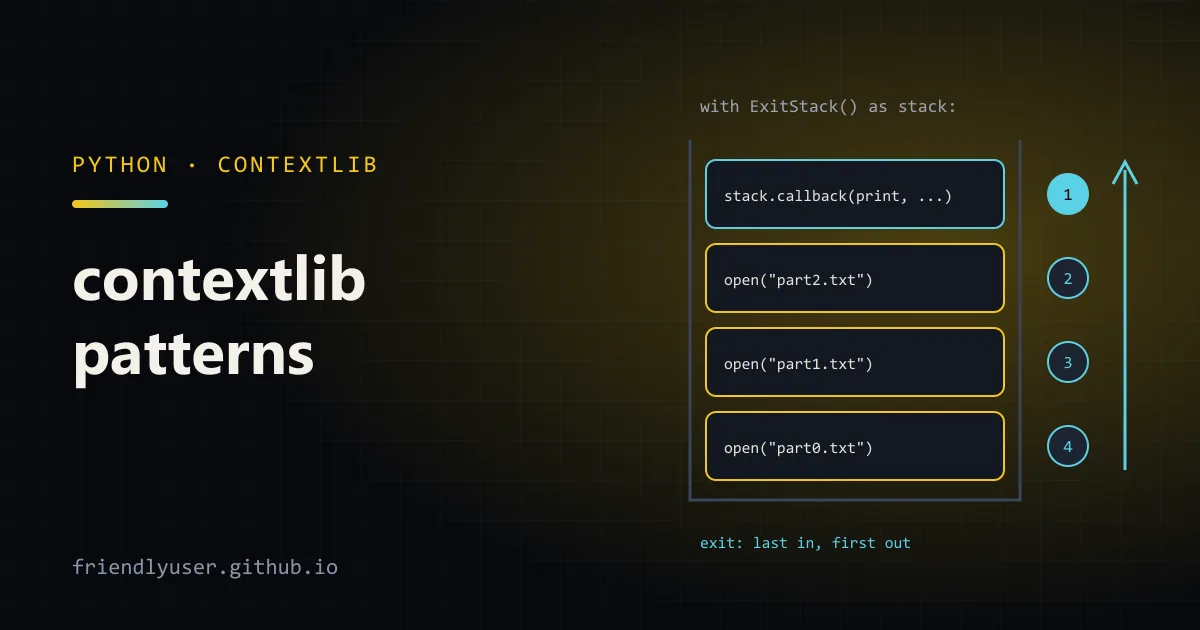
Section titled “ExitStack: a variable number of resources”with open(a) as fa, open(b) as fb: is fine when you know there are two files. When the number comes from user input or a config file, you cannot write the with statement. ExitStack collects context managers at runtime and exits them all, in reverse order, when the stack itself exits:
from contextlib import ExitStack
with ExitStack() as stack:    files = [stack.enter_context(open(n)) for n in names]    stack.callback(print, "all parts read; closing files")    for f in files:        print(f.readline().strip())
print("closed:", all(f.closed for f in files))
line from part 0line from part 1line from part 2all parts read; closing filesclosed: TrueThe important property is what happens on a partial failure. If the third open() raises FileNotFoundError, the first two files are already registered on the stack, so they are closed as the exception propagates. A hand-written loop with a list and a try/finally is easy to get wrong here; ExitStack gets it right by construction.
The other methods:
stack.callback(fn, *args)registers any function as cleanup, which is handy for things that are not context managers (stack.callback(shutil.rmtree, tmpdir)).stack.push(exit_fn)registers an__exit__-style function that sees the exception.stack.pop_all()moves everything onto a newExitStackand returns it, so the currentwithblock exits without closing anything.
pop_all() is how you write a function that opens resources safely but hands them to the caller:
def open_all(paths):    with ExitStack() as stack:        files = [stack.enter_context(open(p)) for p in paths]        # If any open() failed we never get here, and the stack closed the rest.        return stack.pop_all(), files

stack, files = open_all(names)with stack:    ...  # use files; they are closed when this block exits
If all opens succeed, ownership moves to the caller’s with stack:. If one fails, the function’s own with closes the ones that were opened.
suppress: ignore specific exceptions
Section titled “suppress: ignore specific exceptions”import osfrom contextlib import suppress
with suppress(FileNotFoundError): os.remove("cache.tmp")It is the same as try: ... except FileNotFoundError: pass, in fewer lines and with the intent in the first line. Two warnings. Anything after the failing statement inside the block is skipped too, so keep the block to one statement. And never write suppress(Exception): that hides bugs, which is the reason bare except: pass has a bad reputation.
chdir: change directory for one block (3.11+)
Section titled “chdir: change directory for one block (3.11+)”Some tools only work relative to the current directory. chdir changes it on entry and restores the previous one on exit, even if the block raises:
from contextlib import chdirfrom pathlib import Path
print("before:", Path.cwd())with chdir("/tmp"):    print("inside:", Path.cwd())print("after:", Path.cwd())
The current directory is process-wide state. chdir is not safe to use while other threads, or other asyncio tasks that might be scheduled during the block, depend on the current directory. In library code and anything concurrent, pass explicit paths (or cwd= to subprocess.run) instead.
asynccontextmanager
Section titled “asynccontextmanager”The async version works the same way, with await allowed before and after the yield, and it is used with async with:
import asynciofrom contextlib import asynccontextmanager

class FakePool:    async def acquire(self):        await asyncio.sleep(0.01)        print("  acquired connection")        return "conn-1"
    async def release(self, conn):        await asyncio.sleep(0.01)        print("  released", conn)

@asynccontextmanagerasync def connection(pool: FakePool):    conn = await pool.acquire()    try:        yield conn    finally:        await pool.release(conn)

async def main():    async with connection(FakePool()) as conn:        print("  using", conn)

asyncio.run(main())
acquired connection using conn-1 released conn-1The try/finally rule matters even more here. If the task is cancelled inside the block, CancelledError arrives at the yield, and only a finally (or an except BaseException that re-raises) gets the connection back to the pool.
AsyncExitStack is the async counterpart of ExitStack, with enter_async_context() and push_async_callback() for async resources. It also accepts regular context managers through enter_context().
Other small helpers worth knowing
Section titled “Other small helpers worth knowing”nullcontext(value)does nothing and returnsvalue. Use it when awithis sometimes needed:with (lock if threaded else nullcontext()):.closing(obj)callsobj.close()on exit, for objects with aclose()method that are not context managers.redirect_stdout(buffer)andredirect_stderr(buffer)capture output from code that prints. Likechdir, they change global state, so keep them out of threaded code.
When to write a class instead
Section titled “When to write a class instead”A generator-based context manager is single-use: each call creates a new generator, and you cannot enter the same object twice. If you need a reusable or re-entrant object (a lock you enter many times, a connection pool object that is also its own context manager), write a class with __enter__ and __exit__, or __aenter__ and __aexit__. contextlib.AbstractContextManager provides a default __enter__ that returns self.
Further reading
Section titled “Further reading”© 2026 David Li · Home · Blog · RSS ·Classic site · Built with Astro, Starlight and three.js · Logos:Font Awesome Free (CC BY 4.0)