Discriminated unions and exhaustive checks in TypeScript
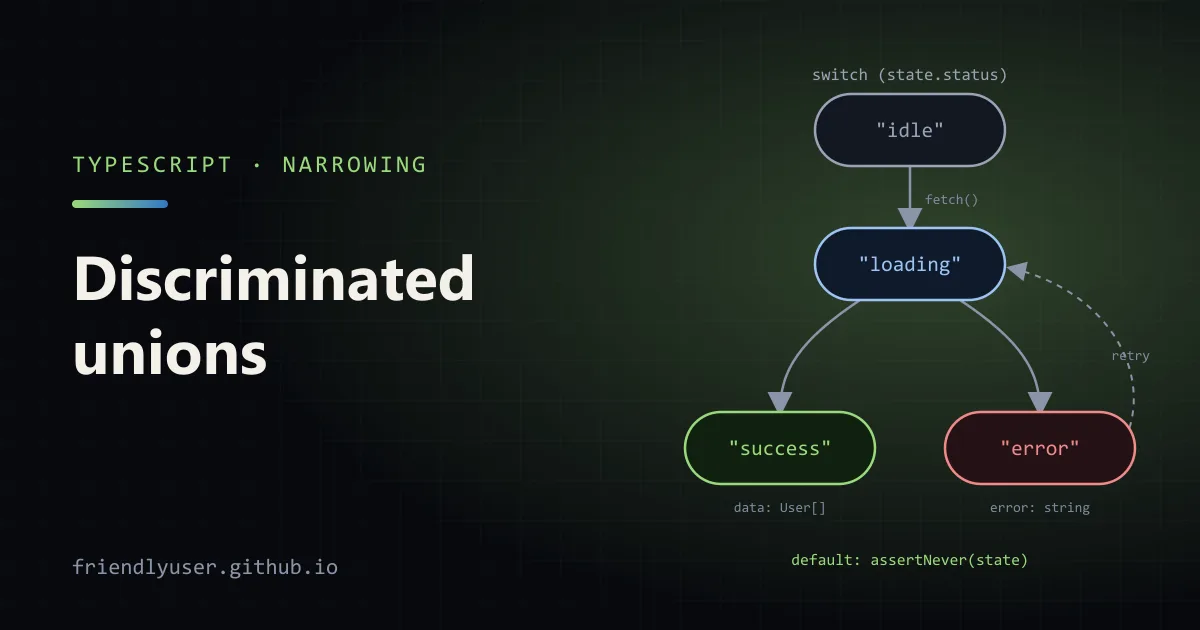
A discriminated union is a union of object types that all share one property, the tag, whose type is a different literal in each member. When you check the tag, TypeScript narrows the value to the matching member, so each branch of your code sees exactly the fields that exist in that case. Add a never check at the end and the compiler also tells you every place that needs updating when you add a new case.
This is the pattern I reach for whenever a value can be in one of several shapes: request states, parsed events, reducer actions, results that are either a value or an error. Examples were checked with TypeScript 5.9 in strict mode and run with Node 24.
Impossible states with optional fields
Section titled “Impossible states with optional fields”The usual first attempt at modelling a fetch looks like this:
type RequestState = { isLoading: boolean; data?: User[]; error?: string;};Nothing stops isLoading: true and error: "timeout" at the same time, or data and error both being set. Every reader has to guess which combinations are real, and every read of data needs a ?. or a non-null assertion.
A union with a tag
Section titled “A union with a tag”List the states that can actually happen, and give each one a literal status:
type User = { id: string; name: string };
type RequestState =  | { status: "idle" }  | { status: "loading"; startedAt: number }  | { status: "success"; data: User[] }  | { status: "error"; error: string; retryable: boolean };
data only exists on the success member, and error only on error. There is no way to build a value that is both.
Narrowing by the tag
Section titled “Narrowing by the tag”Any check on status narrows the type. A switch is the most common form:
function render(state: RequestState): string { switch (state.status) { case "idle": return "Nothing loaded yet"; case "loading": return `Loading for ${Date.now() - state.startedAt} ms`; case "success": return state.data.map((u) => u.name).join(", "); // data: User[], no "?." case "error": return state.retryable ? `${state.error} (retrying)` : state.error; }}if (state.status === "success"), early returns (if (state.status !== "success") return 0;) and the in operator ("data" in state) narrow the same way. Since TypeScript 4.4 and 4.6, narrowing also works through a destructured or aliased tag:
type Action = { kind: "add"; payload: number } | { kind: "rename"; payload: string };
function apply(action: Action) {  const { kind, payload } = action;  if (kind === "add") return payload + 1; // payload: number  return payload.toUpperCase();           // payload: string}
That only works with const bindings and a destructured object that isn’t reassigned. If narrowing seems to stop working, check for a let.
The tag doesn’t have to be a string. Any literal type works, which is why the common Result type uses a boolean:
type Result<T, E = string> = { ok: true; value: T } | { ok: false; error: E };Exhaustiveness checks with never
Section titled “Exhaustiveness checks with never”In the render function above, the switch covers all four statuses, and the declared string return type already gives a weak check: remove a case and TypeScript reports “Function lacks ending return statement”. That check disappears as soon as the function returns void or has code after the switch, so I prefer an explicit one.
After every case has been handled, the type of state in the default branch is never. A helper that only accepts never turns “forgot a case” into a compile error:
function assertNever(value: never, message = "Unexpected value"): never {  throw new Error(`${message}: ${JSON.stringify(value)}`);}
function render(state: RequestState): string {  switch (state.status) {    // ...the four cases from above...    default:      return assertNever(state, "Unhandled request state");  }}
Now add | { status: "cancelled" } to RequestState. Every switch that uses assertNever fails to compile, with an error that names the missing member:
error TS2345: Argument of type '{ status: "cancelled"; }' is not assignable to parameter of type 'never'.The helper also throws at runtime, which matters because types are erased. If a server sends a status your code has never heard of, you get a clear error instead of a function that silently returns undefined.
If you don’t want a helper, satisfies never (TypeScript 4.9+) gives the same compile-time check inline:
default: throw new Error(`Unhandled status: ${state satisfies never}`);Linters can do this too. typescript-eslint’s switch-exhaustiveness-check rule reports a switch over a union that misses a member, which is useful in code that doesn’t follow the default convention.
Parsing unknown JSON into a union
Section titled “Parsing unknown JSON into a union”Types say nothing about data that comes from outside the program. JSON.parse returns any, and casting it straight to a union (as WebhookEvent) means the narrowing in the rest of the code is built on a guess. The fix is to parse unknown into the union once, at the edge, and return a Result so the caller has to deal with bad input.
Here is a complete example. Save it as events.ts:
type User = { id: string; name: string };
type WebhookEvent =  | { type: "user.created"; user: User }  | { type: "user.deleted"; userId: string }  | { type: "ping" };
type Result<T, E = string> = { ok: true; value: T } | { ok: false; error: E };
function assertNever(value: never, message = "Unexpected value"): never {  throw new Error(`${message}: ${JSON.stringify(value)}`);}
function isRecord(v: unknown): v is Record<string, unknown> {  return typeof v === "object" && v !== null && !Array.isArray(v);}
function parseUser(v: unknown): User | undefined {  if (isRecord(v) && typeof v.id === "string" && typeof v.name === "string") {    return { id: v.id, name: v.name };  }  return undefined;}
function parseEvent(input: unknown): Result<WebhookEvent> {  if (!isRecord(input)) return { ok: false, error: "event is not an object" };  switch (input.type) {    case "user.created": {      const user = parseUser(input.user);      return user        ? { ok: true, value: { type: "user.created", user } }        : { ok: false, error: "user.created without a valid user" };    }    case "user.deleted":      return typeof input.userId === "string"        ? { ok: true, value: { type: "user.deleted", userId: input.userId } }        : { ok: false, error: "user.deleted without userId" };    case "ping":      return { ok: true, value: { type: "ping" } };    default:      return { ok: false, error: `unknown event type ${JSON.stringify(input.type)}` };  }}
function handle(event: WebhookEvent): string {  switch (event.type) {    case "user.created":      return `welcome ${event.user.name}`;    case "user.deleted":      return `goodbye ${event.userId}`;    case "ping":      return "pong";    default:      return assertNever(event);  }}
const bodies = [  '{"type":"user.created","user":{"id":"u1","name":"Ada"}}',  '{"type":"user.deleted","userId":"u1"}',  '{"type":"ping"}',  '{"type":"user.created","user":{"id":42}}',  '{"type":"invoice.paid"}',  "[1,2,3]",];
for (const body of bodies) {  const result = parseEvent(JSON.parse(body));  console.log(result.ok ? handle(result.value) : `rejected: ${result.error}`);}
Type-check it with npx tsc --noEmit --strict events.ts, then run it with node events.ts (Node 22.18+ strips the types):
welcome Adagoodbye u1pongrejected: user.created without a valid userrejected: unknown event type "invoice.paid"rejected: event is not an objectA few choices in parseEvent are deliberate:
- It builds new objects instead of returning
inputafter checking it. Extra fields from the payload don’t leak into your types, and the return statements are checked againstWebhookEvent, so a typo in a field name is a compile error. - Unknown types are an error result, not an exception. Webhook senders add event types all the time, and the caller can decide to log and ignore them.
handlehas its own exhaustiveness check. Add auser.updatedmember and both functions need a change, and the compiler finds them for you.
For more than a handful of event types, hand-written guards get tedious. A schema library such as Zod or Valibot can describe the same union (Zod has z.discriminatedUnion("type", [...])) and infer the TypeScript type from it, so the parser and the type can’t drift apart.
Gotchas
Section titled “Gotchas”The tag must be a literal type in every member. If one member declares status: string, then status === "ok" no longer narrows to the "ok" member, because the string member could also hold "ok". Give every member its own literal.
Narrowing doesn’t survive callbacks on mutable variables. If state is a let or a property that might be reassigned, TypeScript can’t assume a narrowing from outside still holds inside arr.map(() => ...). Copy the narrowed value into a const first.
Don’t spread unions carelessly. return { ...state, status: "loading", startedAt: Date.now() } compiles as a RequestState, because excess property checks don’t apply to spread properties. If state was a success, the new loading value still carries data at runtime. Build each state from scratch when you transition.
Keep the tag name consistent. Using type in one union and kind in another is fine, but mixing tags inside one union defeats narrowing. Pick one name per union.
Further reading
Section titled “Further reading”© 2026 David Li · Home · Blog · RSS ·Classic site · Built with Astro, Starlight and three.js · Logos:Font Awesome Free (CC BY 4.0)