dataclasses, attrs or Pydantic: picking a Python data class library
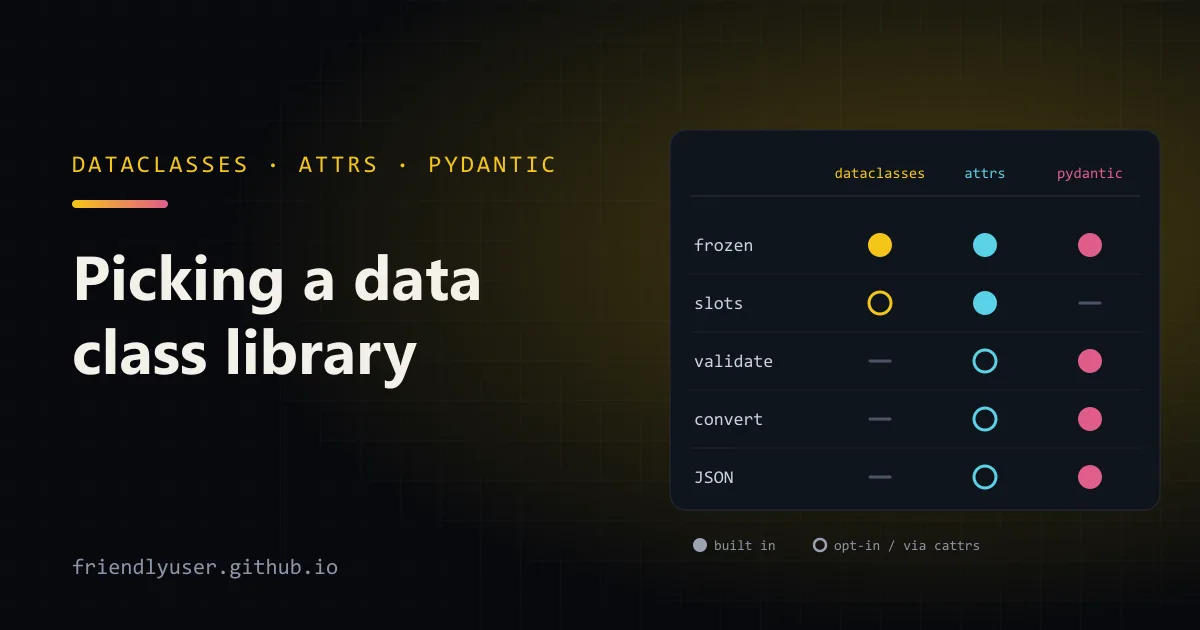
Python has three common ways to declare a class that is mostly fields: the standard library’s dataclasses, the third-party attrs package, and Pydantic. They look almost the same at the definition site, which hides the fact that they answer different questions. dataclasses and attrs generate boilerplate for objects your own code creates. Pydantic validates and converts data that came from somewhere else.
This post writes one small model three ways and compares the parts that matter day to day: immutability, __slots__, defaults, validation, type conversion and serialisation. Examples were run on Python 3.12 with attrs 25.4, cattrs 25.3 and Pydantic 2.12.
The model
Section titled “The model”An order with an integer ID, a customer name, a timestamp, a tuple of item names and a list of tags. We want it immutable, and we want a blank customer name to be rejected.
dataclasses
Section titled “dataclasses”from dataclasses import dataclass, fieldfrom datetime import datetime
@dataclass(frozen=True, slots=True)class OrderDC: order_id: int customer: str placed_at: datetime items: tuple[str, ...] = () tags: list[str] = field(default_factory=list)frozen=True makes assignment raise FrozenInstanceError and generates __hash__. slots=True (Python 3.10+) builds a class with __slots__, so instances have no __dict__ and use less memory per object. A mutable default such as [] must go through default_factory; the decorator raises ValueError if you write tags: list[str] = [].
What a dataclass does not do is check anything. The type annotations are only used to find the fields:
>>> OrderDC("1", "", "yesterday")OrderDC(order_id='1', customer='', placed_at='yesterday', items=(), tags=[])To reject a blank name you would write a __post_init__ that raises.
import attrsfrom datetime import datetime

@attrs.frozenclass OrderAttrs:    order_id: int = attrs.field(converter=int)    customer: str = attrs.field(validator=attrs.validators.min_len(1))    placed_at: datetime    items: tuple[str, ...] = attrs.field(default=(), converter=tuple)    tags: list[str] = attrs.Factory(list)
attrs is where dataclasses came from, and it still does more. @attrs.frozen is @attrs.define(frozen=True), and define uses slots by default, so there is nothing extra to switch on. Per-field validators and converters are opt-in: the order_id converter turns "2" into 2, the items converter turns a list into a tuple, and min_len(1) rejects an empty customer.
>>> OrderAttrs("2", "ada", now, ["book", "pen"])OrderAttrs(order_id=2, customer='ada', placed_at=datetime.datetime(2026, 2, 6, 9, 30), items=('book', 'pen'), tags=[])>>> OrderAttrs(3, "", now)ValueError: Length of 'customer' must be >= 1: 0The important point is that attrs only validates what you ask it to. placed_at has no validator, so OrderAttrs(1, "ada", "yesterday") is accepted. That is a design choice: attrs treats validation as an explicit, per-field decision, not something implied by annotations.
Pydantic
Section titled “Pydantic”from datetime import datetimefrom pydantic import BaseModel, ConfigDict, Field, field_validator
class OrderPD(BaseModel): model_config = ConfigDict(frozen=True)
order_id: int customer: str = Field(min_length=1) placed_at: datetime items: tuple[str, ...] = () tags: list[str] = []
@field_validator("customer") @classmethod def strip_customer(cls, v: str) -> str: return v.strip()Pydantic reads the annotations and validates every field on construction. It also converts: in the default “lax” mode a string "3" becomes 3 and an ISO 8601 string becomes a datetime. A mutable default like [] is fine here, because Pydantic copies defaults per instance.
>>> OrderPD.model_validate({"order_id": "3", "customer": " ada ",... "placed_at": "2026-02-06T09:30:00", "items": ["book"]})OrderPD(order_id=3, customer='ada', placed_at=datetime.datetime(2026, 2, 6, 9, 30), items=('book',), tags=[])Bad input produces one error per field, with the location and the reason:
3 validation errors for OrderPDorder_id Input should be a valid integer, unable to parse string as an integer [type=int_parsing, input_value='three', input_type=str]customer String should have at least 1 character [type=string_too_short, input_value='', input_type=str]placed_at Input should be a valid datetime or date, input is too short [type=datetime_from_date_parsing, input_value='yesterday', input_type=str](Each error also prints a link to the error-type docs; I trimmed those lines.) That structured error list is the main reason to use Pydantic on API input: e.errors() gives you a list of dicts you can return to the caller as-is.
If you do not want the coercion, set ConfigDict(strict=True) on the model or Field(strict=True) on one field, and "3" is rejected for an int.
Side by side
Section titled “Side by side”| dataclasses | attrs | Pydantic | |
|---|---|---|---|
| Install | standard library | pip install attrs | pip install pydantic |
| Immutable | frozen=True | @attrs.frozen | ConfigDict(frozen=True) |
__slots__ | slots=True (3.10+) | on by default with define | no; fields live in the instance __dict__ |
| Mutable defaults | default_factory | attrs.Factory | plain [] is copied |
| Validation | none (write __post_init__) | opt-in validators per field | every field, from the annotations |
| Conversion | none | opt-in converters per field | automatic in lax mode |
| Copy with changes | dataclasses.replace | attrs.evolve | model.model_copy(update=...) |
| To dict | dataclasses.asdict | attrs.asdict | model.model_dump() |
| To/from JSON | do it yourself | use cattrs | model_dump_json() / model_validate_json() |
One detail from that table: model_copy(update=...) does not validate the update. p.model_copy(update={"customer": ""}) produces an object with a blank customer. If the new values are untrusted, build a new model with model_validate instead.
Serialisation and conversion
Section titled “Serialisation and conversion”dataclasses.asdict and attrs.asdict give you a nested dict, but values such as datetime stay as Python objects, so json.dumps on the result fails. For dataclasses you write a small default= function for json.dumps. For attrs, the companion library cattrs does structured conversion in both directions:
from datetime import datetimeimport attrsimport cattrs

@attrs.frozenclass Order:    order_id: int    customer: str    placed_at: datetime    items: tuple[str, ...] = ()

conv = cattrs.Converter()conv.register_structure_hook(datetime, lambda v, _: datetime.fromisoformat(v))conv.register_unstructure_hook(datetime, lambda d: d.isoformat())
o = conv.structure(    {"order_id": 1, "customer": "ada", "placed_at": "2026-02-06T09:30:00", "items": ["book"]},    Order,)print(o)print(conv.unstructure(o))
Order(order_id=1, customer='ada', placed_at=datetime.datetime(2026, 2, 6, 9, 30), items=('book',)){'order_id': 1, 'customer': 'ada', 'placed_at': '2026-02-06T09:30:00', 'items': ['book']}The hooks live on the converter, not the class. That keeps the model free of any knowledge about JSON, which is the attrs philosophy in one sentence.
Pydantic has serialisation built in: model_dump() for a dict, model_dump(mode="json") for a JSON-safe dict, and model_dump_json() for a string:
{"order_id":3,"customer":"ada","placed_at":"2026-02-06T09:30:00","items":["book"],"tags":[]}Pydantic can also validate plain dataclasses without converting them to models, through TypeAdapter:
from dataclasses import dataclassfrom pydantic import TypeAdapter

@dataclassclass Point:    x: int    y: int

ta = TypeAdapter(Point)print(ta.validate_python({"x": "1", "y": 2}))  # Point(x=1, y=2)print(ta.dump_json(Point(1, 2)))               # b'{"x":1,"y":2}'
That is a handy middle ground: keep stdlib dataclasses inside your code, and validate them only at the edge.
Running the comparison yourself
Section titled “Running the comparison yourself”The full script with all three models is short enough to paste into one file. With uv you can run it without creating a virtual environment:
uv run --with attrs --with cattrs --with pydantic models.pyTry passing a string for order_id and an empty customer to each class. The dataclass accepts both, attrs converts the first and rejects the second, and Pydantic converts the first and reports the second with its field name.
Which one to pick
Section titled “Which one to pick”- Internal data that your own code creates:
dataclasses. No dependency, type checkers understand it fully, andfrozen=True, slots=Truecovers most needs. If you find yourself writing validation in__post_init__for several classes, that is the point to look at attrs. - Internal data with some invariants, or many classes:
attrs. Validators and converters per field, slots by default, and cattrs when you need JSON without tying the model to a format. - Untrusted input (HTTP bodies, config files, queue messages): Pydantic. Validation and coercion are the whole point, the error reports are good, and frameworks such as FastAPI build on it.
A common split in larger codebases is Pydantic models at the boundary (request and response schemas, settings) and dataclasses or attrs classes for the domain objects inside. Converting between them is a few lines, and it stops HTTP-shaped concerns from leaking into the core logic.
Things to watch for
Section titled “Things to watch for”- Pydantic is not a drop-in for dataclasses. Its models have their own method names (
model_dump,model_copy,model_validate) and pydantic-specific behaviour such as coercion. Code that callsdataclasses.asdicton them will not work. - Coercion can hide bugs. Lax mode accepts
"3"for anintand1for abool. If your internal code passes the wrong type, Pydantic will often fix it silently. Strict mode is worth considering for models that are not built from external input. - Don’t compare speed from blog posts. Pydantic’s validation core is compiled, attrs and dataclasses generate plain Python methods, and which is faster depends on whether you validate. Measure your own workload if it matters.
Further reading
Section titled “Further reading”© 2026 David Li · Home · Blog · RSS ·Classic site · Built with Astro, Starlight and three.js · Logos:Font Awesome Free (CC BY 4.0)