Python typing with Protocols and the PEP 695 generic syntax
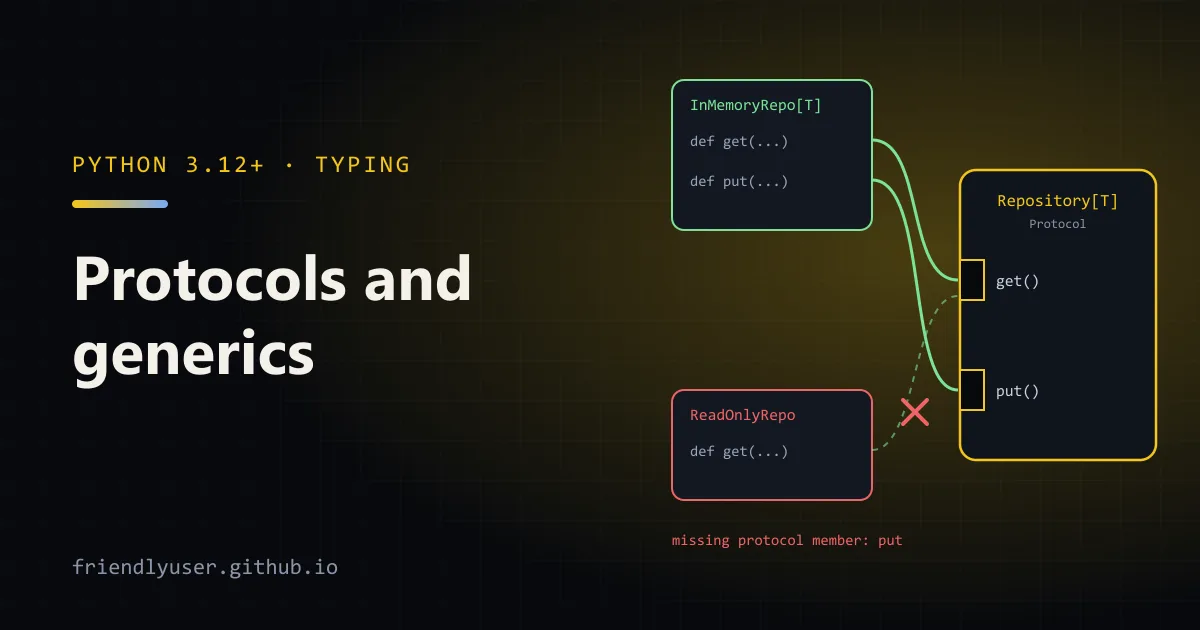
A Protocol describes what an object must be able to do, not what it inherits from. Any class with matching methods satisfies it, without importing it or subclassing it. That is how Python code is usually written anyway (duck typing), and Protocols let a type checker verify it.
Generics are the other half: a Repository[User] and a Repository[Order] share one definition but keep their item types apart. Python 3.12 added a much shorter syntax for generics (PEP 695) and a type statement for aliases. This post covers both, with the examples checked by mypy 1.20 and Pyright 1.1.409 and run on Python 3.12.
Structural typing with Protocol
Section titled “Structural typing with Protocol”Start with the simplest useful protocol:
from typing import Protocol

class SupportsClose(Protocol):    def close(self) -> None: ...

def shutdown(*resources: SupportsClose) -> None:    for r in resources:        r.close()
shutdown accepts a file, a socket, a database connection, or any class you write with a close() method. None of them know SupportsClose exists. With an abstract base class, every one of those types would have to inherit from it, which you cannot arrange for the standard library or third-party code.
The body of a protocol method is .... Protocol members can also be attributes (name: str) or properties.
A generic protocol
Section titled “A generic protocol”A repository interface that works for any item type:
from dataclasses import dataclassfrom typing import Protocol

class Repository[T](Protocol):    def get(self, key: str) -> T | None: ...    def put(self, key: str, value: T) -> None: ...

@dataclassclass User:    name: str    email: str

def register(repo: Repository[User], user: User) -> None:    if repo.get(user.email) is not None:        raise ValueError(f"{user.email} already registered")    repo.put(user.email, user)
class Repository[T](Protocol) is the PEP 695 syntax. Before 3.12 the same thing needed a module-level TypeVar and an explicit Generic base:
from typing import Generic, Protocol, TypeVar
T = TypeVar("T")

class Repository(Protocol[T]):    def get(self, key: str) -> T | None: ...    def put(self, key: str, value: T) -> None: ...
The new form scopes T to the class, so there is no stray T at module level and no risk of reusing one TypeVar in two unrelated places.
An implementation does not mention the protocol at all:
class InMemoryRepo[T]:    def __init__(self) -> None:        self._items: dict[str, T] = {}
    def get(self, key: str) -> T | None:        return self._items.get(key)
    def put(self, key: str, value: T) -> None:        self._items[key] = value
    def close(self) -> None:        self._items.clear()

repo = InMemoryRepo[User]()register(repo, User("Ada", "ada@example.com"))shutdown(repo, open(__file__))
InMemoryRepo[User] satisfies Repository[User] because its methods match, and it satisfies SupportsClose because it has close(). One class, two protocols, zero inheritance.
What the type checker catches
Section titled “What the type checker catches”Put a few mistakes in a second file:
from shapes import InMemoryRepo, User, largest, register

class ReadOnlyRepo:    def get(self, key: str) -> User | None:        return None

register(ReadOnlyRepo(), User("a", "b"))        # no put()register(InMemoryRepo[int](), User("a", "b"))   # wrong item typelargest("a", "b")                               # covered below
mypy in strict mode:
errors.py:9: error: Argument 1 to "register" has incompatible type "ReadOnlyRepo"; expected "Repository[User]" [arg-type]errors.py:9: note: "ReadOnlyRepo" is missing following "Repository" protocol member:errors.py:9: note: puterrors.py:10: error: Argument 1 to "register" has incompatible type "InMemoryRepo[int]"; expected "Repository[User]" [arg-type]errors.py:11: error: Value of type variable "T" of "largest" cannot be "str" [type-var]Found 3 errors in 1 file (checked 2 source files)Pyright reports the same three problems, and for the second one it explains exactly which method signatures disagree ("get" is an incompatible type ... "int | None" is not assignable to "T@Repository | None"). When a protocol mismatch is confusing, Pyright’s message is usually the quicker one to read.
runtime_checkable and its caveats
Section titled “runtime_checkable and its caveats”Protocols are a static-typing feature. If you try isinstance(x, SupportsClose) you get:
TypeError: Instance and class checks can only be used with @runtime_checkable protocolsDecorating the protocol with @runtime_checkable allows isinstance, but the check is much weaker than what the type checker does. It only tests that the attributes exist:
from typing import Protocol, runtime_checkable

@runtime_checkableclass Closeable(Protocol):    def close(self) -> None: ...

class Door:    def close(self, force: bool) -> str:  # wrong signature        return "slam"

class Flag:    close = True  # not even callable

print(isinstance(Door(), Closeable))  # Trueprint(isinstance(Flag(), Closeable))  # True
Signatures, return types and even callability are not checked. A few more rules:
issubclass()does not work on protocols that have non-method members. With aname: strmember you getTypeError: Protocols with non-method members don't support issubclass().- The check looks up every protocol member on the object, so it is slower than an
isinstanceagainst a normal class. In a hot loop that can show up. - A
Trueresult does not narrow anything you can trust at runtime. Treat it as “probably has these methods” and nothing more.
I use runtime_checkable for dispatch on clearly different kinds of object (does this thing have read or not), and never as validation.
The PEP 695 syntax in functions and aliases
Section titled “The PEP 695 syntax in functions and aliases”Generic functions declare their type parameters in brackets after the name:
def first[T](items: list[T]) -> T: return items[0]Bounds and constraints
Section titled “Bounds and constraints”A bound restricts T to subtypes of something, and works with protocols:
class HasName(Protocol):    @property    def name(self) -> str: ...

def names[T: HasName](items: list[T]) -> list[str]:    return [i.name for i in items]
Constraints restrict T to exactly one of a list of types. Note the tuple:
def largest[T: (int, float)](a: T, b: T) -> T: return a if a >= b else blargest(3, 7) is fine and largest("a", "b") is the error shown earlier. The difference matters: with a bound, T solves to the actual argument type (say User); with constraints, T becomes exactly one of the listed types.
Python 3.13 added defaults for type parameters (PEP 696), written class Box[T = int]: .... That syntax is a SyntaxError on 3.12.
Variance is inferred
Section titled “Variance is inferred”With the old TypeVar, you had to declare covariant=True or contravariant=True yourself and get it right. With PEP 695 syntax the checker works it out from how T is used:
class Animal: ...class Dog(Animal): ...

class Box[T]:    def __init__(self, item: T) -> None:        self.item = item  # public, mutable attribute
    def get(self) -> T:        return self.item

class ReadOnly[T]:    def __init__(self, item: T) -> None:        self._item = item
    def get(self) -> T:        return self._item

def feed_box(b: Box[Animal]) -> None: ...def feed_ro(b: ReadOnly[Animal]) -> None: ...

feed_box(Box[Dog](Dog()))      # error: Box is invariantfeed_ro(ReadOnly[Dog](Dog()))  # fine: ReadOnly is covariant
Box exposes a writable item, so a Box[Dog] used as a Box[Animal] could have a Cat written into it; mypy rejects it. ReadOnly only hands T out, so it is inferred covariant and a ReadOnly[Dog] is accepted where a ReadOnly[Animal] is expected. Repository[T] above uses T both in and out, so it is invariant.
The type statement
Section titled “The type statement”type Pair[T] = tuple[T, T]type JSON = dict[str, JSON] | list[JSON] | str | int | float | bool | None
def swap[T](pair: Pair[T]) -> Pair[T]: a, b = pair return b, a
config: JSON = {"debug": True, "ports": [80, 443]}type creates a TypeAliasType. Its value is evaluated lazily, which is why JSON can refer to itself without quotes. Aliases can be generic (Pair[T]).
Because the alias is an object and not the underlying type, you cannot use it at runtime as a class:
type IntList = list[int]isinstance([1], IntList)# TypeError: isinstance() arg 2 must be a type, a tuple of types, or a unionUse IntList.__value__ if you need the real type at runtime.
Running the checks yourself
Section titled “Running the checks yourself”With uv installed, no project setup is needed:
uvx mypy --strict shapes.py errors.pyuvx pyright shapes.py errors.pyThe pyright package on PyPI is a wrapper that downloads the Node-based checker on first run. If you already have Node, npx pyright does the same.
Both checkers support PEP 695 syntax. If your project’s minimum Python is below 3.12, though, you cannot use it: the new brackets are a SyntaxError on older interpreters. Use TypeVar and Generic there, and the same type checks apply.
Gotchas
Section titled “Gotchas”- Inference can widen instead of failing.
swap((1, "two"))passes both checkers, becauseTis solved asobject(mypy) orint | str(Pyright) rather than rejected. If you need two arguments of exactly the same type, a generic signature alone will not enforce it. - Parameter names are part of the signature. Pyright rejects an implementation whose
f(self, name: str)doesn’t match the protocol’sf(self, key: str), because a caller could passkey=by keyword. mypy 1.20 accepted the same code. If names should not matter, make the protocol’s parameters positional-only with/. - Explicit subclassing is allowed.
class InMemoryRepo[T](Repository[T])works and makes the checker verify the class at its definition instead of at the first call site. It is a reasonable choice for implementations you own. - Don’t over-abstract. A protocol with one implementation and one caller is just indirection. They pay off at boundaries: test doubles, plugins, and functions that accept several unrelated types.
Further reading
Section titled “Further reading”© 2026 David Li · Home · Blog · RSS ·Classic site · Built with Astro, Starlight and three.js · Logos:Font Awesome Free (CC BY 4.0)