asyncio TaskGroup and asyncio.timeout: structured concurrency in Python
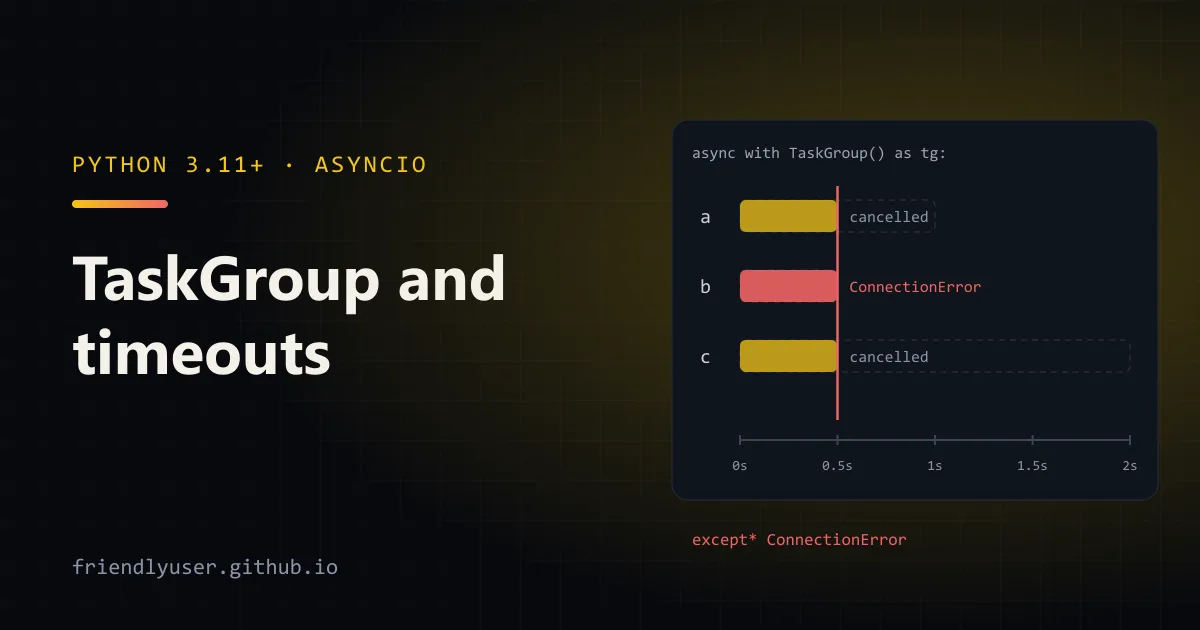
asyncio.TaskGroup and asyncio.timeout arrived in Python 3.11, and together they give asyncio what Trio users call structured concurrency: tasks started inside a block are finished, one way or another, by the time the block exits. No task outlives the code that started it, and a failure in one task cancels its siblings instead of leaving them running in the background.
This post compares TaskGroup with asyncio.gather, shows how failures come out as an ExceptionGroup, adds per-request and overall deadlines, and puts it all together in a small concurrent fetcher with a concurrency limit. Examples were run on Python 3.12; everything shown needs 3.11 or newer.
The problem with gather
Section titled “The problem with gather”asyncio.gather runs awaitables concurrently and returns their results in order. Its default failure behaviour is the problem: when one awaitable raises, gather propagates that exception immediately, and the others keep running. Nothing awaits them any more, so their results and any later exceptions are lost.
Here is a helper that logs when it finishes or gets cancelled:
import asyncioimport time
START = time.perf_counter()

def log(msg: str) -> None:    print(f"{time.perf_counter() - START:4.1f}s {msg}")

async def fetch(name: str, delay: float, fail: bool = False) -> str:    try:        await asyncio.sleep(delay)        if fail:            raise ConnectionError(f"{name} refused the connection")        log(f"{name} done")        return f"{name}: ok"    except asyncio.CancelledError:        log(f"{name} cancelled")        raise
With gather, task b fails after half a second:
async def with_gather() -> None: log("gather: start") try: await asyncio.gather(fetch("a", 1), fetch("b", 0.5, fail=True), fetch("c", 2)) except ConnectionError as e: log(f"gather raised: {e}") await asyncio.sleep(2) # give the orphans time to show themselves log("gather: end") 0.0s gather: start 0.5s gather raised: b refused the connection 1.0s a done 2.0s c done 2.6s gather: endThe caller has already moved on to error handling at 0.5 s, but a and c carry on and finish later. In a real program those might be HTTP requests or database writes happening after you decided the operation failed.
The same thing with TaskGroup
Section titled “The same thing with TaskGroup”async def with_taskgroup() -> None: log("taskgroup: start") try: async with asyncio.TaskGroup() as tg: tg.create_task(fetch("a", 1)) tg.create_task(fetch("b", 0.5, fail=True)) tg.create_task(fetch("c", 2)) except* ConnectionError as eg: for e in eg.exceptions: log(f"taskgroup raised: {e!r}") log("taskgroup: end") 0.0s taskgroup: start 0.5s c cancelled 0.5s a cancelled 0.5s taskgroup raised: ConnectionError('b refused the connection') 0.5s taskgroup: endWhen b fails, the group cancels a and c, waits for them to finish cancelling, and only then raises. By the time the except* clause runs, nothing from the group is still running.
The rules for a TaskGroup block:
tg.create_task()schedules a task and returns it. You can keep the task object and readtask.result()after the block.- Leaving the
async withblock waits for every task in the group. - If any task raises (other than
CancelledError), the remaining tasks are cancelled. The body of theasync withis cancelled too, if it is still running. - All the exceptions are collected and raised together as an
ExceptionGroup(orBaseExceptionGroup). - If the body itself raises, the tasks are cancelled the same way.
ExceptionGroup and except*
Section titled “ExceptionGroup and except*”Because more than one task can fail before the cancellation takes effect, TaskGroup always raises a group, even for a single failure. A plain except ValueError: does not catch it:
try: async with asyncio.TaskGroup() as tg: tg.create_task(work(3)) # raises ValueErrorexcept ValueError: print("never printed")except ExceptionGroup as eg: print(eg) # unhandled errors in a TaskGroup (1 sub-exception)except* (also new in 3.11) matches exceptions inside the group. Each except* clause receives a group containing only the matching exceptions, and several clauses can run for one group:
try: async with asyncio.TaskGroup() as tg: for url in urls: tg.create_task(download(url))except* TimeoutError as eg: print(f"{len(eg.exceptions)} downloads timed out")except* ConnectionError as eg: print(f"{len(eg.exceptions)} hosts refused")Anything not matched by an except* clause is re-raised in a new group. You cannot mix except and except* in the same try.
Do not expect the group to contain one exception per failing task. Once the first failure triggers cancellation, the other tasks are usually cancelled before they get a chance to fail. In a test with tasks set to fail at 0.3 s and 0.6 s, only the first error was in the group; the second task was cancelled at 0.3 s.
When you want every result, failures included
Section titled “When you want every result, failures included”Sometimes one bad item should not stop the rest, for example when processing a batch and reporting the failures at the end. Catch inside the task and return the error as a value:
async def safe(i: int) -> int | Exception:    try:        return await work(i)    except ValueError as e:        return e

async with asyncio.TaskGroup() as tg:    tasks = [tg.create_task(safe(i)) for i in range(1, 7)]
results = [t.result() for t in tasks]ok = [r for r in results if not isinstance(r, Exception)]failed = [r for r in results if isinstance(r, Exception)]
asyncio.gather(..., return_exceptions=True) does the same job and is still fine for this case, because with return_exceptions=True it waits for everything. The orphan problem only applies to gather without it.
Deadlines with asyncio.timeout
Section titled “Deadlines with asyncio.timeout”asyncio.timeout(delay) is an async context manager that cancels the code inside it once delay seconds have passed, and turns that cancellation into a TimeoutError when the block exits:
try: async with asyncio.timeout(0.5) as cm: await asyncio.sleep(2)except TimeoutError: print("timed out; expired =", cm.expired()) # timed out; expired = TrueCompared with the older asyncio.wait_for(coro, timeout), it wraps a block rather than one awaitable, so a deadline can cover several steps (connect, send, read) without nesting. The context manager also has reschedule(when) to move the deadline, and asyncio.timeout(None) starts with no deadline that you can set later. asyncio.timeout_at(when) takes an absolute time from loop.time() instead of a delay.
Two details matter:
- The exception is the built-in
TimeoutError. Since 3.11,asyncio.TimeoutErroris an alias for it. - Inside the block, the code sees a
CancelledError, not aTimeoutError. Cleanup code that catchesCancelledErrormust re-raise it, or the timeout cannot do its job.
Putting it together: a concurrent fetcher with limits
Section titled “Putting it together: a concurrent fetcher with limits”A common job: fetch a list of URLs, at most N at a time, with a timeout per request and an overall budget for the whole batch. The example below uses asyncio.sleep in place of an HTTP client so it runs anywhere; swap fake_get for an httpx.AsyncClient or aiohttp call and the structure stays the same.
import asyncioimport randomimport time
MAX_CONCURRENT = 3PER_REQUEST_TIMEOUT = 1.0TOTAL_BUDGET = 5.0

async def fake_get(url: str) -> int:    """Stand-in for an HTTP call: random latency, one slow URL."""    delay = 2.0 if url.endswith("/7") else random.uniform(0.1, 0.6)    await asyncio.sleep(delay)    return 200

async def fetch(url: str, limit: asyncio.Semaphore) -> tuple[str, int | str]:    async with limit:        try:            async with asyncio.timeout(PER_REQUEST_TIMEOUT):                status = await fake_get(url)        except TimeoutError:            return url, "timed out"    return url, status

async def main() -> None:    urls = [f"https://example.com/items/{i}" for i in range(10)]    limit = asyncio.Semaphore(MAX_CONCURRENT)    start = time.perf_counter()
    async with asyncio.timeout(TOTAL_BUDGET):        async with asyncio.TaskGroup() as tg:            tasks = [tg.create_task(fetch(u, limit)) for u in urls]
    for task in tasks:        url, result = task.result()        print(f"{url:32} {result}")    print(f"finished in {time.perf_counter() - start:.1f}s")

random.seed(1)asyncio.run(main())
https://example.com/items/0 200https://example.com/items/1 200https://example.com/items/2 200https://example.com/items/3 200https://example.com/items/4 200https://example.com/items/5 200https://example.com/items/6 200https://example.com/items/7 timed outhttps://example.com/items/8 200https://example.com/items/9 200finished in 1.8sThe layering is deliberate:
- The semaphore is outside the per-request timeout. Time spent waiting for a free slot does not count against the request’s one second. Put the
timeoutoutsideasync with limitand requests at the back of the queue time out before they start. - The per-request timeout is handled inside the task. A slow URL becomes a result (
"timed out") instead of an exception, so it does not cancel the other nine. - The overall budget wraps the whole
TaskGroup. If it expires, every running and waiting task is cancelled, the group finishes, andmaingets aTimeoutError.
Creating all the tasks up front and letting the semaphore gate them is fine for hundreds or a few thousand items. For a very large or unbounded input (lines from a file, messages from a queue), use a fixed number of worker tasks reading from an asyncio.Queue instead, so you are not holding a task object per item.
Gotchas
Section titled “Gotchas”- Don’t swallow
CancelledError. If a task catches it and returns normally, theTaskGroupandasyncio.timeoutmachinery cannot tell that cancellation happened. Catch it only to clean up, thenraise. - A
TaskGroupcannot be reused. Once its block has exited,create_taskon it raisesRuntimeError. Create a new group for the next batch. - Fire-and-forget does not fit. If you want a background task that outlives the current function,
TaskGroupis the wrong tool. Keep a reference to the task yourself (the event loop holds only a weak reference) and decide who awaits or cancels it. - Libraries may still raise plain exceptions. Code that awaits a
TaskGroupraisesExceptionGroup; code that callsgatherraises the first exception directly. When you change one to the other, update everyexceptthat wraps it.
Further reading
Section titled “Further reading”© 2026 David Li · Home · Blog · RSS ·Classic site · Built with Astro, Starlight and three.js · Logos:Font Awesome Free (CC BY 4.0)